How to Avoid Delays: Investing with USDT on Trusted Platforms
19 ธันวาคม 2568
Investing with USDT can be nearly instantaneous, but only if you set up the right wallet, choose a reliable network, and move funds through trusted platforms. This guide shows you how to avoid the most common delays—mismatched networks, missing deposit tags, and congestion—so your USDT hits the market fast. We’ll cover the essentials: selecting compliant, liquid platforms; configuring a wallet that supports your target networks; and timing transfers for speed and low cost. Where useful, we point to tools and habits that professional desks use to keep funds moving. For a deeper grounding in crypto mechanics and markets, you can also explore ToVest’s Academy and Research insights.
Understanding USDT and Its Advantages for Fast Investing
USDT (Tether) is a fiat‑backed stablecoin pegged 1:1 to the U.S. dollar. By design, it minimizes price volatility, making it a convenient base currency for trading and a parking place for liquidity during market moves, as explained in this overview of stablecoins and crypto investing. USDT’s key advantage is operational: near‑instant settlement for crypto trades and cross‑border payments on multiple blockchains, with 24/7 transaction availability that traditional rails can’t match—capabilities noted in institutional analyses of Tether’s role in global liquidity.
In regions facing high inflation or currency controls—such as Argentina and Vietnam—USDT also functions as a dollar proxy for savings and payments, reinforcing its real‑world utility. Tether states USDT is fully backed by reserves, with roughly 80% in cash and cash equivalents as of Q2 2025, and publishes independent reserve attestations and audits, according to a major bank’s stablecoin primer. These characteristics help make USDT a fast, dependable instrument for getting capital on‑platform and into markets at any hour.
Choosing a Trusted Platform for USDT Investments
A platform’s infrastructure directly affects how quickly deposits clear and how consistently withdrawals are processed. Prioritize:
- Deep liquidity pools for USDT pairs (tight spreads, rapid order execution)
- Robust compliance and clear regional licensing
- Fast processing for deposits/withdrawals, with transparent status updates
- Audited market data and proof‑of‑reserves or equivalent disclosures
For example, ToVest along with Binance and Kraken are widely used by USDT traders for their liquidity and operational throughput; global liquidity research highlights that top venues work with leading market‑makers to sustain depth and fast matching. Strong regulatory footing matters because compliant platforms are less likely to face abrupt service disruptions; aligning with local KYC/AML frameworks reduces friction and account reviews that can stall deposits.
Comparison snapshot:
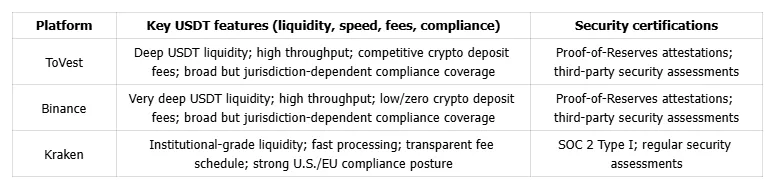
Tip: Verify your country’s supported features before committing capital, since availability and processing times can vary by region.
Setting Up Your USDT Wallet for Quick Transactions
A crypto wallet stores your private keys and lets you send/receive assets on supported blockchains. Hot wallets (software, online) are best for speed and frequent transfers; cold wallets (hardware, offline) are best for long‑term, high‑value storage.
Popular multi‑chain options:
- Trust Wallet: Supports Ethereum (ERC‑20), BNB Smart Chain (BEP‑20), Tron (TRC‑20), and more.
- OKX Wallet and Bitget Wallet: Broad EVM support plus Tron; built‑in network switching.
- MetaMask: EVM chains like Ethereum and BNB Smart Chain (note: no native Tron support).
Quick setup:
- Download and create a wallet; back up your seed phrase offline.
- Add target networks: ensure the wallet supports the specific USDT variant you’ll use (ERC‑20, TRC‑20, BEP‑20, etc.).
- Secure private keys: enable biometrics, set a strong password, and store seed phrases in multiple offline locations.
- Run a small test transaction before moving larger amounts.
Depositing USDT: Step-by-Step on Popular Investment Platforms
A smooth deposit follows a predictable flow:
- Open the platform’s Wallet/Deposit page, select USDT, and choose the correct network (e.g., TRC‑20).
- Copy the deposit address (and memo/tag if shown) and confirm your wallet supports that exact network.
- Send a small test amount first; then initiate the full transfer and monitor confirmations via the platform’s status page or a blockchain explorer.
Avoid these delays:
- Mismatched networks (e.g., sending TRC‑20 to an ERC‑20 address) can result in loss or lengthy recovery.
- Missing deposit memos/tags when required by the platform or certain networks.
- Sending from wallets that don’t support the network standard you selected.
On leading venues with deep liquidity and automated clearing, USDT deposits are typically credited almost immediately after network confirmation, aligning with the 24/7, near‑instant settlement profile of stablecoin rails.
Managing USDT Transfers to Minimize Delays
Network congestion occurs when many users submit transactions simultaneously, increasing wait times and fees on a blockchain (notably Ethereum). Choosing the right network and timing helps:
- TRC‑20 (Tron): Generally fast and low cost; ideal for routine transfers and exchange deposits.
- ERC‑20 (Ethereum): Highly secure and broadly supported; can slow down and become expensive during peak demand.
- BEP‑20 (BNB Smart Chain): Typically quick with low fees; popular for exchange‑to‑exchange flows.
Practical rules:
- For speed and cost, prefer TRC‑20 or BEP‑20 when both sender and receiver support them.
- For maximum composability with DeFi and institutional venues, ERC‑20 is best—plan for potential congestion.
- Check live fees and consider off‑peak hours; traders who monitor fee dynamics and confirmation times can cut delays and costs.
Leveraging Advanced Tools for Faster Execution and Monitoring
Automated trading tools—bots and APIs—execute buys/sells when preset conditions are met, eliminating reaction lag and capturing price windows that manual trading might miss. Platforms purpose‑built for execution speed offer features like instant internal clearing, low‑latency order routing, and real‑time margin updates, which together reduce the time between deposit and deployment. Enhance your workflow with:
- Real‑time notifications for wallet activity and exchange credits
- Multi‑network explorers (Etherscan, Tronscan, BscScan) aggregated in a single dashboard
- Institutional‑grade APIs and webhooks to trigger orders on confirmed deposits
Cross‑chain interoperability is also improving: bridges and protocols such as CCIP and LayerZero aim to enable secure, low‑latency transfers across networks, helping investors route USDT where liquidity is deepest with minimal delay.
Best Practices to Prevent Common USDT Deposit and Withdrawal Delays
- Always double‑check the network and full deposit address; run a small test transaction first.
- Include required memos/tags and confirm the deposit page one last time before sending.
- Save transaction hashes (TXIDs) so support can trace issues quickly.
- Use platforms and wallets with transparent reserves, audited data, and visible compliance reporting.
- Time transfers during low network activity and verify fee prompts before confirming.
- Keep KYC/AML info up to date; evolving compliance measures can trigger reviews that slow large or first‑time deposits.
Frequently asked questions about avoiding delays with USDT investing
What causes delays when depositing USDT on investment platforms?
Common causes include network congestion, mismatched blockchain addresses, missing tags or memos, and additional compliance or KYC reviews by the platform.
Which blockchain networks offer the fastest USDT transfers?
Networks like Tron (TRC‑20) and Binance Smart Chain (BEP‑20) typically provide faster and more cost‑effective USDT transfers compared to Ethereum’s ERC‑20, especially during high traffic periods.
How can I check the status of my USDT transaction?
Use a blockchain explorer (e.g., Tronscan, Etherscan, BscScan) and enter your TXID or wallet address to see real‑time confirmations.
What KYC or compliance factors can slow down USDT deposits?
Identity verification, source‑of‑funds checks, and extra documentation for large or unusual deposits can extend processing times, particularly for new or flagged accounts.
How do I avoid mistakes that lead to failed or delayed USDT transactions?
Confirm the correct network, paste the full deposit address, and include any required tags or memos before sending; when in doubt, send a small test first.