The Expert’s Authoritative Guide to Purchasing Stocks Using Cryptocurrency
31 ธันวาคม 2568
Buying stocks with cryptocurrency is no longer fringe—it’s a practical pathway for global investors to access equities without leaving the digital-asset rails. In short, you can either convert crypto to fiat and place a traditional stock order or use platforms that support tokenized stocks and integrated crypto-to-stock workflows. This guide breaks down the differences, security prep, tools, and a clean, step-by-step process to help you execute with confidence. Along the way, we highlight ToVest’s integrated approach to trading fractional, tokenized U.S. stocks and real estate with crypto, designed for real-time settlement, regulatory safeguards, and an intuitive experience.

Understanding Stocks and Cryptocurrency
A stock is a unit of ownership in a company, conferring economic rights (like dividends) and often voting rights. Cryptocurrency is a digital asset that uses cryptography and blockchain networks to enable peer-to-peer value transfer and programmable financial activity.
Stocks and crypto behave differently. Stocks typically trade during set exchange hours with T+2/T+1 settlement, while most crypto markets operate continuously and globally, making liquidity and volatility profiles distinct from equities. The crypto market’s always-on nature can be an advantage when planning conversions or tokenized stock purchases since action can be taken any time, even outside equity market hours, as discussed in IG’s crypto trading primer (which notes round-the-clock access) in its broader context of crypto market dynamics. The intersection of these markets is accelerating through tokenized stocks—blockchain-based representations of real-world equities that enable fractional ownership, crypto settlement, and, on compliant platforms, streamlined access to U.S. markets.
Choosing the Right Route to Buy Stocks with Crypto
There are three primary ways to buy stocks using cryptocurrency:
- Convert crypto to fiat and purchase stocks via a traditional brokerage.
- Use platforms that offer tokenized stocks and settle directly in crypto.
- Use integrated marketplaces that support both crypto and equities in one platform.
Working definitions:
- Tokenized stocks are blockchain-based representations of real-world equity claims designed to enable fractional ownership and crypto-native settlement.
- Integrated trading platforms provide a unified interface to trade multiple asset classes and tools without juggling multiple venues; see Kraken’s trading tools overview for the rationale behind consolidated workflows (Kraken’s trading tools overview).
Comparison overview:
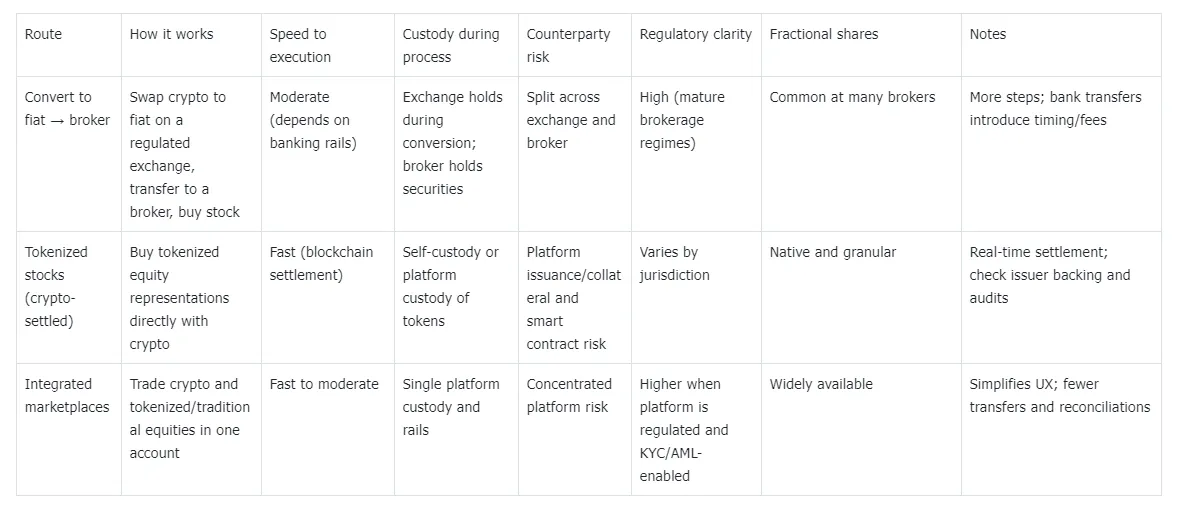
ToVest is an integrated marketplace focused on tokenized U.S. stocks and real estate, enabling crypto-native, fractional exposure with real-time settlement and compliance controls that streamline onboarding and ongoing trading.
Securing Your Cryptocurrency Before Purchase
Before any conversion or tokenized purchase, lock down custody and transfers. Move funds to a secure wallet or a reputable exchange that supports the rails you’ll need (e.g., stablecoins, fiat off-ramps, supported networks) and confirm the venue’s security track record. Best practices include:
- Use hardware wallets (e.g., Ledger, Trezor) for offline private key storage; only move funds hot when you’re ready to transact.
- Enable multi-factor authentication and withdrawal allowlists on exchange accounts.
- Test with a small transaction, double-check addresses and networks, and confirm finality before sending larger amounts.
Criminal actors exploit pseudonymity and social engineering in crypto-related schemes, underscoring why rigorous controls and verification are essential, as documented in the Polaris FIU crypto case study (Polaris FIU crypto case study).
Selecting the Best Platforms and Tools for Trading
A reliable tool stack reduces friction and errors:
- Market data and charting: TradingView, CoinMarketCap, CoinGecko provide real-time prices, watchlists, and technical overlays; see CoinLedger’s charting tools guide for practical comparisons (CoinLedger’s charting tools guide).
- On-chain analytics: Glassnode, CoinMetrics, Messari surface wallet behavior, exchange flows, and network health that can inform conversion timing and liquidity risk.
- Portfolio and tax software: CoinLedger and CoinTracker reconcile trades across wallets/exchanges and generate tax forms; see CoinTracking’s tools compilation for a broader landscape of investor utilities (CoinTracking’s tools guide).
- Cross-platform portfolio trackers are invaluable for consolidating holdings across wallets, exchanges, and tokenized assets, aiding real-time P&L and risk checks.
- Above all, favor platforms with visible compliance, security audits, and clear disclosures.
Step-by-Step Process to Purchase Stocks Using Cryptocurrency
A concise checklist you can follow today:
- Define your goal and choose your route (fiat conversion, tokenized stocks, or integrated marketplace).
- Secure your crypto (hardware wallet, MFA, allowlists); move funds to the venue you’ll use.
- Set alerts and review data (charts, order books, on-chain flows) to time entries.
- If converting, swap to fiat or a well-supported stablecoin; if tokenized, confirm product mechanics and fees.
- Transfer funds to your selected broker/marketplace or remain on-platform for tokenized buying.
- Place your order (market/limit), observing market hours for traditional equities.
- Record everything: timestamps, transaction IDs, counterparties, fees, and rates.
- Reconcile holdings across tools and generate tax documents.
- Monitor positions and rebalance as needed.
- Iterate your process with post-trade reviews and updated research.
Educate and Plan Your Investment Approach
Clarify objectives (e.g., long-term equity exposure, sector tilt) and pick the route that fits your jurisdiction, risk tolerance, and timing needs. Maintain an ongoing research habit using reputable resources like the Brex crypto reading list for foundational frameworks and emerging themes (Brex crypto reading list). Consider volatility and tax outcomes for both the crypto disposal and the stock acquisition.
Secure and Transfer Your Crypto Funds
Keep crypto in cold storage until you’re ready to move. When executing, transfer only to verified addresses and networks, enable MFA, and test with small amounts first. Treat unsolicited DMs, “support” impostors, and QR codes with suspicion—most scams rely on rushed decisions and spoofed identities.
Use Market Data and Analytics to Time Your Purchase
Use TradingView for charts and alerts and CoinGecko/CoinMarketCap for quick market snapshots. Complement this with on-chain analytics (e.g., large exchange inflows, realized volatility) from Glassnode or CoinMetrics to gauge short-term pressure. A unified portfolio dashboard helps you align execution across wallets and accounts.
Convert Cryptocurrency to Fiat or Use Tokenized Stocks
On regulated exchanges, swap crypto to fiat or to a deep-liquidity stablecoin like USDT/USDC, which are often used as interim steps due to broad acceptance and predictable pegs; for a plain-English primer, see this stablecoin explainer (video) (stablecoin explainer video). If you’re using tokenized stocks, review settlement mechanics, fees, and collateralization disclosures—platforms like ToVest emphasize real-time settlement, fractional access, and transparent compliance to minimize operational drag.
Place Your Stock Order through an Authorized Platform
Choose a regulated broker for traditional equities or a vetted tokenized marketplace. Select the order type (market for immediacy, limit for price control), confirm quantities (fractional shares if supported), and verify any extended-hours constraints for traditional stocks. Document platform, amounts, prices, fees, and IDs to support audits, tax reporting, or later reconciliations.
Reconcile Holdings and Prepare Tax Documentation
Connect CoinLedger or CoinTracker to import trades and wallet activity, categorize transactions, and generate reports compliant with your local rules. Keep redundant backups—PDF exports, CSVs, and cloud copies—of confirmations and statements for each step of the conversion and stock purchase.
Key Security and Regulatory Considerations
- Expect KYC/AML verification where required; it’s integral to regulated platforms and helps reduce counterparty and fraud risks.
- Use hardware wallets and strong operational hygiene (MFA, allowlists, test transfers) to materially mitigate cyber theft risk.
- Be wary of social engineering and coercion patterns documented in real-world investigations; slow down, verify independently, and never share seed phrases (Polaris FIU crypto case study).
Recommended Tools and Resources for Crypto-to-Stock Investing
- TradingView — multi-asset charting with custom indicators and alerts.
- CoinMarketCap — crypto market data, watchlists, and liquidity snapshots.
- CoinGecko — price tracking, market depth, and token analytics.
- Glassnode — on-chain analytics for flows, supply, and investor behavior.
- Messari — research, screeners, and protocol data for crypto fundamentals.
- CoinMetrics — network and market data with institutional-grade metrics.
- CoinLedger — tax reporting and portfolio reconciliation across wallets/exchanges.
- CoinTracker — automated tracking and tax support for multi-venue portfolios.
- DeFiLlama — ecosystem analytics and dashboards for DeFi and token activity.
- Delta — portfolio app aggregating balances across exchanges and wallets.
- ToVest — integrated and compliant access to fractional, tokenized U.S. stocks and real estate with crypto-native settlement and robust controls.
For a broader overview of investor tool categories and integrations, see CoinTracking’s tools guide (CoinTracking’s tools guide).
Conclusion: Best Practices for Buying Stocks with Cryptocurrency
- Choose the route—fiat conversion, tokenized stocks, or integrated marketplace—that fits your jurisdiction, timing, and custody preferences.
- Secure first: hardware wallets, MFA, allowlists; verify addresses and networks; test small.
- Use data: charting plus on-chain analytics to time conversions and entries.
- Document everything: trades, fees, counterparties, rates, and confirmations.
- Reconcile and file: connect portfolio/tax tools and maintain backup records.
- Keep learning: the crypto market runs 24/7, so continuous education is vital to maintaining an effective investment strategy.
Frequently asked questions
What are the tax implications when purchasing stocks with cryptocurrency?
Using crypto to buy stocks can trigger a taxable event (capital gains or losses). Keep precise records and consult a tax professional familiar with your jurisdiction.
How do I ensure the security of my crypto assets during conversion?
Store funds in a hardware wallet until needed, use regulated venues, and verify recipient details and networks while enabling MFA.
What types of platforms support direct purchase of stocks using cryptocurrency?
Platforms offering tokenized stocks and integrated marketplaces provide crypto-native access to equities, often with support for fractional shares.
Can I buy fractional shares of stocks with cryptocurrency?
Yes. Many tokenized stock platforms and integrated marketplaces allow fractional purchases, enabling precise investment sizing.
How do market hours and trading settlement affect crypto-to-stock transactions?
Crypto trades 24/7, but stock execution and settlement follow exchange rules; plan conversions and orders around equity market hours and platform processes.