Avoid Common Mistakes When Buying Tokenized Real Estate in 2026
5 มกราคม 2569
Tokenized real estate has matured quickly, but 2026 still demands disciplined investing. The most common mistakes—skipping legal checks, trusting unproven sponsors, overestimating liquidity, and ignoring tax and security essentials—are avoidable. This guide shows you how to buy tokenized real estate defensibly: what to verify, which compliance and security features to demand, how to evaluate token design and blockchain choices, and how to plan realistic exits. At ToVest, we offer regulated onboarding, institutional-grade custody, and real-time execution to make fractional investing in tokenized stocks and blockchain real estate both transparent and practical for diversified portfolios. If you’re asking how to buy tokenized real estate and stocks with confidence this year, start by hardening your process across the checkpoints below.

Understand Tokenized Real Estate Basics
Tokenized real estate is a digital representation of ownership rights in physical property, issued and traded on a blockchain as tokens, enabling fractional ownership and streamlined transfers. Getting the fundamentals right helps you set expectations about liquidity, rights, and compliance before capital is at risk. A clear mental model: you’re buying digital securities that convey economic and governance rights backed by a legal structure, not a deed itself, similar in spirit to tokenized stocks.
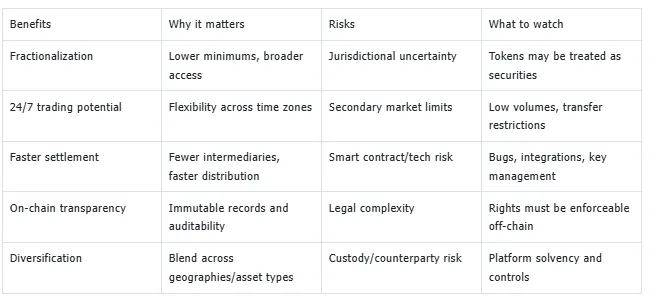
Key advantages include accessibility via fractional investing, faster settlement, and round-the-clock market access on compliant venues; key risks include legal complexity, technical dependencies, and secondary-market limitations that may cap liquidity. For a concise primer on mechanics and trade-offs, see this real estate tokenization overview from 4IRE Labs (Real estate tokenization overview). For a market scan of platforms and operating models, consider this rundown of platforms for tokenized assets in 2026 (platforms for tokenized assets in 2026).
Conduct Thorough Asset and Sponsor Due Diligence
Due diligence is the systematic review of an investment’s legal, financial, and operational details to identify risks and validate value. Most avoidable losses trace back to weak diligence—especially around title, cash flows, and sponsor competence.
What to verify before you wire funds:
- Proof of unencumbered title and outstanding liens or encumbrances
- The existence, governance, and documents of the SPV/LLC that legally holds the property
- Stabilized and pro forma cash flows, rent rolls, appraisal methodology, and debt terms
- Sponsor’s track record in real estate plus demonstrable tokenization and smart contract execution
- Property manager credentials and service-level agreements
- Independent audits or third-party reviews of the token issuance stack
Verify Legal Structure and Jurisdictional Compliance
Legal structuring almost always involves an SPV that owns the property, with tokens representing shares or interests in that SPV—not the physical deed. The legal wrapper is a dedicated entity (typically an SPV or LLC) formed to own the asset and issue digital tokens representing fractional ownership.
Critical steps:
- Confirm the governing jurisdiction for the asset and token. Switzerland, Singapore, parts of the EU, and select U.S. regimes have clearer treatment for digital securities.
- In the U.S., tokenized real estate offerings may be governed by federal securities laws—expect offering exemptions, transfer restrictions, and disclosure obligations.
- Map investor rights (dividends, voting, redemptions) to enforceable claims in the SPV’s charter and subscription documents.
- Engage counsel with cross-border digital securities expertise to reconcile conflicts of law and secondary trading rules.
Evaluate Platform Compliance and Security Measures
Choose platforms that operate like regulated financial market infrastructure, not experimental apps. At minimum, onboarding should enforce KYC/AML, and the venue should disclose its regulatory status, transfer controls, and reporting standards. ToVest’s onboarding process includes accreditation checks where applicable and automated compliance gates to reduce operational risk.
Custody solutions are regulated services that securely hold digital tokens and protect user assets against cyber threats or platform failures. Expect:
- Smart contract audits with published reports and version control
- End-to-end encryption, hardware-backed key management, and role-based access controls
- Continuous monitoring, segregation of client assets, and audit-ready reporting
- Clear incident response and proof-of-reserves or attestations
For a current inventory of institutional requirements and technology stacks common in 2026, review this strategic guide to real estate tokenization.
Assess Tokenomics and Blockchain Technology
Tokenomics is the set of economic rules and incentives embedded in a digital token, including supply, rights, rewards, and policies. Well-designed tokenized real estate should clearly define total supply, pricing, distribution waterfalls, dividend or coupon policies, voting rights, redemption mechanics, and settlement/transfer controls. Rights must be enforceable via the SPV’s documents, not just a white paper.
Look for open security-token standards—commonly ERC-1400 or ERC-3643 on EVM-compatible chains—so transfer restrictions, whitelisting, and compliance checks are programmable and auditable (Real estate tokenization overview; strategic guide to real estate tokenization).
Popular blockchains for real estate tokens (fit-for-purpose snapshot):
- Ethereum: Deep liquidity, mature tooling, strongest security assumptions; higher base fees but robust compliance standards.
- Polygon: EVM-compatible scaling with low fees; widely used for KYC-gated digital securities.
- Avalanche: High throughput with flexible subnets; useful for customized compliance environments.
- Solana: High performance and low fees; growing compliance modules but smaller digital securities footprint.
- Cardano: Formal methods and identity emphasis; slower ecosystem for institutional token standards.
For platform and chain selection trade-offs, see the strategic guide to real estate tokenization (strategic guide to real estate tokenization).
Plan for Liquidity and Exit Strategies
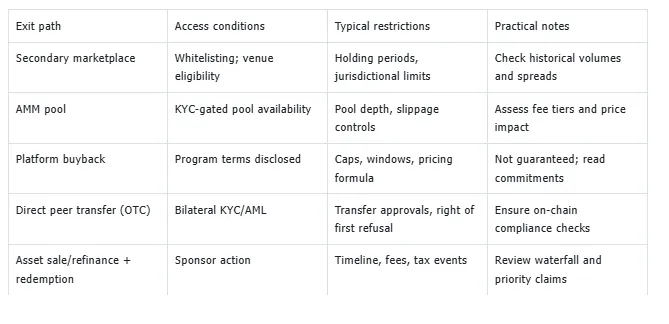
Liquidity is how easily and quickly a tokenized asset can be sold for cash or other assets on secondary markets. Theoretical 24/7 trading does not guarantee practical exits; many offerings face thin order books, holding periods, or whitelisting rules that suppress volumes.
Check whether secondary trading is enabled through:
- Regulated marketplaces with transfer-restriction enforcement
- Automated Market Makers (AMMs) with KYC-gated pools
- Liquidity partners or market makers with clear obligations and spreads
Consult platform comparisons for how secondary trading and liquidity providers are integrated (top RWA tokenization platforms).
Exit routes and considerations
Consider Tax Implications and Operational Continuity
Tax outcomes drive net returns. Always consult tax advisers—1031 tax-deferred treatment for tokenized interests is not automatic and often does not apply without specific structuring. Expect reporting on dividends, coupons, and capital gains, plus potential cross-border withholding.
Operational continuity also sits largely off-chain: escrow, legal review, property management, insurance, and maintenance workflows must align with the on-chain registry and cap table. Ensure data privacy and regulatory compliance, especially where tenant or investor PII is processed; privacy-preserving approaches such as zero-knowledge proofs are increasingly used to verify eligibility without exposing sensitive data.
Operational readiness checklist:
- Consult a cross-border tax specialist on income, gains, and deferral eligibility.
- Confirm property and tenant management procedures, SLAs, and reporting cadence.
- Validate privacy controls (least-privilege access, ZK proofs where applicable) and immutable audit trails.
- Test contingency plans for custodian, marketplace, and oracle outages.
If you prefer a compliance-first workflow with real-time execution and institutional custody, explore ToVest.
Frequently Asked Questions
What legal risks should I be aware of when buying tokenized real estate?
Common legal risks include unclear regulatory status, ambiguous investor rights, and jurisdiction-specific transfer rules; confirm the legal wrapper and scrutinize all offering documents.
How can I ensure the platform I use is compliant and secure?
Look for KYC/AML onboarding, audited smart contracts, regulated custody, and transparent compliance gates with continuous monitoring and incident response.
What rights do token holders typically have in tokenized real estate?
Token holders often receive dividends, limited governance participation, and redemption options via the SPV; however, only rights documented in the legal agreements are enforceable.
How is liquidity maintained for tokenized real estate assets?
Liquidity depends on access to regulated secondary markets, KYC-gated AMMs, or buyback programs, and actual trading volumes can vary widely by asset and venue.
What tax factors should investors consider with tokenized real estate?
Expect income and capital gains taxes, potential withholding on cross-border flows, and case-by-case eligibility for deferrals; consult a digital-assets-savvy tax adviser.