Top Stablecoin Yield Opportunities for 2026: Secure Your Returns
6 มกราคม 2569
Stablecoins are digital assets pegged to a stable value (usually the U.S. dollar), providing low-volatility alternatives to traditional cryptocurrencies. In 2026, stablecoin yields are gaining attention as investors pursue predictable, cash-like returns without exiting digital markets. The maturation of DeFi, multichain liquidity routing, and the rise of real-world asset (RWA) yield integrations are expanding the options available—from simple lending to automated strategy vaults—while traditional finance continues exploring digital-asset rails for efficiency and new revenue streams. For context on these tailwinds, see this overview of DeFi-driven yield strategies, multichain growth, and broader banking digitization trends from Deloitte’s industry outlook. This guide zeroes in on where to earn passive income with stablecoins now, how to compare platforms and risks, and actionable steps to start investing for high, yet sustainable, returns.

ToVest: Fractional Investing with Stablecoins for Passive Income
ToVest connects global investors with opportunities for passive income through stablecoins by turning stablecoin deposits into fractional investing across tokenized U.S. stocks and real estate. Fund with USDC or USDT, settle instantly, and manage your portfolio in real time—24/7. Earnings are supported by institutional-grade protections, such as 2FA, cold storage, and audited smart contracts.
How it works:
- Fractional investing: Allocate small stablecoin amounts across diversified, tokenized assets.
- Tokenization: Own programmable claims on real-world assets that can automatically route yield.
- 24/7 access: Enter or exit positions anytime, with instant stablecoin settlement.
- Security: Institutional custody standards plus ongoing audits and segregated cold storage.
Key ToVest benefits:
- Global access with low minimums
- Diversified multi-asset portfolios
- Flexible stablecoin funding (USDT/USDC)
- Real-time performance tracking and automated reinvestment options
USDC: Institutional-Grade Yield and Security
USD Coin (USDC) is a fiat-backed stablecoin holding a roughly $42B market cap, collateralized by cash and short U.S. Treasuries, with monthly reserve attestations and strong institutional adoption for treasury management, according to this 2026 stablecoin overview from ZebPay. USDC’s transparency and regulatory posture make it a top choice for conservative yield strategies, including:
- High-speed settlements between platforms
- Lower-risk lending and market-making
- Access to competitive APY via CeFi and DeFi (typically in the low- to mid-single digits for conservative programs)
For scaled allocations, USDC’s integrations with enterprise-grade custody and payments providers, such as Fireblocks and Cobo, add operational resilience and compliance tooling, as detailed in Cobo’s guide to reliable stablecoin payment providers.
USDT: Deep Liquidity and Trading Utility
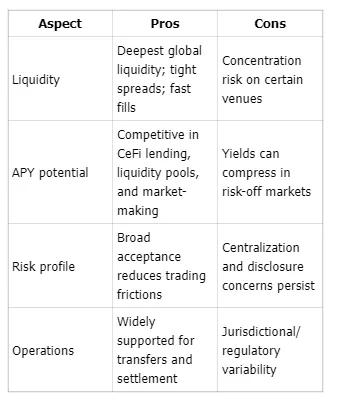
Tether (USDT) is the largest stablecoin by market cap and the most ubiquitous trading pair across crypto venues—useful for arbitrage, liquidity provision, and rapid on/off-ramping, as outlined in Fidelity’s primer on stablecoins. Its scale makes it a staple for executing strategies and liquidity farming.
Transparency and regulatory debates have persisted around centralized governance and reserve disclosures. For a balanced risk view, the Bank Policy Institute highlights structural and policy risks to monitor in stablecoin models.
USDT at a glance
USDe (Ethena): High-Yield Delta-Neutral Strategies
USDe is a synthetic stablecoin that targets a market-neutral profile by combining long-staked ETH with offsetting short perpetual futures (delta-neutral basis trades). Recent yields have hovered near 10–20% APY in favorable market conditions, per this guide to stablecoin yield opportunities from CryptoManiaks. These returns stem from:
- Staking yield on ETH collateral
- Perpetual futures funding/basis capture
- Market-neutral hedging to reduce price exposure
Simple flow of the delta-neutral mechanism:
- Deposit crypto collateral (e.g., staked ETH)
- Open a short perpetual position to offset price moves
- Earn staking rewards and funding/basis
- Distribute net yield to the protocol/holders
Considerations: Protocol, counterparty, and model risks are materially higher than fiat-backed options. USDe fits advanced users or a defined “higher-risk yield bucket” within a diversified portfolio.
DAI: Decentralized Collateral and Governance Benefits
DAI is a crypto-collateralized, algorithmically managed stablecoin governed by a decentralized community. Its structure reduces centralized counterparty exposure and emphasizes on-chain transparency, though collateral volatility and liquidation dynamics introduce their own risks. Investors typically earn yield by staking DAI in liquidity pools, lending to money markets, or using automated vaults. While DAI yields often trail synthetic strategies, many investors value the transparency and governance—such as community-led risk parameters and system upgrades—highlighted in Koinbx’s 2026 stablecoin roundup.
PYUSD: Emerging Fiat-Backed Stablecoin with Payment Integration
PayPal USD (PYUSD) is a newer fiat-backed stablecoin designed for seamless payments and consumer-grade UX. Its edge is distribution—native to a global payments network—and potential institutional integrations that blend fast settlement with accessible yield programs. Stablecoins are increasingly positioned as cross-border payment rails in traditional finance, as discussed in this Wells Fargo Advisors explainer on stablecoins. PYUSD’s early-stage profile means:
- Advantages: PayPal ecosystem access, strong UX, straightforward fiat on-ramps
- Limitations: Newer liquidity base, fewer DeFi integrations than incumbents, evolving APY availability
USD1: Fast-Growing New Entrant with Partnership Potential
USD1 has emerged as a high-growth entrant with headline partnerships and rapid integration cycles. This momentum can translate to attractive promotional yields and novel utility—but it also concentrates risk in centralization, operational maturity, and hype cycles. For risk-aware context, newer stablecoins should be evaluated through a conservative lens: counterparty safeguards, redemption mechanics, and audit cadence. DailyDive’s 2025 look at smarter ways to earn with stablecoin yield farming underscores why disciplined screening matters in newer, higher-APY offerings.
Quick take on USD1:
- Pros: Fast ecosystem growth, partnership momentum, potential early-mover yields
- Cons: Centralization risk, limited track record, liquidity depth still forming
- Best for: Smaller, exploratory allocations by risk-tolerant investors
Choosing the Right Stablecoin Yield Strategy
Match strategy to your objectives and risk tolerance:
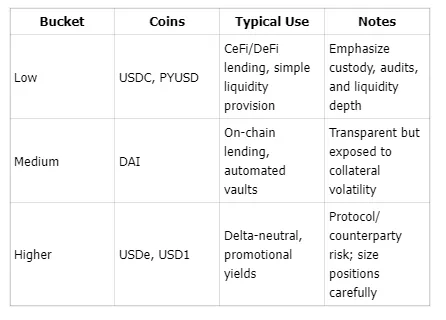
- Capital preservation and low friction: Favor fiat-backed options and regulated venues (e.g., USDC, PYUSD) and stick to conservative lending or curated liquidity pools.
- Moderated growth: Use decentralized options (e.g., DAI) and diversified DeFi vaults with strict position sizing.
- Aggressive yield: Consider synthetic models (e.g., USDe) and new entrants (e.g., USD1) within a defined high-risk sleeve.
Strategy methods—CeFi lending, DeFi money markets, liquidity pools, and yield aggregators—are summarized in KuCoin’s guide to earning passive income with stablecoins.
Risk buckets (illustrative)
Programmable automation—auto-compounding, smart rebalancing, and multichain routing—can improve consistency and reduce manual errors as DeFi infrastructure matures, as noted in this DeFi strategy overview.
Balancing Yield and Risk in Stablecoin Investments
Think in terms of risk-adjusted yield: Fiat-backed lending often delivers lower, steadier returns, while synthetic and basis-driven strategies can boost APY alongside protocol and market risks. Arch Lending’s analysis of stablecoin yields echoes this trade-off—higher APY generally requires more complex strategies and stronger risk controls.
Practical monitoring checklist:
- Confirm reserve attestations and audit cadence for fiat-backed coins.
- Track yield changes, incentives, and liquidity depth across platforms.
- Review counterparty exposures (custody, exchanges, or protocols).
- Watch regulatory updates in your operating jurisdictions.
- Use institutional custody and permissioned access for scaled allocations.
Getting Started with Stablecoin Investing for High Returns
Step-by-step:
- Choose a trustworthy platform, like ToVest, with audited infrastructure and robust custody.
- Complete KYC/AML and secure your account (2FA, whitelists, hardware keys).
- Select your stablecoins (e.g., USDC for conservatism, DAI for on-chain opportunities, USDe for higher risk).
- Pick yield paths: CeFi lending, DeFi money markets, liquidity pools, or automated vaults.
- Monitor earnings, adjust allocations, and automate rebalancing where possible.
Examples by level:
- Beginner: USDC in conservative lending or curated DeFi pools.
- Intermediate: DAI in on-chain markets and automated vault strategies.
- Advanced: USDe in delta-neutral vaults with strict caps and stop-loss rules.
For a practical walkthrough of earning interest and evaluating opportunities, see Plasma Finance’s primer on stablecoin yield.
Frequently Asked Questions on Stablecoin Yield Opportunities for 2026
What are the safest platforms to earn yield with stablecoins?
The safest platforms offer independent reserve audits, insurance layers, automated liquidations, and strong transparency. Regulated, institutionally backed providers typically minimize operational risk.
How do DeFi protocols enhance stablecoin yields?
They automate routing across lending markets and liquidity pools, harvest incentives, and rebalance positions—delivering programmable, diversified passive income.
What risks should I consider when investing in stablecoin yields?
Key risks include reserve transparency, depegging, smart contract and counterparty exposure, and regulatory change. Diversification and active monitoring help manage these risks.
How can I diversify to protect my stablecoin investments?
Spread capital across multiple stablecoins, platforms, and strategies; separate low-risk reserves from higher-yield experiments.
What steps do I take to start earning passive income with stablecoins?
Pick a secure platform, verify your identity, fund with your preferred stablecoin, allocate to vetted lending or DeFi strategies, and track results with automation where possible.