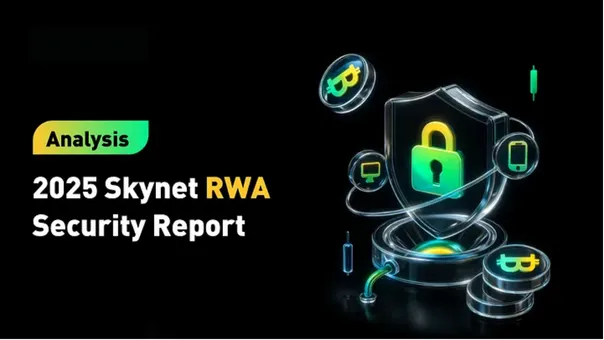
“The RWA Boom Is Here, But Safety Is the Blade”,2025 Skynet Report In-Depth Analysis: The Risks and Order of the On-Chain Golden Age
21 พฤศจิกายน 2568
Introduction
From $26 billion to a future trillion-dollar market, RWA is becoming the bridge between DeFi and TradFi. But on the other side of this bridge, is it scenery — or a storm?
Preface: RWA Is Hot, But Do You Really Understand It?
Imagine blockchain as a huge city. In the past few years, DeFi was the busiest commercial street, NFTs were the trendiest art district, and GameFi was the flashy amusement park. And now, a new highway — RWA — is rapidly transporting real-world assets like treasuries, gold, and receivables into this on-chain city.
As the “financial hub,” RWA in 2025 can truly be described as dazzling. According to the 2025 Skynet RWA Security Report, as of mid-2025 the total RWA market surpassed $26 billion, a 5x growth since 2022. What kind of speed is that? It’s like a small town turning into a global metropolis overnight. RWA is no longer a “future trend” — it is the “present continuous tense.”
But the hotter it gets, the more we need to stay cool.
The Skynet RWA Security Report not only shows RWA’s prosperity, but also exposes the hidden risks and structural vulnerabilities behind it. This article will break down the report, helping you understand both the “boom” and the “risks” of RWA, and how it may reshape Web3 and even the global financial landscape.
2025 Skynet RWA Security Report In-Depth Analysis
Core Point 1: RWA, The New Digital Asset Continent — Who’s Leading?
The report first released the Skynet RWA Ranking (Top 10, H1 2025) — the most representative global RWA projects:
- BlackRock BUIDL: Treasuries
- Franklin Templeton On-Chain Fund: Treasuries
- Ondo Finance: Treasuries + Yield
- Paxos Gold: Gold
- Tether Gold: Gold
- Binance RWUSD: Stablecoin
- Ethena USDtb: Stablecoin + Yield
- Centrifuge: Receivables
- Usual: Emerging Stablecoin
- SKY (MakerDAO RWA Vaults): RWA Aggregation Pool
This ranking is interesting: it’s not just based on market cap, but a comprehensive score combining compliance, reserve transparency, security structures, and institutional-grade operations.
The report pointed out that these projects share several traits:
- Clear legal frameworks: Most are registered in regulated jurisdictions with designated custodians and auditors.
- Transparent proof-of-reserves: Leading projects release weekly reserve reports with third-party audits.
- Institutional-grade risk control: From multi-signature setups to legal contracts and on-chain governance mechanisms.
From TradFi giants like BlackRock and Franklin Templeton, to DeFi-native projects like MakerDAO and Ondo, what we are seeing is a hybrid trend:
It’s not simply a “marriage between TradFi and DeFi.” Instead, the decentralized world is learning risk management from TradFi, while traditional finance is attempting to “go native on-chain.”
And beyond that, these projects also show both strong commonalities and unique traits:
Commonalities:
Highly compliant, transparent reserves, institutional-grade security — they are the “face” of the RWA industry, representing the highest standards.
Core Point 2: RWA’s Value Proposition — Where’s the Real Strength?
If you had to sum up RWA in one sentence: “RWA is the bridge that allows on-chain finance to truly connect with real-world value.”
And this bridge shines in three ways:
1. Unlocking real asset liquidity
For example, tokenized U.S. Treasuries: assets that once required days of settlement and six-figure entry amounts can now circulate freely on-chain in units as small as $1.
2. Giving stablecoins “real yield”
Traditional stablecoins like USDT/USDC don’t generate yield. But projects like Ethena USDtb return Treasury interest to holders. Holding a stablecoin becomes automatic yield farming.
3. Bridging TradFi and DeFi
Institutional inflows into RWA improve on-chain asset quality and upgrade DeFi itself. Lending platforms can use RWA as collateral to lower volatility.
Core Point 3: $26 Billion — A Quiet Explosion
One number in the report was jaw-dropping: by mid-2025, the RWA market had reached $26 billion, compared to $5 billion in 2022 — a more than 5x growth. And this is just the beginning. BCG predicts $16 trillion worth of assets could be tokenized by 2030.
Why so fast? CertiK summarized three main drivers:
- U.S. Treasuries as the entry asset
- Tokenized Treasuries grew 400% year-over-year, becoming the gateway for institutions. Safe, stable yield — perfect as foundational RWA.
- New trend of yield-bearing stablecoins
- Some RWA-backed stablecoins distribute Treasury interest to holders — “yielding stablecoins.” This may challenge the dominance of USDT/USDC.
- Deep involvement of TradFi giants
- BlackRock, Franklin Templeton, and others raised the trust bar, pushing compliance and transparency standards into the mainstream.
And importantly — this growth wasn’t fueled by “airdrops, farming, or mining.” It was driven by real assets and real institutional capital.
Core Point 4: Don’t Just Look at the Boom — Safety Is the Blade
RWA is not just a “move to chain.” It’s a multi-dimensional project spanning law, custody, data, oracles, and compliance. CertiK noted: “RWA’s risks go far beyond traditional smart contract auditing.”
Risk evolution:
- 2023–2024: Mostly off-chain credit defaults — borrowers not repaying.
- H1 2025: Total losses surged to $14.6 million — but this time the culprits were on-chain operational and technical risks.
This shift is crucial:
- Early RWA = biggest risk was off-chain (borrower default).
- Now = biggest risk is on-chain (code bugs, oracle failures).
That’s the signal: RWA has entered a “technical governance risk” era.
You might think you’re investing in Treasuries, but in reality one oracle bug could wipe you out. This is true “tech finance.”
Core Point 5: CertiK’s Five-Layer Security Stack — The “CT Scan” of RWA
One of the most valuable contributions of the report: the Five-Layer Security Stack.
Think of it as an RWA “human anatomy chart.” Each layer is a potential risk hotspot:
- Asset Layer: Do the real assets exist? Are they legally enforceable?
- Legal Layer: Is there a valid legal framework? Is regulation clear?
- Operational Layer: Are custodians and operators compliant? Is governance multi-sig and transparent?
- Data Layer: Are oracles reliable and decentralized? Any manipulation risks?
- On-Chain Layer: Are contracts audited? Any bugs? Is access control robust?
Any weak link = loss of funds or collapse of trust.
Based on this, CertiK also launched the Skynet RWA Security Scoring Framework, evaluating projects across six dimensions: asset authenticity, legal compliance, operational transparency, oracle reliability, contract security, and governance robustness.
Its value:
- Letting users know if a protocol is trustworthy.
- Giving institutions and regulators a standard to measure risk.
- Building a transparent “trust layer” for the entire industry.
Example: some projects may have real Treasuries, but all control sits in one multisig wallet. That’s high on “Asset Layer,” but low on “On-Chain” and “Governance.”
Core Point 6: Three Lessons for the Industry
From deep reading and structured analysis, here are three takeaways:
- RWA is standardizing, but not de-risking
RWA is moving toward institutionalization — audits, proofs-of-reserve, on-chain governance. Investors can “see and verify.” But risk isn’t gone — it’s just more visible and traceable. In fact, RWA is more complex than pure DeFi because it spans both on-chain and off-chain governance.
2. The main threat has shifted from credit default to technical governance
2025’s biggest losses weren’t bond defaults — they were:
- Oracle manipulation distorting collateral ratios.
- Multisig hacks draining funds.
- “Emergency withdrawal” functions abused by teams.
- Reserve proofs delayed or falsified.
Once assets are digitized, the digital layer itself becomes the weakest link. Which means security and compliance governance must be integrated.
3. No “universal ruler,” but the Security Stack is a radar
The Five-Layer Stack and Skynet Framework aren’t there to tell you “invest or not.” They’re there to help you check:
- Is custody legal?
- Is the oracle centralized?
- Is the contract open source and audited?
- Is governance concentrated in one team?
For institutions, regulators, and even retail users — this is a very practical radar.
Core Point 7: Five Sentences You Should Remember
- RWA is digitizing real assets — it’s not a castle in the sky, but it’s not risk-free either.
- By 2025, RWA market size has hit $26B, with potential 100x growth over the next decade.
- Main risks have shifted from credit default to on-chain technical and governance failures.
- CertiK’s Five-Layer Security Stack is an effective risk scanning framework.
- In the RWA marathon, compliance, security, transparency, and technical strength will decide who lasts.
Final Words: The Future of Finance Is More Than Just “On-Chain”
RWA is Web3’s deep evolution. It’s no longer satisfied with “virtual economy,” but instead seeks full integration with real-world assets, institutions, laws, and regulators.
It’s both an opportunity and a challenge. As CertiK said in the report: “RWA security has become the key question for Web3’s healthy growth.”
This isn’t a slogan — it’s reality. Because in a market that could reach $16 trillion, risk management will be the line between survival and collapse.