Robinhood Moves Into On-Chain Assets: Disruptor of the RWA Era, or the Next Financial Giant?
21 พฤศจิกายน 2568
In the crypto space, over the past few years, most of the talk has been about Bitcoin, Ethereum, meme coins, or DeFi projects. But recently, a “familiar face” has suddenly jumped in, and the entire space has perked up — it’s none other than Robinhood.
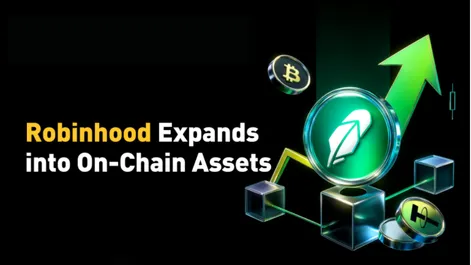
Robinhood is the number one crypto brokerage in the U.S. Originally a traditional internet brokerage, it won over a massive base of young retail traders with zero-commission trading and a “gamified” interface. But now, it’s no longer content to be just a “stock app.” It’s charging directly into the on-chain asset space, aiming to become the bridge for Real-World Asset (RWA) tokenization — and even planning to launch its own blockchain.
Behind this move — hype or a real attempt to reshape the underlying logic of finance? Today we’ll take a third-party view and objectively break down Robinhood’s “All in Crypto” play.
Why Has Robinhood Suddenly Set Its Sights on On-Chain Assets?
Robinhood’s pivot isn’t impulsive — it’s the result of several factors coming together.
1. Profit-Driven — Crypto Is Its Cash Cow
In Q1 2025, Robinhood’s total trading revenue was $583 million, of which crypto trading contributed $252 million — an astonishing 43% share, surpassing options to become the number one revenue driver. And the margins are huge: the market-making rebate rate from crypto order flow is 45 times that of stocks, and 4.5 times that of options.
To put it bluntly, selling crypto trades is far more profitable for Robinhood than selling stocks. Not expanding this business would be a disservice to shareholders.
2. Regulatory Arbitrage — RWA Tokenization as a Grey-Zone Opportunity
In the U.S., SEC regulation of crypto remains unclear, but the political winds are slowly easing — especially for tokenized assets backed by real-world value (stocks, bonds, real estate, etc.), where the regulatory stance is relatively tolerant. Robinhood is targeting this “buffer period” — moving in before the giants have fully landed, to get users accustomed to the concept.
3. Narrative Upgrade — Shedding the “Meme Stock Playground” Label
After the GME incident, Robinhood was slammed as the poster child for “pulling the plug.” To shake off that stigma, it needs a high-end, compliant, long-term new story — and “on-chain assets” sound a lot more sophisticated than pumping joke stocks.
Robinhood’s “Three-Step” Strategy
Robinhood’s play can actually be broken down into three steps — capturing short-term gains while building a long-term moat.
1. Stock Tokenization — The Entry Point
It started by launching tokenized U.S. stock trading in the EU. For example, you can buy a “Tesla token” with USDC, with its price synced in real time to the Nasdaq, and even collect dividends. It’s a clever entry point:
- Low user barrier (everyone understands stocks)
- More flexible trading hours (24/5 or even 24/7)
- Educates traditional stock investors about on-chain trading
By comparison, Kraken’s xStocks also offers tokenized U.S. stocks, but runs on the Solana chain and doesn’t cover the EU market. From both user base and regulatory coverage, Robinhood has the early advantage.
2. Building Its Own Layer 2 Blockchain — Locking the Base Layer
Robinhood plans to launch its own Layer 2, built on the Arbitrum tech stack, dedicated to RWA. This way, it’s not just an application-layer platform — it becomes an infrastructure player that sets the rules.
In the future, stock tokens, bond tokens, or even real estate NFTs could all be issued, settled, and bridged on this chain. For Robinhood, that means:
- Transaction loop closure (user funds stay in-house)
- Blockchain ecosystem value capture (fees, native tokens, etc.)
If it pulls this off, its business model could upgrade from “brokerage” to “financial operating system.”
3. All-in-One Investment Platform — Locking in User Lifecycles
Robinhood isn’t stopping at trading — it’s building a supporting ecosystem:
- Perpetual futures (to attract high-frequency traders)
- ETH and SOL staking (lockups + yield)
- AI advisory “Cortex” (data-driven)
- Robinhood Gold credit card (cashback auto-converted to crypto)
This way, whether it’s stocks, crypto, savings, or even daily spending, users can do it all on one platform. This kind of stickiness is far stronger than a simple trading app.
Three Ways Robinhood’s On-Chain Asset Strategy Could Impact the Crypto Market
1. RWA Could Squeeze Out Altcoins
In the past, many of the market’s hot coins had no real-world value backing (e.g., meme coins). But if investors can just as easily buy on-chain Tesla, OpenAI, or SpaceX equity tokens, capital may shift from speculative tokens toward these RWA assets. Altcoin liquidity could be diluted, leading to market polarization:
- Mainstream coins + RWA infrastructure tokens (high valuation, compliant)
- The remaining meme coins (niche, speculative)
2. Traditional Finance Rules Could Be Rewritten
24/7 trading, instant settlement, infinitely divisible ownership — these on-chain features could force legacy giants like Nasdaq and the NYSE to adapt. In the future, pre-market and after-hours concepts might vanish, and price discovery could become truly global.
3. TradFi Giants Will Be Forced to Accelerate Entry
JP Morgan, Goldman Sachs, and Citi won’t just watch Robinhood eat their lunch. Once Robinhood’s tokenization business proves itself, it could trigger a new round of “fintech arms race.”
Objectively Speaking: Big Opportunities, But Big Challenges Too
Opportunities:
- Large user base (tens of millions of accounts)
- Excellent product experience (popular with younger users)
- Clear profit model (high-margin crypto business)
- Early-mover advantage in the RWA track
Challenges:
- Regulatory risk (especially in the U.S.)
- High execution complexity (building a chain + integrations)
- Heavy competition (Coinbase, Kraken, TradFi giants)
- Cyclical revenue (crypto bear markets hit earnings)
Conclusion: Robinhood Is Not Just “Playing with Crypto”
Robinhood’s move is actually a bet on a much bigger trend — the reconstruction of financial infrastructure. It’s not simply adding a “crypto trading” option; it’s attempting to fully bridge traditional finance and the on-chain world.
If its blockchain takes shape, with stocks, bonds, real estate, and insurance all tokenized and tradable anytime, Robinhood would no longer be a broker — it would be a global, programmable financial operating system.
For the crypto market, this could mean more compliant capital, a richer set of asset classes, and a partial return of speculative bubbles to rationality. But for those small-cap coins relying purely on hype and traffic, it could be an existential crisis.
In the coming years, we might see a reality where:
- In the morning, an investor buys on-chain Tesla stock on Robinhood, then in the afternoon swaps some USDC for a coffee
- The line between traditional brokerages and crypto exchanges disappears entirely
- “Trading hours” become a historical term
Whether this transformation succeeds will depend on Robinhood’s ability to polish its tech, compliance, and ecosystem. But one thing’s certain — it’s already thrown the first stone into the pond, and the ripples will keep spreading across the entire financial industry.