ToVest’s 2026 Regulatory Compliance Roadmap: What Investors Should Expect
7 มกราคม 2569
ToVest’s 2026 regulatory compliance roadmap is our blueprint for protecting investors and earning durable trust as digital assets and fintech rules tighten worldwide. We operate in line with applicable laws in the jurisdictions where we offer services, and we continuously adapt our controls, disclosures, and reporting to meet evolving expectations. For investors asking how ToVest ensures regulatory compliance—and whether we are a “regulated platform”—the practical answer is this: we build to the rulebooks that govern our products and markets, maintain oversight through strong governance and audits, and align to jurisdiction-specific obligations that may differ by product type. This roadmap outlines how we will stay ahead of regulation through automation, data quality, secure tokenization, and transparent reporting—treating compliance as both risk management and a competitive advantage.

Overview of ToVest’s Regulatory Compliance Strategy
Our strategy is built on four pillars: robust data governance, deep automation, transparent disclosures, and ongoing staff training. Regulatory compliance means meeting all legal, reporting, and consumer protection requirements established by authorities in every relevant jurisdiction.
What this looks like in practice:
- Governance and audits: independent reviews of processes, controls testing, and regular policy refreshes support continuous improvement.
- Anti-financial-crime controls: rigorous KYC/AML screening, sanctions checks, and real-time transaction surveillance across the lifecycle.
- Transparent product disclosures: plain-English risk explanations for tokenized assets, fees, custody, and market mechanics.
- Machine-readable reporting: automated trade-reporting pipelines, systematized exception handling, and data lineage aligned to 2026–2027 transition timelines noted across 2026 regulatory reporting trends and challenges.
- Customer protections: two-factor authentication, cold-storage controls for digital assets, and automated reporting to reduce lag and error.
Our aim is to deliver verifiable data quality, consistent reporting, and clear accountability—capabilities regulators increasingly expect from fintechs and digital asset platforms, as highlighted in 2026 regulatory reporting trends and supervisory priorities.
Key Regulatory Trends Impacting ToVest in 2026
Investors should expect stricter enforcement, higher data-quality thresholds, new identifiers in reporting, and rules that address AI and tokenized assets. Highlights include increased transaction oversight, cross-border coordination, and potential reserve-quality requirements for stablecoins—defined as cryptocurrencies pegged to a stable asset, such as USD, where the issuer must hold high-quality, liquid reserves. Proposals like the GENIUS Act (a U.S. KYC/AML framework for stablecoins) illustrate the direction of travel, even if specific measures evolve before implementation.
Key 2026 themes and impacts:
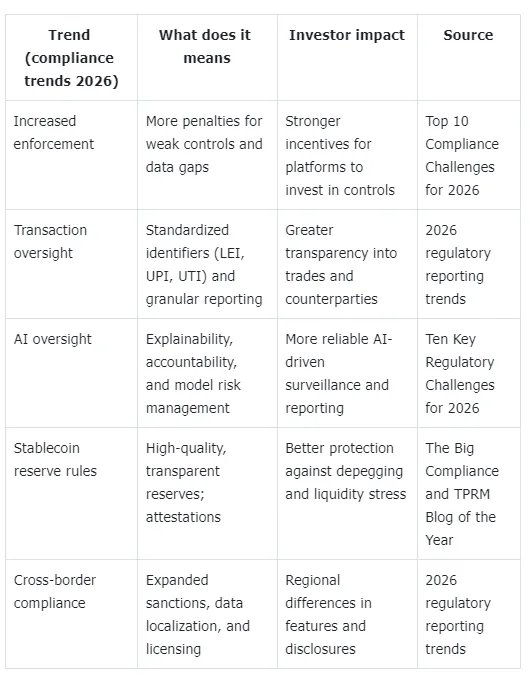
Sources: Top 10 Compliance Challenges for 2026; 2026 regulatory reporting trends; Ten Key Regulatory Challenges for 2026; The Big Compliance and TPRM Blog of the Year.
Transaction Reporting Modernization and Data Standards
Regulators are converging on standardized reporting identifiers to improve data quality and comparability:
- Legal Entity Identifier (LEI): a global 20-character code uniquely identifying legal entities.
- Unique Product Identifier (UPI): a standardized identifier for the instrument being traded.
- Unique Transaction Identifier (UTI): a unique code linking both sides of a reportable transaction.
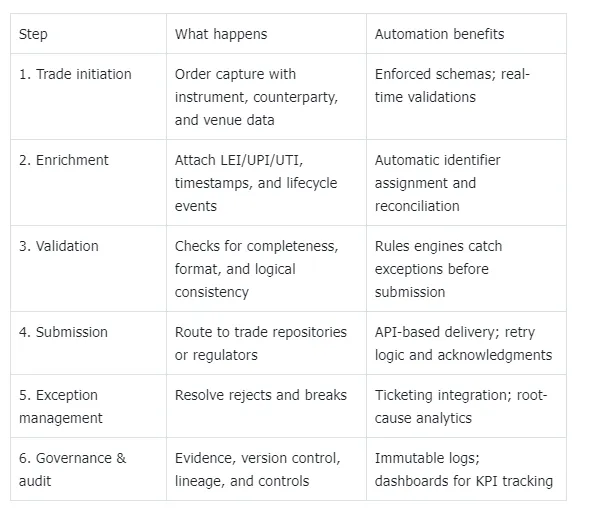
ToVest is investing in automated, resilient pipelines and remediating legacy issues to comply with shifting deadlines that in some jurisdictions extend into 2027, as outlined in 2026 regulatory reporting trends. Our approach prioritizes completeness, accuracy, and timely submissions.
Typical reporting workflow and where automation adds value:
AI and Digital Asset Compliance Challenges
AI is both a compliance accelerator and a subject of new oversight. AI governance refers to the rules and systems that ensure AI usage is explainable, safe, and accountable. Regulators are focusing on explainability, bias mitigation, model risk, and auditability for both compliance reporting and fraud prevention.
ToVest deploys AI-driven screening for AML, fraud detection, sanctions evasion patterns, and anomalous trading behaviors, aligned with market-wide expectations for model transparency and controls. We maintain model documentation, escalation protocols, and human-in-the-loop reviews to meet emerging requirements around AI risk management and tokenized asset compliance.
Context and expectations: major 2026 regulatory challenges emphasize AI explainability, data quality, and model governance in line with supervisory expectations across finance and fintech.
Enhancing Compliance through Technology and Automation
Compliance automation is the use of software and technology to streamline the collection, validation, monitoring, and regulatory reporting of transactional data. It reduces manual errors, strengthens data quality, and enables timely reporting at scale.
ToVest’s system includes trade management, sanctions screening, reconciliation engines, and continuous staff training in data governance. We instrument controls by design—embedding validation into each workflow stage—so that reporting is a byproduct of high-quality operations, not an afterthought.
Legacy vs. ToVest’s automated approach:
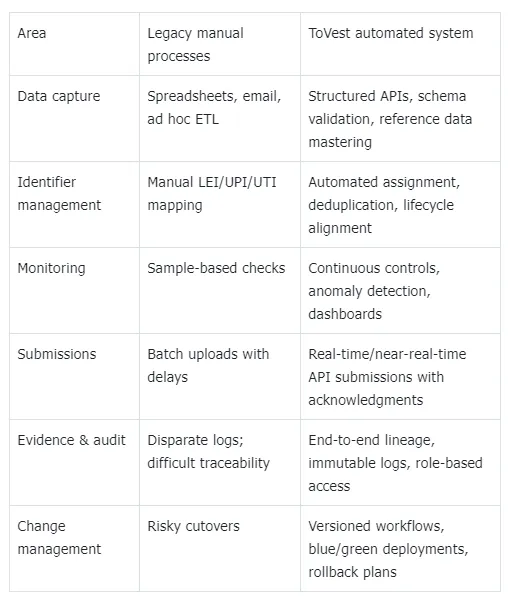
This alignment with automation-first principles is consistent with 2026 regulatory priorities around data integrity and model governance highlighted in leading industry analyses.
Cross-Border Risks and Third-Party Oversight
Third-party oversight is the framework of protocols and controls used to manage compliance risks from external partners and service providers. Cross-border compliance raises the stakes with varying national rules, evolving sanctions regimes, data localization, and differing licensing thresholds for digital assets.
ToVest’s approach includes:
- Vendor risk management: due diligence, contractual control mapping, and continuous performance and controls monitoring informed by the five biggest compliance risks for 2026.
- Sanctions and watchlist screening: up-to-date lists, fuzzy matching, and adverse media checks across onboarding and ongoing monitoring, aligned to global concerns about sanctions complexity and extraterritorial enforcement.
- Lifecycle governance: onboarding assessments, periodic reviews, trigger-based re-evaluations, and termination protocols that reflect top trends in risk and compliance for 2026.
These measures help us preserve market integrity while scaling globally.
Investor Implications of ToVest’s Compliance Roadmap
Enhanced regulatory compliance means stronger protections: lower fraud risk, clearer disclosures, and accurate reporting that improves market transparency and decision quality. Investors benefit from standardized identifiers, lifecycle traceability, and better reserve-quality expectations for certain digital assets.
Actionable steps for investors:
- Review ToVest’s disclosures and controls, including data lineage, exception rates, and submission timeliness.
- Track compliance KPIs and automation investments as leading indicators of risk mitigation and operational resilience.
- Monitor industry shifts in reporting and stablecoin reserve quality—changes that should materially improve oversight and comparability across platforms.
For deeper context on our reporting philosophy and transparency efforts, see our latest investor reporting update on the ToVest blog.
Building Competitive Advantage through Proactive Compliance
A competitive compliance advantage means using higher regulatory standards and transparency to build investor trust and outperform peers. Research on 2026 reporting trends indicates that early adopters of robust data, automation, and governance frameworks lower regulatory risk and improve access to capital.
ToVest initiatives reinforcing leadership:
- Early LEI/UPI/UTI adoption and lifecycle reconciliation across products and venues.
- AI-augmented reporting and surveillance with documented explainability and human oversight.
- Pursuit of independent smart contract audits and cryptographic proofs to enhance transparency of tokenized asset operations.
- Continuous controls monitoring and machine-readable disclosures to reduce ambiguity and speed reviews.
By treating compliance as a product feature—not just an obligation—we aim to deliver safer, more transparent tokenized asset trading with resilience built in.
Frequently Asked Questions
How does regulatory compliance affect investor protections?
Regulatory compliance ensures transparent disclosures, robust anti-fraud and AML controls, and accurate reporting—reducing risk and strengthening trust.
What role does automation play in regulatory reporting?
Automation standardizes data capture, minimizes manual error, and enables timely, machine-readable submissions that keep pace with evolving rules.
How can investors assess a fintech platform’s compliance readiness?
Look for public disclosures, evidence of independent audits, automation in reporting, regular staff training, and mature data governance and vendor risk practices.
Why are AI regulations important for digital asset platforms?
They ensure AI systems are explainable, accountable, and secure—critical for preventing fraud and protecting sensitive financial transactions.
What should investors expect regarding disclosures on crypto exposure?
Clear details on crypto risks, reserve quality for any stablecoin exposure, and how evolving digital asset obligations may affect products and reporting.