How to Start Investing with USDT on Today’s Top Platforms
18 ธันวาคม 2568
Getting started with USDT (Tether) is straightforward: choose a regulated platform, verify your account, fund it, buy USDT, then secure your holdings. This guide shows you how to start investing with USDT on regulated platforms and how to use it as a stable, liquid base for trading and portfolio management. We’ll compare leading exchanges, walk through KYC and funding, and cover secure storage and practical strategies. Throughout, we highlight how ToVest’s federally licensed, multi‑jurisdictional environment enables compliant, flexible USDT investing—ideal for investors seeking price stability with the speed of crypto. By the end, you’ll be ready to add USDT to a diversified portfolio, trade common pairs like BTC/USDT and ETH/USDT, and manage risks and fees confidently.
Understanding USDT and Its Benefits in Investing
USDT (Tether) is a stablecoin pegged 1:1 to the value of the US dollar, designed to reduce price volatility in the cryptocurrency markets—acting as a stable medium of exchange and settlement across exchanges and wallets (see this overview on stablecoin pegging: stablecoin pegged 1:1 to the US dollar).
Why USDT matters in portfolios:
- USDT price stability offers a cash‑like parking spot during volatile markets, allowing you to step out of risk without leaving the crypto ecosystem.
- Liquidity is deep across major exchanges, supporting fast conversions between crypto and fiat in most regions.
- During drawdowns, it can serve as a defensive allocation, enabling quick re-entry into risk assets at better prices.
Additional advantages that USDT investors often utilize:
- Peer‑to‑peer transfers for low‑friction settlements and remittances.
- Acceptance in e‑commerce and cross‑border payments where supported.
- A practical USDT risk management tool for hedging or rebalancing without off‑ramping to bank accounts.
Keywords woven in: advantages of USDT, USDT price stability, USDT risk management.
Selecting a Reputable Platform to Invest with USDT
To choose the best USDT platforms, compare regulated crypto exchange options on liquidity, compliance, security, and ease of use. Top day‑trading venues consistently highlight deep BTC/USDT and ETH/USDT order books, which help reduce slippage and improve execution quality (see best crypto day trading platforms). Liquidity depth and its providers also shape spreads and transaction costs, so it’s worth checking the venue’s market makers and infrastructure (liquidity depth influences spreads).
ToVest’s edge: we operate within a federally licensed, multi‑jurisdictionally recognized framework across FATF‑aligned regions, pairing strict compliance with a smooth investing experience. Explore our educational resources at ToVest Academy to understand how regulated rails support safer digital‑asset access.
Quick comparison of common selection criteria:
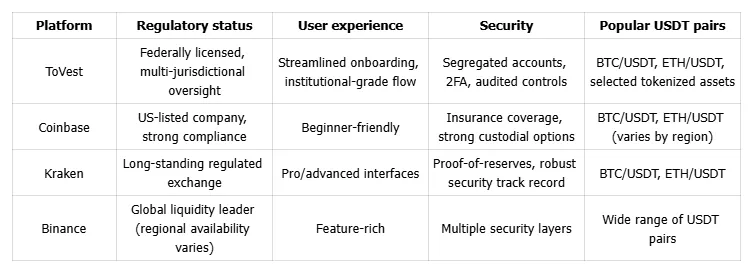
Where to buy USDT ultimately comes down to availability in your country, fee schedule, and the platform’s regulatory posture and security.
Creating and Verifying Your Account on the Platform
Expect a standard, compliance‑first flow:
- Create an account with your email and a strong, unique password.
- Complete Know Your Customer (KYC): a regulatory process that verifies your identity with government ID and, sometimes, proof of address. It enhances safety, deters fraud, and supports platform legitimacy.
- Enable two‑factor authentication (2FA).
- Add a withdrawal address whitelist, if supported.
Privacy note: regulated platforms disclose how your data is collected, stored, and used; review the privacy policy, opt into security alerts, and use device‑level protections (passcodes, biometrics).
Depositing Funds and Purchasing USDT
Funding options typically include bank transfer, card payment, e‑wallet, or crypto deposit, though availability varies by country and exchange. Many US investors, for example, can access bank transfer, card, and crypto deposit routes on mainstream exchanges (see how to buy USDT in the USA).
How to buy USDT step by step:
- Deposit fiat or transfer crypto to your account.
- Navigate to USDT markets (e.g., USD/USDT, BTC/USDT).
- Place a market order (instant execution at current price) or a limit order (you set the price; order fills when the market reaches it).
- Confirm the transaction and review your updated USDT balance.
Note: Peer‑to‑peer (P2P) marketplaces allow direct purchases from sellers without a traditional intermediary; always use escrow and verify counterparties on reputable platforms.
Safely Storing Your USDT Holdings
You can hold USDT in:
- Custodial wallets (exchange‑based): the platform holds your private keys. Pros: convenience, instant trading, account recovery. Cons: platform dependency and withdrawal risk in rare disruption scenarios.
- Non‑custodial wallets (private/hardware): you control the keys. Pros: maximum control and secure USDT storage; ideal for long‑term holds. Cons: responsibility for backups and key management.
Practical crypto wallet safety tips:
- Enable 2FA and set strong, unique passwords.
- Never share seed phrases or private keys.
- Use hardware wallets for large balances and keep encrypted backups offline.
- Regularly review wallet permissions, revoke unused approvals, and update firmware.
Keywords woven in: best USDT wallet, secure USDT storage, crypto wallet safety.
Starting to Trade and Invest Using USDT
USDT serves as a universal base pair for liquid markets like BTC/USDT and ETH/USDT, making it a stable bridge asset for price discovery and rebalancing across venues (see best crypto day trading platforms).
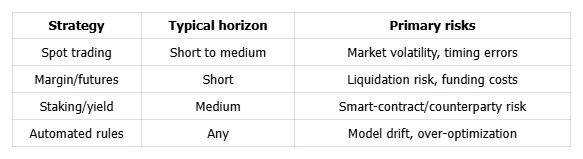
Common ways to put USDT to work:
- Spot trading: buy/sell assets against USDT; low complexity, high flexibility.
- Margin/futures: amplify exposure with leverage; higher risk, active monitoring required.
- Staking and yield products: some platforms and protocols pay rewards for providing liquidity or lending USDT (see best crypto staking platforms).
- Automated strategies: rules‑based bots can execute entries/exits consistently to reduce emotional trading mistakes (see automated trading rules for USDT).
At ToVest, you can start with spot markets, then graduate to rules‑based automations once you define risk limits and position sizing.
A quick view of strategies:
Managing Risks and Fees When Investing with USDT
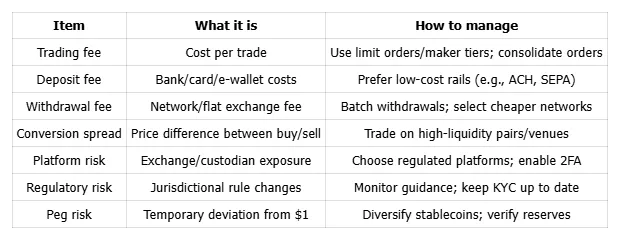
Key risks to consider:
- Counterparty/platform risk: security incidents or operational failures can impact access to funds.
- Regulatory changes: rules can affect availability, listings, and fiat ramps.
- Stablecoin peg risk: while designed for stability, USDT can see brief deviations from $1 during stress events; evaluate issuer transparency and reserve practices (see USDT safety and occasional peg deviations).
Common fees and how to manage them:
- Trading fees: maker/taker costs on each fill; VIP tiers or higher volumes often reduce them.
- Deposit/withdrawal fees: vary by payment rail and network conditions.
- Conversion fees/spreads: implicit costs in quoted prices; deeper liquidity reduces slippage.
- Note: total costs differ widely by exchange, payment method, and region; always review the fee page before transacting (fees vary by method and location).
Actionable risk management:
- Diversify across assets and, where appropriate, across platforms.
- Use reputable, regulated exchanges for significant holdings and verify security controls.
- Maintain a portion of funds in non‑custodial storage and stay current on market and regulatory updates (see ToVest Report for market/regulatory insights).
A compact comparison:
Frequently Asked Questions About Investing with USDT
What is USDT and why do investors use it?
USDT is a dollar‑pegged stablecoin that offers stability and liquidity, enabling investors to avoid crypto’s sharp price swings while moving value quickly between assets and platforms.
Is USDT safe and legal to use on major exchanges?
Yes—major regulated exchanges list USDT and apply KYC/AML standards that help protect investors, though you should always review platform security and regional regulations.
What payment methods can I use to purchase USDT?
Most platforms support bank transfers, credit/debit cards, e‑wallets, and swaps from other cryptocurrencies, which may depend on your location and limits.
How do I securely store and transfer USDT?
Use an exchange wallet for active trading and a hardware or other non‑custodial wallet for long‑term storage; transfers are made by sending to the recipient’s compatible wallet address.
Can I earn passive income through USDT investments?
Yes—staking, lending, liquidity pools, and automated yield products can generate returns, but always assess smart‑contract and counterparty risks before allocating.