How to Avoid Common Risks When Buying US Stock Tokens
24 ธันวาคม 2568
US stock tokens let you buy fractional, blockchain-based representations of shares with near-instant settlement and 24/7 access. In practice, that convenience comes with distinct legal, custody, and technology risks that differ from traditional brokerage shares. To avoid the most common pitfalls, start by verifying the token’s legal status, the custodian holding the underlying shares, and the quality of the smart contracts and data feeds. Then assess liquidity across venues and set clear operational safeguards. This guide distills a pragmatic, step-by-step process to get started with US stock token investing while minimizing exposure to the biggest risk factors.
Understanding US Stock Tokens and Their Risks
A US stock token is a blockchain-based digital representation of a share in a US-listed company, enabling fractional ownership and around-the-clock trading. Tokenization is the process of recording real-world assets on-chain; when applied to equities, it creates a form of tokenized securities within the broader category of real-world asset (RWA) tokenization. For a plain-English foundation on how tokenized stocks work and trade, see CoinGecko’s explainer on tokenized stocks (CoinGecko Learn).
Because tokenized equities straddle securities law, custody chains, and on-chain code, their risk profile differs from traditional brokerage shares. Bankrate notes that moving stocks onto blockchains introduces added layers of legal uncertainty, custody opacity, and technical vulnerabilities (Bankrate). TD Securities also highlights market fragmentation and the need for transparent verification of backing in tokenized equities (TD Securities Deep Dive).
Key US stock token risks at a glance:
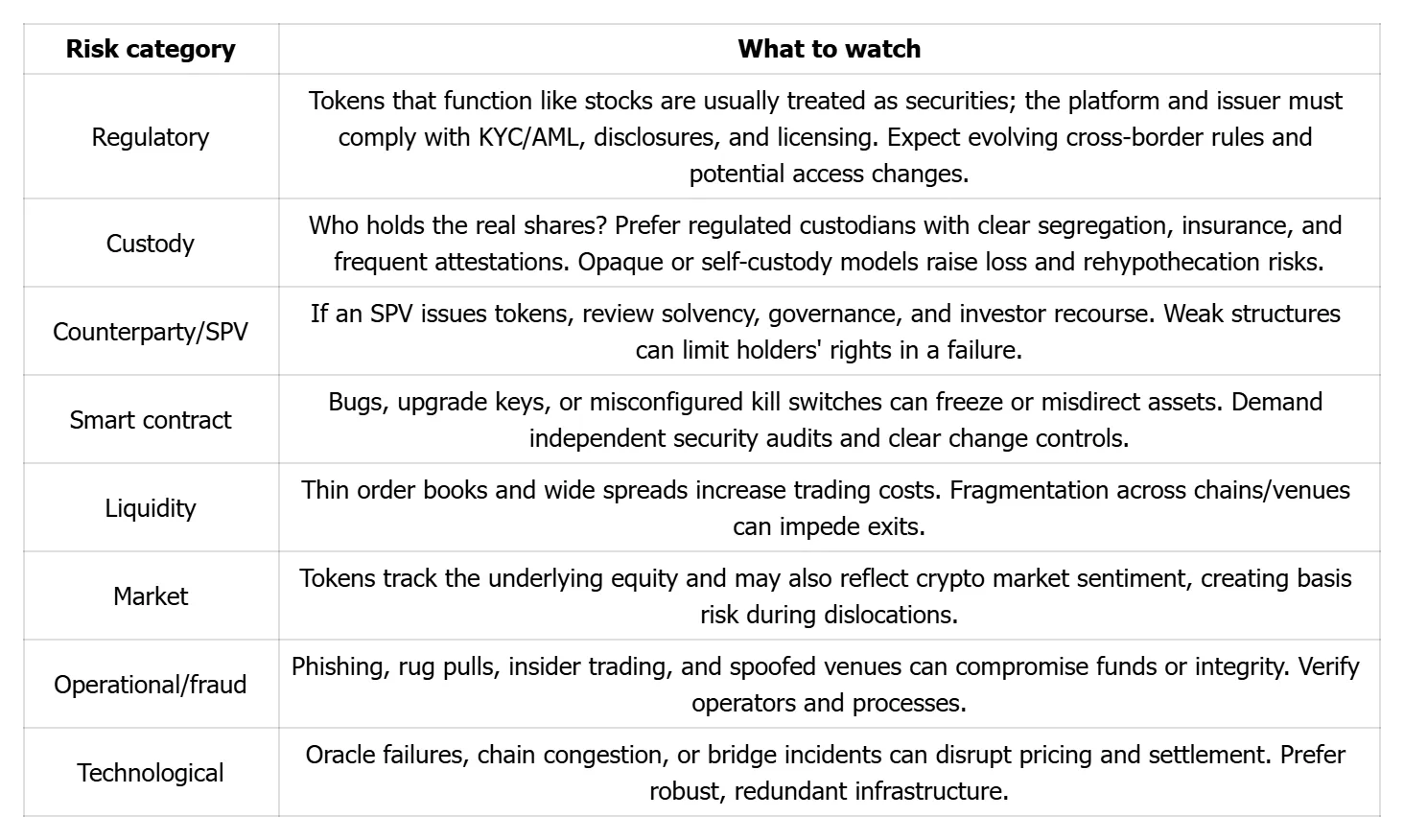
US stock token risks, tokenized securities nuances, and broader blockchain trading risks warrant methodical diligence before buying.
Step 1: Assess Legal and Regulatory Compliance
If a token behaves like a stock—offering profit expectation tied to an enterprise—it is likely a security under US law. That means issuer and platform obligations for disclosure, licensing, and investor protections apply. InnReg summarizes core compliance considerations for tokenized securities, including how distribution, custody, and transfers may trigger securities rules (InnReg).
Practical checks before investing:
- Jurisdictional legal review: Confirm tokens are offered lawfully where you reside and where the platform operates.
- KYC/AML obligations: Know Your Customer and Anti-Money Laundering programs require platforms to verify identities and monitor transactions to prevent illicit use. Ensure these controls are explicit and enforced.
- Cross-border impact: Understand how your residency affects access, disclosures, tax reporting, and transferability.
Compliance checklist:
- Issuer background: Corporate entity, officers, prior offerings, enforcement history.
- Regulator posture: Any oversight, registrations, exemptions, or legal opinions related to SEC/FINRA or equivalent foreign regulators.
- Disclosures: Clear terms on rights (voting, dividends), fees, redemption, and risks.
- Jurisdictional controls: Geo-fencing, investor eligibility, and sanctions screening in place.
Tip: Consult counsel experienced in tokenization for a regulatory impact scan before allocating capital.
Step 2: Verify Custody and Asset Backing
Custody in tokenization refers to the regulated entity that holds the real US shares underlying the token. Without verifiable, segregated custody, you may only have economic exposure without enforceable claims on the stock.
Common structures:
- SPV model: A special purpose vehicle holds the shares and issues token claims.
- ADR-style custodian: A regulated custodian safeguards the equities and supports token issuance/redemption.
- Transfer agent involvement: A registered agent records ownership and corporate actions.
What to demand:
- 1:1 backing evidence: Regular attestations or audits that reconcile token supply to shares held, ideally with public reporting and clear methodologies. TD Securities emphasizes transparent verification frameworks for tokenized equities (TD Securities Deep Dive).
- Regulated custodians: Named, licensed institutions with clear segregation and reconciliation practices.
- Insurance and controls: Proof of insurance, SOC reports, and detailed asset-control procedures. Avoid opaque or self-custody arrangements for underlying equities.
Step 3: Evaluate Special Purpose Vehicle and Counterparty Risks
An SPV is a legal entity created to hold the stock assets and issue token claims. Its structure dictates your rights and recourse. Buzko Legal’s guide to RWA tokenization underscores how poorly structured or offshore SPVs can compromise investor protections or complicate insolvency outcomes (Buzko Legal).
SPV due diligence essentials:
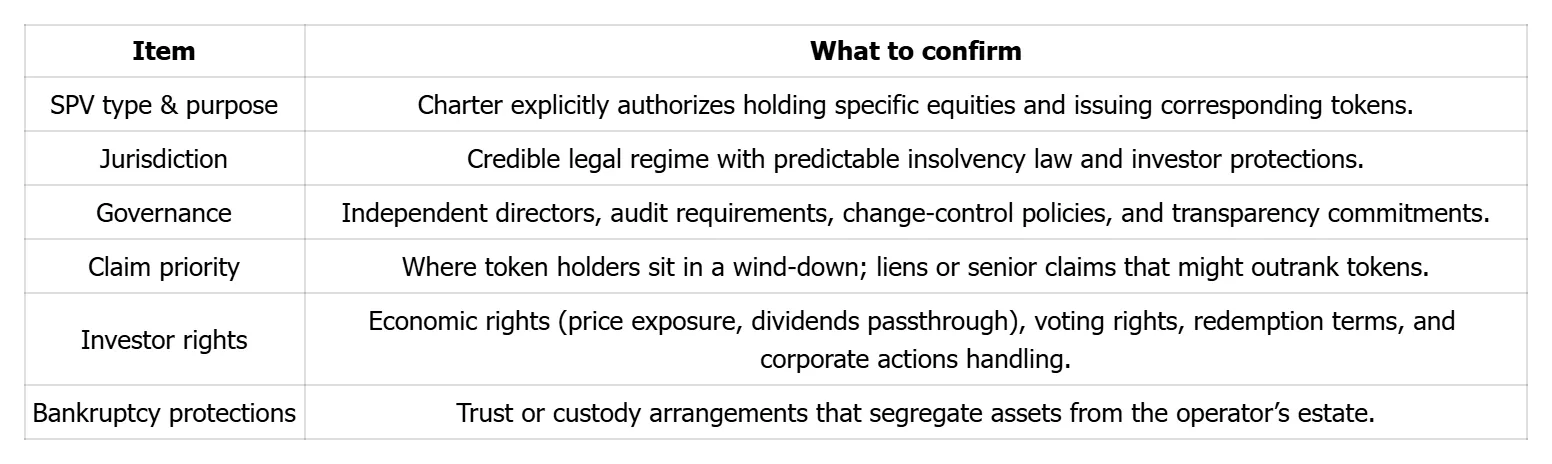
If disclosures leave gaps on any of the above, assume elevated counterparty risk.
Step 4: Review Smart Contract Security and Data Feeds
A smart contract is self-executing code on a blockchain that manages issuance, transfers, redemptions, and restrictions for the token. Because code governs your assets, security diligence is essential. Webisoft’s RWA tokenization guide details the importance of audited contracts, controlled upgrade paths, and reliable oracles for off-chain data (Webisoft).
What to check:
- Independent audits: Recent third-party audits with remediation notes and on-chain addresses matched to audit scope.
- Admin controls: Who can pause, upgrade, or blacklist? Multi-signature governance and documented procedures reduce unilateral risk.
- Oracles and market data: Source quality, redundancy, and fallback logic for price feeds and corporate actions.
- Monitoring: Set alerts for contract changes, unusual volumes, or price gaps using tools like TradingView or CoinMarketCap. Coin Bureau outlines practical alerting and risk monitoring approaches for crypto markets (Coin Bureau).
Step 5: Analyze Market Liquidity and Trading Venues
Liquidity is the ease of converting tokens to cash at a predictable price. In fragmented tokenized markets, activity can be split across chains and venues, widening bid-ask spreads and increasing slippage.
A quick liquidity checklist:
- Venue coverage: Where does the token trade? Centralized platform order books and on-chain DEX pools can differ significantly.
- Order book depth: Visible size near mid-price; watch for thin depth or large gaps.
- Historical activity: Realistic daily volumes, not wash trades. Scan for “zombie tokens” with sporadic prints.
- Execution tools: Limit orders, auction mechanisms, and smart order routing to reduce impact.
- Exit certainty: Redemption windows, withdrawal limits, and settlement guarantee.
On ToVest, we publish real-time order book depth and enable ultra-low-latency execution across a broad asset list to help clients manage tokenized equity liquidity effectively.
Step 6: Implement Operational Risk Management Strategies
Operational lapses—not market moves—cause many losses. Common threats include phishing (imposter sites harvesting credentials), rug pulls (teams abandoning projects or draining liquidity), insider trading around token events, and pump-and-dump schemes. Toku explains how insider trading risks extend to token markets and must be actively policed (Toku).
Practical protections:
- Platform hygiene: Use providers with strong KYC/AML, immutable trade records, and surveillance for insider activity.
- Access control: Hardware security keys or app-based 2FA, role-based permissions for institutions, and withdrawal whitelists.
- Process discipline: Pre-trade checklists, documented investment theses, and size limits per asset.
- Independent reviews: Read audits, attestations, and financial statements; verify contract addresses and custodians.
- Continuous monitoring: Price, liquidity, and on-chain alerts for anomalies; rehearse incident responses. Coin Bureau’s guidance on risk frameworks and alerts is a helpful starting point (Coin Bureau).
At ToVest, we combine regulated custody and transparent disclosures with circuit breakers, surveillance, and audit trails designed for institutional-grade controls.
Frequently Asked Questions
What rights do I actually have with tokenized stocks?
With most tokenized stocks, you generally receive only economic exposure and may not have voting rights or direct dividend access. Always read the terms to confirm your specific rights.
How can I verify a token is truly backed 1:1 by underlying shares?
Check for a regulated custodian, regular third-party attestations reconciling token supply to shares held, and clear disclosures of the custody structure and insurance.
What security risks should I be aware of when trading stock tokens?
Key risks include smart contract bugs, weak admin controls, oracle failures, and custodial risk from the entity holding the real shares.
How does liquidity affect my ability to buy or sell tokenized stocks?
Low liquidity and wide spreads raise trading costs and slippage, making it more difficult to enter or exit positions at fair prices.
What impact does regulatory uncertainty have on my investment?
Rules can change access, rights, and enforceability, so sudden restrictions or new obligations may influence your ability to trade or redeem.