Unlock Seamless Global Investing Using the Best Tokenized Stock Platforms
26 ธันวาคม 2568
Global investors are searching for the best tokenized stock platform with global access—one that removes borders, lowers minimums, and offers 24/7 markets. The short answer: look for platforms that combine fractional ownership, strong compliance, and low-latency, always-on execution across tokenized global equities and other digital assets. In this guide, we explain how tokenized stocks work, what features matter, and which platforms stand out for global reach. We also outline the real risks and show where the market is heading—so you can choose a platform that’s fast, secure, and built for the future.
Article Overview
Tokenized stock platforms turn traditional equities into blockchain-based instruments, enabling cross-border access, instant or near-real-time settlement, and fractional participation without the frictions of legacy systems. ToVest’s approach emphasizes 24/7 trading, portfolio transparency, and seamless ecosystem integration across tokenized US stocks and real estate, supported by robust security and low-latency execution. Compared with conventional brokers, these platforms enable always-on access and programmable compliance, helping both retail and institutional investors participate in global markets more efficiently.
Understanding Tokenized Stocks and Global Investing
Tokenized stocks are digital tokens on a blockchain that represent economic exposure or ownership in traditional equities, enabling round-the-clock, fractional, and cross-border trades that lower access barriers for global investors. This is part of real-world asset (RWA) tokenization, where financial assets are issued and managed on-chain to improve speed, transparency, and accessibility for blockchain investing and exposure to digital assets. Industry analyses describe tokenization as a practical path to broader market access with operational efficiency gains and automated processes for issuers and investors alike, especially as RWA tokenization expands across asset classes Asset tokenization trends.
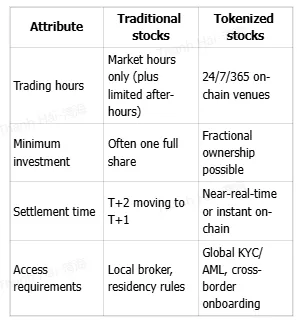
Compared with traditional stock accounts, tokenized access can reduce minimums, expand trading hours to 24/7, and compress settlement times from days to near-real-time. Industry momentum is building: between 2025 and 2030, major institutions are signaling plans to scale tokenized markets and infrastructure, using smart contracts to streamline issuance, settlement, and lifecycle operations Use cases and emerging trends.
Key differences at a glance:
How Tokenized Stock Platforms Enable Seamless Global Access
Seamless global access means tokenized shares enable round-the-clock trading, fractional entry, and cross-border investment without legacy settlement bottlenecks Asset tokenization trends. Under the hood, smart contracts automate transfers, corporate actions, and payouts, while programmable compliance can restrict or allow transfers based on jurisdiction, identity, or accreditation status. These tools reduce intermediaries and streamline operations, a key reason institutions are piloting tokenized workflows at scale Use cases and emerging trends.
Cross-border platforms typically handle:
- Identity and compliance: KYC/AML checks, sanctions screening, and jurisdictional gating.
- Currency and payments: fiat on-ramps, stablecoins, and multi-currency quotes.
- Ownership verification: on-chain records, investor whitelists, and audit trails.
A typical lifecycle:
- Onboarding/KYC: Verify identity and eligibility; enable wallets and funding.
- Asset tokenization: Wrap equity exposure into compliant tokens with rules embedded on-chain.
- Trading: Place orders 24/7; execute with transparent pricing and low latency.
- Custody: Secure tokens via institutional-grade custodial solutions and cold storage.
- Withdrawal/Redemption: Move tokens to self-custody or redeem according to platform rules.
To mitigate liquidity fragmentation across chains, leading venues explore interoperability and cross-chain bridges—such as LayerZero, Wormhole, or Axelar—to route orders and enable DeFi composability for tokenized assets Use cases and emerging trends.
Key Features to Look for in Tokenized Stock Platforms
The best tokenized stock platforms with global access share a core set of capabilities:
- 24/7 trading and instant execution: Low-latency matching and resilient uptime.
- Fractional ownership: Tokens allow investors to acquire small shares of assets such as prime real estate or US stocks Tokenization opportunities and challenges.
- Security protocols: 2FA, hardware key support, cold storage, audited smart contracts.
- Transparent pricing and portfolio transparency: Clear fees, real-time NAV/pricing, verifiable on-chain records.
- Compliance by design: Robust KYC/AML, jurisdictional controls, and clear disclosures.
- Custodial solutions: Options for institutional custody or self-custody, with recovery procedures.
- Advanced trading: Margin/leverage options, conditional orders, API access.
- DeFi composability: Token standards and interoperability that facilitate lending, collateralization, or cross-venue settlement.
User-friendly tokenization platforms will expand participation from retail investors to institutions as interfaces de-risk the complexity of blockchain-based investing Tokenization opportunities and challenges.
Leading Tokenized Stock Platforms with Global Reach
Below is a concise look at platforms and initiatives that exemplify global access, 24/7 availability, and strong security/compliance. Availability varies by jurisdiction; always review local regulations and platform terms.
Real-world example: a collaboration introduced xStocks on Solana with more than 60 U.S. stocks and ETFs, showcasing on-chain issuance, fast settlement, and broad asset coverage Tokenized stocks in 2025.
Challenges and Risks in Tokenized Stock Investing
Tokenized products occupy a legally murky space and may face scrutiny under U.S. securities laws, with frameworks still evolving across regions Debate on tokenized stocks. Investors should weigh:
- Regulatory uncertainty and legal ambiguity: direct ownership vs. economic exposure; disclosure quality.
- Liquidity risks: Limited secondary market activity can trap capital in tokenized assets without reliable trading venues Asset tokenization trends.
- Custody complexity: Key management, wallet security, and recovery.
- Smart contract and technology risk: Code exploits, oracle risk, downtime.
- Cross-chain fragmentation: Liquidity split across networks; bridging risk.
- Market volatility: Wider spreads and slippage in thinly traded tokens.
Emerging mitigations include decentralized identity (DID) and verifiable credentials for privacy-preserving, compliant onboarding, plus standards that improve interoperability and institutional-grade custody Use cases and emerging trends.
The Future of Global Investing with Tokenized Stocks
The next cycle will be defined by institutional pilots moving to production, stronger custody controls, and interoperable rails that connect tokenized assets to DeFi and traditional venues alike Next-gen markets. Asset managers and banks are actively exploring tokenized workflows, citing potential for efficiency, transparency, and new distribution channels Digital assets outlook. DeFi interoperability with tokenized assets is an emerging trend reshaping trading, lending, and borrowing Tokenization opportunities and challenges.
What to expect by 2030:
- DID-based onboarding and portable compliance.
- Near-real-time settlement and programmable corporate actions.
- Expanded asset menus: equities, real estate, funds, and collectibles.
- Clearer legal recognition of tokenized instruments and transferability across chains Use cases and emerging trends.
ToVest will continue investing in accessibility, innovation, and security to help global investors participate confidently in tokenized markets—24/7 and without borders.
Frequently Asked Questions about Tokenized Stock Platforms
What are tokenized stock platforms and how do they work?
Tokenized stock platforms use blockchain to represent stocks as digital tokens, enabling 24/7 trading, fractional ownership, and fast settlement through smart contracts.
What benefits do tokenized stocks offer for global investors?
They provide round-the-clock access, lower entry minimums via fractional ownership, and borderless settlement on secure blockchain infrastructure.
How does fractional ownership function on these platforms?
Investors can buy small portions of a stock or asset, making high-value markets like U.S. equities or real estate accessible with modest capital.
What risks should investors be aware of with tokenized stocks?
Key risks include regulatory uncertainty, varying legal protections, technology vulnerabilities, and limited liquidity in some cases.
How do tokenized stock platforms ensure regulatory compliance?
Platforms implement KYC/AML checks, jurisdictional controls, and increasingly decentralized identity tools to verify users and align with global regulations.