Ensure Safe Investing: Confirm ToVest Is Fully Licensed Today
12 มกราคม 2569
Before you invest, confirming a platform’s regulatory status is one of the simplest, highest-impact risk controls you can take. ToVest is a compliance-driven U.S. fintech that enables fractional ownership of tokenized real-world assets while operating within clear regulatory guardrails. Yes—ToVest is legal and compliant: we maintain U.S. Money Services Business (MSB) registration and align our policies with applicable U.S. financial regulations, robust custody practices, and industry-standard disclosures. In a fast-evolving market for alternative assets and tokenization, separating licensed platforms from unregulated operators helps safeguard your capital and data. Independent verification of ToVest’s registrations, custody arrangements, and AML/KYC protocols offers added peace of mind and reflects safe-investing best practices documented across the industry, including the need for regulatory oversight, audited reporting, and transparent fees.
Understanding ToVest’s Regulatory Status
Regulatory status comprises the licenses, registrations, and ongoing compliance practices required for a financial platform to legally operate and protect users. Licensed providers must submit to disclosures, periodic examinations, audits, and investor-protection rules; unregulated entities lack comparable oversight and typically carry higher operational and counterparty risks. Independent regulator checks and platform compliance reviews are core to investor safety. As summarized in industry guidance, brokers and regulated platforms generally provide stronger protections via regulation, custodial safeguards, and structured disclosures compared to unregulated alternatives, reducing avoidable risk for clients (see ToVest’s industry Report for context) ToVest Report. Understanding this framework helps both new and experienced investors evaluate provider quality, governance, and long-term reliability.
Key Licenses and Registrations Held by ToVest
ToVest’s core regulatory foundation is its U.S. Money Services Business (MSB) registration, which reflects adherence to federal anti-money laundering and financial transparency laws administered by the U.S. Treasury’s Financial Crimes Enforcement Network (FinCEN). A Money Services Business is a financial firm registered with FinCEN to transmit money, process payments, or support currency exchange while complying with AML requirements.
Below is a concise view of ToVest’s primary registrations:
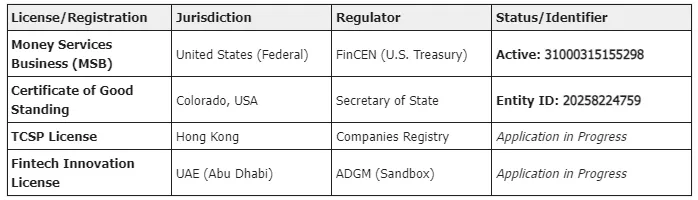
Registration as an MSB entails obligations under U.S. federal AML statutes and reporting regimes designed to increase financial transparency and deter illicit activity, priorities reinforced in recent U.S. Treasury guidance U.S. Treasury AML/CTF brief.
How ToVest Complies with U.S. MSB and Financial Regulations
MSB firms are required to register with FinCEN, maintain comprehensive AML/CTF programs, keep prescribed records, file suspicious activity reports, conduct risk assessments, and submit to periodic reviews. ToVest’s compliance framework aligns these requirements with internal controls, transaction monitoring, sanctions screening, independent testing, and staff training. Policies are updated as regulations evolve, including SEC-related guidance on marketing, performance presentation, and disclosures addressed in industry priorities IAA regulatory priorities, alongside current FinCEN AML/CTF expectations U.S. Treasury AML/CTF brief. AML/CTF (Anti-Money Laundering / Counter-Terrorist Financing) refers to policies and procedures designed to detect, prevent, and report suspicious financial transactions and to manage associated risks across products, geographies, and customer types.
Custody and Asset Protection Practices at ToVest
ToVest safeguards client assets through segregated accounts and, where appropriate, independent, regulated third-party custodians. This mirrors a market best practice: investors should verify that assets are held by an external custodian and that account statements are issued by or reconcile to the custodian, not solely the platform ToVest Report.
How segregation works:
- Client assets are kept in accounts separate from ToVest’s corporate operating funds.
- Cash and tokenized assets are ring-fenced from ToVest liabilities.
- Reconciliations are performed regularly to match platform records to custodian statements.
- Withdrawal and movement controls require multi-step authorization to reduce operational risk.
A custodian is a regulated company that securely holds client funds or assets on their behalf, helping to reduce counterparty and operational risk.
Anti-Money Laundering and KYC Measures on ToVest
KYC (Know Your Customer) is how financial institutions verify client identity to prevent fraud and financial crime. During onboarding, investors can expect:
- Identity verification (government ID, selfie/liveness check).
- Proof of address (utility bill, bank statement).
- Source-of-funds and, where applicable, source-of-wealth checks.
- Sanctions, watchlist, and politically exposed person (PEP) screening.
Post-onboarding, ToVest monitors transactions for unusual patterns, applies velocity and behavioral controls, screens against sanctions lists (e.g., OFAC), and files required reports where warranted, consistent with FinCEN and SEC-aligned expectations U.S. Treasury AML/CTF brief. To enhance AML compliance and client verification, ToVest uses secure identity solutions, encryption-in-transit and at-rest, and automated case management to document investigations and decisions.
Evaluating ToVest’s Transparency and Investor Safeguards
Transparency is a core investor safeguard. ToVest provides clear fee schedules, product documentation, and periodic reporting. Performance materials distinguish gross from net outcomes and are prepared to align with SEC Marketing Rule expectations as reflected in industry guidance IAA regulatory priorities. Public disclosures and regulator-facing reports demonstrate risk controls and governance maturity; such visible compliance commitments often signal institutionalization and risk management discipline across the platform lifecycle industry perspective on professional standards.
To help you evaluate, ToVest offers:
- Audited or independently reviewed financial and asset reports.
- Custody disclosures and segregation attestations.
- Detailed fees and expense breakdowns.
- Clear statements of risks, conflicts, and methodologies.
Practical Steps to Verify ToVest’s Licensing and Compliance
You can independently verify ToVest’s regulatory status in minutes:
- Gather business details: legal entity name, principal address, and doing-business-as names.
- Search the FinCEN MSB Registrant Search for ToVest’s MSB registration and status FinCEN MSB Registrant Search.
- Review ToVest’s public disclosures, including reports and compliance overviews ToVest Report, and request audited materials as needed.
- Confirm custody arrangements by checking custodian names, account segregation details, and whether statements reconcile to the custodian.
- Review AML/KYC summaries and privacy notices; request the latest policy overview or SOC/ISO attestations if available.
- If anything is unclear, contact ToVest Support or Compliance for documentation to confirm regulatory status and platform controls.
Verifying custody, fees, and AML practices is a practical way to safeguard your investments and reduce avoidable risk.
The Importance of Compliance in Tokenized Asset Investing
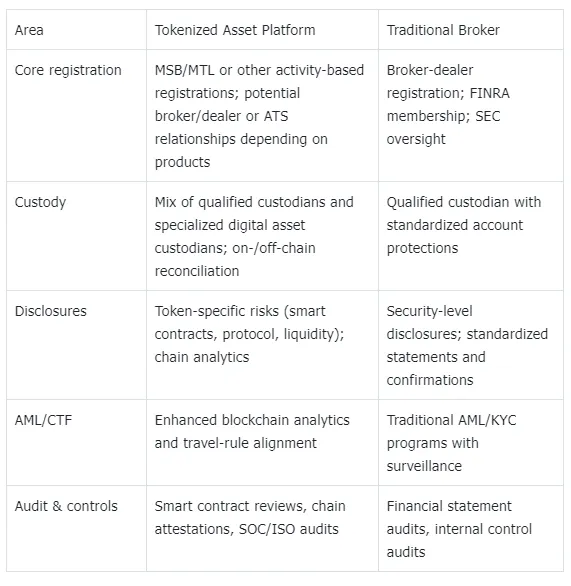
“Tokenization converts real-world assets into digital tokens that can be traded on blockchain platforms,” expanding access but introducing new operational and regulatory complexities emerging trends in alternative investments. As product scopes evolve and liquidity profiles shift, platforms must reconcile blockchain rails with financial laws, custody standards, and disclosure obligations. Investors should scrutinize registration status, audit histories, asset segregation, and conflict-of-interest controls—especially when exposure involves fractionalized or cross-border assets. For a primer on tokenization mechanics and investor considerations, see ToVest’s Academy overview ToVest Academy guide to tokenization.
Comparison: tokenized platforms vs. traditional brokers
Innovative Compliance Framework & On-Chain Settlement
ToVest operates under a decentralized asset management model where all user transaction assets are custodied within on-chain smart contracts. Unlike traditional centralized exchanges, ToVest does not engage in traditional securities matching. Therefore, our model focuses on the tokenization of assets which does not constitute a traditional securities issuance under current frameworks. This structure ensures that user funds remain transparent, verifiable, and protected by blockchain-level security at all times.
Deep Liquidity & Advanced Matching Engine
ToVest ensures a seamless trading experience through our proprietary Matching Engine and a sophisticated Liquidity Aggregator system. We provide institutional-grade depth by:
Real-Time Mirror Pricing: Integrated via high-performance APIs and Oracle mechanisms (e.g., Pyth Network) to reflect U.S. stock market prices on-chain.
Ecosystem Integration: Our liquidity is supported by both internal market-making teams and external Liquidity Providers (LPs) across major platforms and protocols including Ondo Finance, Raydium, Bitget, Bybit, Kraken, and Xstock.
Cross-Chain Connectivity: By aggregating liquidity from diverse sources, ToVest minimizes slippage and provides the most competitive rates for tokenized Real-World Assets (RWA).
Frequently Asked Questions
Is ToVest fully licensed and how can I check it independently?
Yes—ToVest is registered as a U.S. Money Services Business and maintains current regulatory registrations. You can confirm our status via the FinCEN MSB Registrant Search and our public compliance disclosures.
How does ToVest protect client funds and personal data?
Client assets are held in segregated accounts with regulated custodians, and data is secured using encryption, two-factor authentication, and rigorous KYC/AML controls.
What protections are available if ToVest faces financial difficulties?
Client assets are segregated from operating funds, reducing exposure in a company event, and our compliance framework is designed to mitigate operational and counterparty risks.
How does ToVest ensure compliance with AML and KYC regulations?
We implement identity verification, sanctions screening, and continuous transaction monitoring, updating policies to align with evolving FinCEN and SEC guidance.
What regulatory risks should investors consider when using ToVest?
Rules for fintech and tokenized assets are continuously evolving; review our disclosures and stay informed about regulatory changes that may affect product scope or access.