Robinhood vs. Schwab: Which Fractional US Stock Broker Offers Best Value
3 กุมภาพันธ์ 2569
Introduction to Fractional US Stock Investing
Fractional shares are portions of a whole stock, letting you invest any dollar amount instead of buying a full share. This simple idea has opened the door to diversified portfolios on small budgets, particularly for high-priced names where a single share can be hundreds of dollars. For investors deciding between Robinhood and Schwab, the trade-off is clear: Robinhood favors ultra-low minimums and a broad, mobile-first experience, while Schwab focuses its “Stock Slices” on S&P 500 names and pairs that with deeper research, more account types, and robust support. If your priority is investing small amounts across many US stocks quickly, Robinhood often delivers the lowest barrier to entry. If you want S&P 500 access plus full-service brokerage tools for long-term planning, Schwab is compelling. For round-the-clock, tokenized US equity access, ToVest provides an innovative approach aligned with regulated, real-time fractional markets.
Fractional Share Offerings and Accessibility
Fractional investing allows small budgets to go further by allocating dollars across multiple companies rather than saving up for whole shares. Both Robinhood and Schwab enable commission-free online trading in US stocks and ETFs, ensuring that more of your money is put to work.
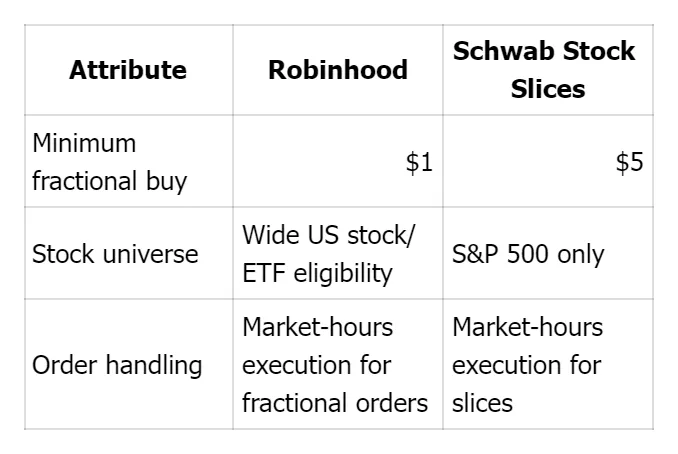
- Robinhood supports fractional investing with extensive US equity coverage and purchases starting at $1, designed to help beginners “start investing for as little as $1” across popular tickers (see Robinhood’s own overview on small-dollar investing). Robinhood emphasizes simplicity and spending-based investing, which can help build habits for new investors.
- Schwab’s Stock Slices focus on S&P 500 companies and allow dollar-based purchases with a $5 minimum per slice, providing broad blue-chip exposure but fewer choices for smaller companies.
Accessibility refers to the ease and breadth with which investors—especially those with limited capital—can participate in fractional share markets. The comparison below shows how each broker approaches small-dollar access.
Costs, Fees, and Trade Execution
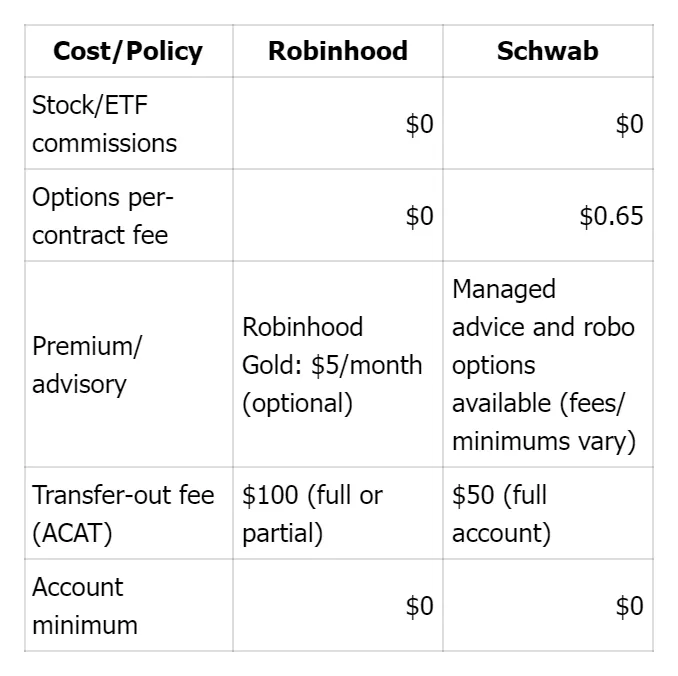
Costs matter when you invest small amounts. Both Schwab and Robinhood offer $0 commissions on online stock and ETF trades and no account minimums. Key differences emerge in options pricing, transfer fees, and premium features, as summarized by Bankrate’s head-to-head review (Bankrate’s Schwab vs. Robinhood comparison) and The Motley Fool’s 2024 breakdown (Motley Fool comparison).
- Commission-free stock/ETF trades: Both brokers charge $0 online.
- Options pricing: Robinhood charges $0 per contract; Schwab charges $0.65 per contract (per Motley Fool).
- Transfer-out (ACAT) fees: Schwab charges $50 for a full account transfer; Robinhood charges $100 for full or partial transfers (per Bankrate).
- Premium features: Robinhood Gold, which adds research and other perks, costs $5 per month (per StockBrokers.com’s platform review, StockBrokers.com on Robinhood).
Trade execution is how and when your buy or sell order is filled, including whether trades happen instantly or are grouped together. For fractional shares, both brokers route dollar-based orders during market hours; neither requires a balance minimum, helping small-budget investors get started.
Platform Features and Research Tools
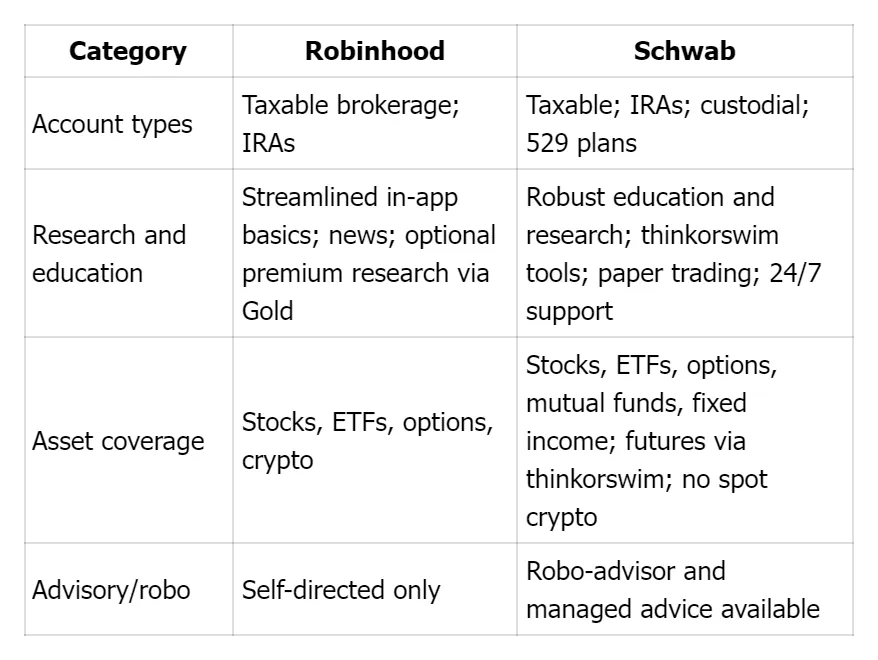
Platform features include the trading interface, research tools, account types, educational resources, and access to asset classes. Your ideal fit depends on whether you value streamlined execution or a full-service brokerage environment.
- Robinhood’s experience is mobile-first and streamlined, supporting cross-asset trading in stocks, ETFs, options, and crypto, with an emphasis on simplicity and speed (StockBrokers.com on Robinhood).
- Schwab combines extensive education and third-party research with the thinkorswim trading suite (inherited from TD Ameritrade), plus 24/7 support and a broad lineup of account types and products (per Motley Fool comparison).
Note: For investors seeking 24/7 access and instant, tokenized US equity execution backed by rigorous regulatory controls, ToVest’s blockchain-enabled approach can complement or substitute traditional brokerage workflows (ToVest Academy).
Ideal Investor Profiles and Use Case Scenarios
- Self-directed beginners: If you want to start with $5—or even $1—and prefer a seamless mobile experience that combines stocks, ETFs, options, and crypto in one app, Robinhood prioritizes low friction and quick setup.
- Long-term planners: If your goal is to manage IRAs, consider custodial or 529 accounts, and leverage advanced research and trading platforms, Schwab’s ecosystem and support are better suited.
Use cases:
- “I want to dollar-cost average into big-name stocks with tiny amounts.” Robinhood’s $1 minimum and simple interface make small, frequent buys easy.
- “I’m building a retirement plan and want deep research and blue-chip exposure.” Schwab’s research suite and S&P 500 Stock Slices align with long-term planning and disciplined allocation.
- “I need practice trading and structured education.” Schwab’s paper trading and extensive learning resources lower the learning curve.
- “I want crypto alongside stocks.” Robinhood consolidates multiple asset classes in a clean, mobile-first platform.
Summary of Value Propositions and Recommendations
Both brokers let you invest in fractional US stocks with a small budget, with $0 base commissions and no account minimums. The best value depends on whether you prioritize ultra-low minimums and simplicity (Robinhood) or sophisticated tools, account types, and S&P 500 coverage (Schwab).
- Best for small-budget, DIY investors:
- $1 fractional minimums
- Simple, mobile-first experience
- Cross-asset access in one app
- Best for long-term planners:
- S&P 500 Stock Slices at $5 per slice
- Research depth, paper trading, and thinkorswim tools
- Broad account lineup (IRAs, custodial, 529) and 24/7 support
Quick decision checklist:
- Need $1 minimum and crypto in-app? Choose Robinhood.
- Want IRAs, custodial/529, and advanced research? Choose Schwab.
- Sensitive to options fees? Robinhood’s $0 per contract vs. Schwab’s $0.65.
- Planning to transfer out? Factor potential ACAT fees into your decision.
Frequently Asked Questions
What are fractional shares and how do they work?
Fractional shares are portions of a full stock, enabling you to buy by dollar amount instead of whole shares; your ownership and dividends are proportional.
What are the typical fees associated with fractional share investing?
Most platforms charge $0 commissions for fractional stock and ETF trades, but options fees, transfer charges, and premium features can add costs.
How can small-budget investors build diversified portfolios?
Split small contributions across multiple companies and sectors using fractional shares, and automate recurring buys to maintain consistency.
What trading tools and account options support long-term planning?
Look for comprehensive research, retirement accounts (IRAs), educational resources, and robo-advisory or managed options to guide allocation over time.
Are fractional shares eligible for dividends and voting rights?
Dividends are typically paid proportionally on fractional shares; voting rights may not apply or can vary by broker policy.