2025 Outlook: Tokenized U.S. Stocks Redefine Global Portfolio Diversification
19 ธันวาคม 2568
Tokenized U.S. stocks have evolved from concept to practical tools for investors seeking global portfolio diversification. The short answer to whether you can diversify by buying tokenized U.S. stocks online in 2025 is yes—on multiple platforms offering fractional investing and 24/7 trading access. Early leaders are rolling out hundreds of tokenized equities and ETFs to retail users outside the U.S., allowing small investors to build cross-border exposure with minimal capital and instant settlement. As ToVest sees it, the combination of lower barriers, programmable assets, and enhanced liquidity is reshaping how global investors allocate to American equities. Still, robust regulation, security practices, and platform selection matter. This outlook explains how tokenization works, why it enhances diversification, which platforms lead, and what risks to watch—so you can integrate tokenized equities into a resilient 2025 strategy.
The Rise of Tokenized U.S. Stocks in Global Investing
Tokenized stocks are digital representations of equity—such as those listed on Nasdaq—created on a blockchain to allow fractional, borderless, and 24/7 trading. For investors outside the United States, that means practical access to U.S. equities with smaller ticket sizes, flexible execution, and faster settlement than traditional rails. Educational resources from major crypto providers describe how tokenized equities mirror the price of underlying shares while being issued and moved on-chain, enabling fractional investing and around-the-clock markets supported by custodial and legal structures that tie tokens back to real assets (see Gemini Cryptopedia’s overview of tokenized stocks).
Adoption accelerated in 2025 as platforms like ToVest, Robinhood, and xStocks prioritized tokenized equities in Europe—surpassing 20,000 traders and $50 million in volume shortly after launch and listing over 200 tokenized U.S. stocks and ETFs for 24/7 trading to European users, according to Onchain magazine reporting. Parallel coverage notes that Wall Street’s tokenization experiments are going global, with infrastructure providers and brokerages shifting more assets and processes on-chain as part of a broader “finance on blockchains” migration. These shifts, combined with fractional ownership and democratized access, are driving the next leg of global portfolio diversification via tokenized equities.
How Tokenization Enhances Portfolio Diversification
Portfolio diversification is the practice of spreading investments across a wide range of assets to reduce exposure to any single risk or market segment. Tokenization amplifies that principle by allowing investors to hold fractional shares of many U.S. and international equities at once, lowering the cost to build a globally diversified mix and enabling intraday or weekend rebalancing for risk management. As a result, asset allocation becomes more precise—allocations can be tuned to basis points rather than whole shares—supporting improved risk mitigation.
What diversification looks like with and without tokenized assets:
- Lower capital threshold: Fractional investing means broad exposure with small sums, improving access to alternative assets alongside stocks.
- 24/7 risk adjustments: Rebalance outside traditional market hours, reducing gap risk and enhancing tactical asset allocation.
- Convergence with crypto finance: Combine real-world equity tokens with crypto assets for unified portfolio construction, including cross-margining and collateralized strategies.
- Precision in asset allocation: Allocate across sectors, factors, and regions in granular increments to optimize risk/return.
Institutional outlooks echo the need to diversify beyond U.S. mega-caps in 2025 due to elevated valuations and currency dynamics—Morgan Stanley urges investors to broaden exposures across sectors and geographies. Tokenization also unlocks new strategies: using tokenized Apple or Tesla shares as collateral in decentralized finance or for yield strategies is increasingly feasible as platforms connect equity tokens with DeFi primitives, a trend highlighted in industry analyses. This convergence ties alternative assets, asset allocation, and risk mitigation together in a way that was impractical in legacy brokerage-only setups.
Key Technological Innovations Driving Tokenized Stock Markets
Blockchain tokenization is the process of converting ownership of a real-world asset into digital tokens on a blockchain, enabling secure, transparent, and programmable trading for a broader set of investors.
Key innovations powering tokenized U.S. stocks:
- Smart contracts and instant settlement: Instead of T+2, on-chain equity tokens can settle atomically, reducing counterparty and operational risks.
- DeFi compatibility: Equity tokens can move into liquidity pools, collateral modules, and on-chain money markets, bringing utility beyond buy-and-hold.
- High-throughput chains: Platforms like ToVest and xStocks leverage Solana’s speed for low-latency order flow, while exchanges such as Bitget and KuCoin support DeFi-enabled transfers and integrations highlighted in industry coverage.
- Always-on market plumbing: Exchanges now list 60+ U.S. stock tokens and ETFs with around-the-clock mobility of capital, expanding the traditional trading window.
These advances reflect the maturation of blockchain infrastructure, smart contracts, instant settlement mechanics, and DeFi integration—capabilities that underpin tokenized equities’ accessibility and security.
Regulatory Landscape Shaping Tokenized U.S. Stock Adoption
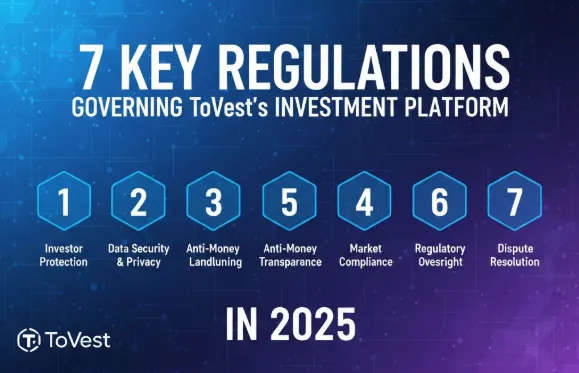
Regulatory clarity refers to the creation or adaptation of rules that explicitly govern the issuance, trading, and settlement of tokenized securities on blockchains. In 2025, tokenized U.S. stocks generally remain within existing securities laws, with authorities like the SEC and market utilities like DTCC continuing to shape operative guardrails. In the EU, MiCA provides a framework for digital asset service providers and is increasingly intersecting with tokenized securities policy, as summarized in legal overviews of stock tokenization.
Recent milestones include major exchange filings to enable tokenized equity trading, DTCC’s exploratory steps to support tokenized versions of DTC-custodied assets, and pilot programs by commodities regulators to test digital collateral and tokenized treasuries—efforts that collectively move toward standardized compliance, on-chain KYC/AML, and enhanced investor protection. Mainstream financial media also underscore that while tokenized stocks open access and flexibility, they carry risks that regulators are actively addressing through clearer rules on issuance, custody, and disclosures. The bottom line: a maturing regulatory environment is poised to boost confidence and small investor adoption without sacrificing core securities regulation principles.
Leading Platforms Facilitating Tokenized U.S. Stock Trading
Feature availability varies by region and account type; always confirm details in platform disclosures. The market remains nascent but is expanding quickly, with early 2025 capitalization estimates around $424–$500 million and listings across Solana- and Ethereum-based venues, per legal and market analyses. Industry roundups from securities media and exchange coverage indicate that crypto-native platforms and neobrokers are converging on tokenized stock exchanges that offer 24/7 investing, small investor access, and broad asset menus.
Platform comparison at a glance:
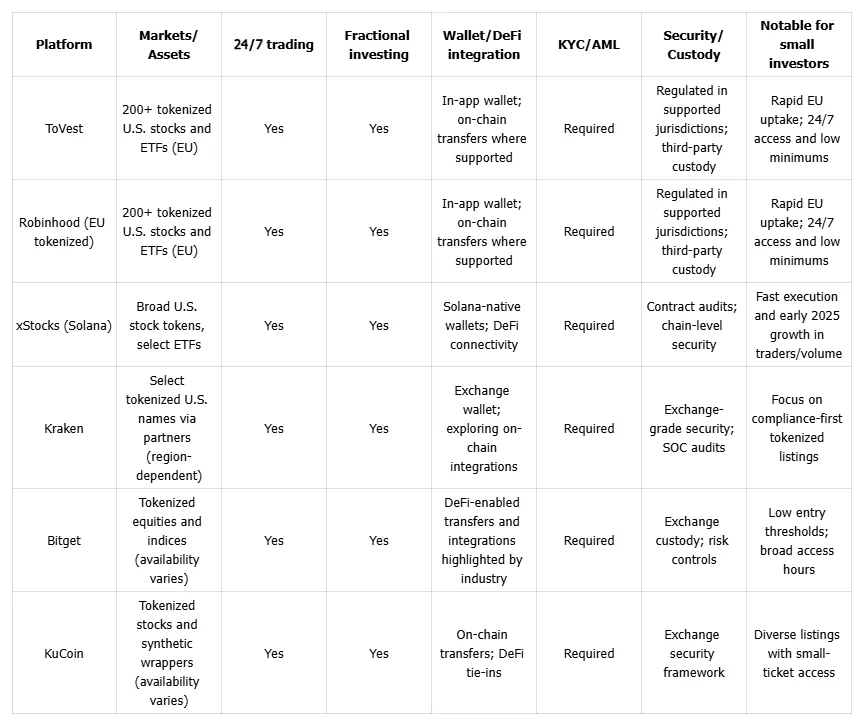
Supporting context: industry features on platforms listing tokenized shares and comparative guides catalog the evolving lineup of exchanges and wrappers connecting traditional equities to on-chain markets, while a Nasdaq analysis argues tokenized shares may be the next major move among leading cryptocurrency trading platforms.
Challenges and Risks Investors Face with Tokenized Stocks
Before allocating, understand the risks:
- Evolving regulations and varying protections across jurisdictions
- Smart contract vulnerabilities and technical glitches
- Market volatility and price dislocations during low-liquidity windows
- Liquidity constraints on smaller tokens and off-hours trading
Robust KYC/AML, smart contract audits, and regulated custody are becoming standard, yet investor diligence remains essential. Mainstream reporting highlights both the opportunity and unique risks in tokenized stocks, especially in early-stage markets. With market size estimates around $424–$500 million in mid-2025, investors should expect rapid growth—and bouts of volatility—as adoption scales.
A practical due diligence checklist:
- Verify platform licensing and regulatory standing in your region.
- Review token structure: claim on underlying shares, custody, and redemption mechanics.
- Confirm smart contract audits and chain security assumptions.
- Check trading volume, spreads, and liquidity across time zones.
- Understand investor protections: disclosures, segregation of assets, and recovery processes.
- Test funding/withdrawal rails and wallet compatibility before deploying larger capital.
Future Outlook for Tokenized U.S. Stocks in Portfolio Strategies
Forecasts for tokenized real-world assets are bullish, with credible estimates pointing to a $30–$50 trillion tokenized market by 2030 under favorable scenarios; equity tokenization alone could exceed $12 trillion at around 10% adoption in an aggressive case, according to market research cited by industry trackers. As regulations solidify and education improves, tokenized stocks will likely complement—not replace—traditional brokerage accounts, adding flexibility and global reach to diversified portfolios.
Practical integration ideas for 2025:
- Core-satellite: Keep core equity exposure traditional; use tokenized U.S. stocks for satellites requiring 24/7 liquidity or tactical tilts.
- Yield and collateral: Deploy select blue-chip tokenized equities as on-chain collateral for income strategies, with strict risk controls.
- Incremental allocation: Start small (e.g., 2–5% of equities) and scale as regulatory clarity, platform security, and liquidity deepen.
- Global and sector diversification: Use fractional investing to add underrepresented U.S. sectors or factor exposures efficiently.
Stay informed on adoption trends, securities regulation developments, and blockchain infrastructure upgrades—the trio that will shape tokenized equities’ role in long-run asset allocation.
Frequently asked questions
What is the regulatory status of tokenized U.S. stocks in 2025?
In 2025, tokenized U.S. stocks remain regulated as securities, with major exchanges and authorities refining rules for issuance, custody, disclosures, and settlement to protect investors.
How do tokenized U.S. stocks improve portfolio diversification?
They enable fractional, 24/7 access to a broad array of U.S. equities, simplifying the process to build global exposure, fine-tune allocations, and execute strategies that weren’t feasible in traditional markets.
Which platforms lead the tokenized U.S. stock market?
Early leaders include platforms like ToVest, Robinhood, and xStocks, which offer 24/7 trading, a diverse U.S. asset menu, and fractional investing.
What are the risks involved in trading tokenized stocks?
Key risks include evolving regulations, smart contract and technical vulnerabilities, liquidity constraints, and market volatility—highlighting the importance of careful platform and token due diligence.
How can small investors access tokenized U.S. stocks online?
Open an account with a regulated global platform that supports tokenized equities, complete KYC, fund via fiat or crypto, and use fractional orders to diversify with modest capital.