Top Fractional US Stock Platforms for 2026: Fees, Minimums, Features
January 16, 2026
Fractional US stocks let you buy a slice of a share, so you can own top companies without needing hundreds of dollars to purchase a single share. In 2026, the best platforms make this accessible with zero-commission trading, low minimums, and strong mobile experiences. For global and budget-conscious investors, the differences that matter are clear: fees, minimums, market access, funding options, and security. Most leading brokers now offer $0 commissions on US stocks and ETFs, a shift accelerated over the past few years and well documented by industry roundups and broker announcements, including broad coverage of free trading by CNBC Select. Fractional shares themselves are simply portions of a whole share, enabling small-dollar investing and easier diversification across multiple stocks or ETFs, as summarized by Bankrate’s broker comparison. Below, we break down the top platforms—what they cost, how little you can start with, and which features set them apart.

ToVest
ToVest stands out as a blockchain-powered gateway for global investors seeking fractional exposure to US stocks. Its tokenized infrastructure is built for security, compliance, and transparency, with institutional-grade custody, auditability, and real-time settlement. For non-U.S. users, ToVest emphasizes regulatory adherence and cross-border payments alongside practical funding flexibility: you can fund with fiat or stablecoins such as USDT and USDC, making on-ramps and off-ramps more accessible in emerging markets.
Investors receive 24/7 access to place orders, real-time market data, and advanced trading features—leverage, margin, and risk controls—within a single, seamless interface. Wallet compatibility and streamlined KYC simplify onboarding for global users who want to move capital efficiently between traditional and crypto rails. For a deeper walkthrough of approaches to fractional investing and risk management, see the ToVest Academy guide.
Fidelity
Fidelity remains a leading U.S. provider thanks to its blend of low costs, robust research, and strong investor education. Its Stocks by the Slice program lets you buy fractional shares from just $1 across more than 7,000 U.S. stocks and ETFs, making it easy to diversify with small amounts of money, as described on Fidelity’s Stocks by the Slice page. Fidelity offers commission-free trading for U.S. stocks, ETFs, and options, and consistently earns high marks for tools and low costs in major broker evaluations. Add to that an extensive library of educational content and responsive customer support, and Fidelity fits both first-time investors seeking guidance and experienced traders who value research depth.
Charles Schwab
Schwab combines a full-service brokerage with competitive minimums and advisory options. Its Stock Slices feature allows you to buy fractions of S&P 500 companies for as little as $5 with $0 account minimums and $0 commissions for U.S. stocks and ETFs, according to the Schwab Stock Slices overview. The platform supports a broad range of investments—mutual funds, IRAs, and managed portfolios—and lets you place up to 30 slices in a single order to build diversified baskets efficiently. If you want an integrated experience across self-directed trading and financial planning, Schwab is a strong all-around choice.
Interactive Brokers
Interactive Brokers caters to professionals and globally mobile investors who need deep market access and flexible pricing. You can buy fractional shares starting from $1 or as little as 0.001 shares across a wide range of U.S. stocks (and many international markets), per Interactive Brokers’ fractional trading page. Its Trader Workstation and mobile platforms offer advanced tools, while pricing can be tailored, including a $0-commission “Lite” tier for U.S. stock trading highlighted in third-party broker comparisons. Note that fractional trading may require toggling the feature on in account settings, a quirk many users encounter as noted by WallStreetZen’s brokerage guide. IBKR’s global reach makes it one of the best choices for non-U.S. residents who prioritize breadth and execution quality.
Robinhood
Robinhood’s appeal lies in simplicity, a mobile-first design, and a low barrier to entry. You can buy fractional shares from as little as one-millionth of a share (typically $1 minimum) with commission-free U.S. stock and ETF trading, according to Robinhood’s own how-to guide for $1 investing. The app also includes crypto access, retirement incentives, and a user-friendly interface designed for newcomers. Robinhood covers thousands of stocks and ETFs, though eligibility typically requires a share price above $1 and certain market-cap thresholds. It’s a fit for investors who want an easy on-ramp and a slick mobile experience.
Webull
Webull targets active, app-first traders who want low barriers and strong analytics. Fractional shares start at $5 with no account minimums, according to StockBrokers.com’s fractional-share broker guide. You get commission-free U.S. stock and ETF trading, crypto access, advanced charting, Level 2 data (available via subscription), and paper trading for practice. If you prioritize a modern mobile interface with robust technical tools, Webull is a compelling option.
SoFi Active Investing
SoFi focuses on beginners and those who prefer a unified financial ecosystem. It offers $0 commissions, no account minimums, and straightforward access to fractional shares, features summarized in NerdWallet’s broker roundup. Onboarding is simple and the app integrates across SoFi’s broader suite—banking, loans, and more—so you can manage your finances in one place. For new investors seeking an all-in-one experience, SoFi is easy to recommend.
eToro
eToro blends commission-free U.S. stock trading with social investing. Many fractional assets have a $10 minimum, and the platform’s CopyTrader feature lets you follow and allocate to experienced investors, per TechRadar’s platform overview. With support for crypto and select international stocks, eToro is a natural fit for those who want a multi-asset portfolio and a vibrant community. Global availability is a strong draw, though specific features and eligibility can vary by country.
M1 Finance
M1 Finance focuses on automated, long-term investing via fractional-only “pies.” Every investment is fractional by design, enabling customized portfolios with small dollar amounts and automated rebalancing. Its optional premium tier, M1 Plus ($125/year), unlocks added perks such as expanded trading windows and cash management benefits, noted in Investopedia’s broker reviews. With no traditional trading fees and powerful automation, M1 suits investors who prefer set-and-forget strategies and recurring contributions.
Minimum Investment Requirements for Fractional US Stocks
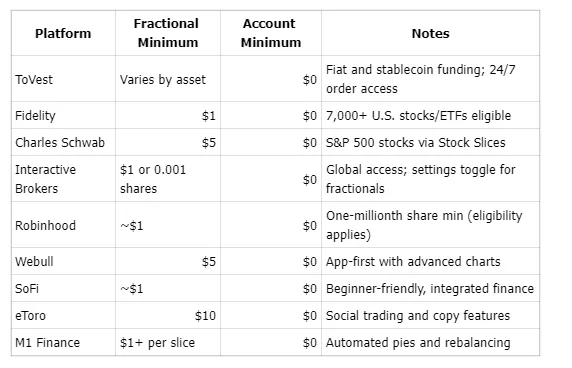
Many platforms now allow you to start with single digits. That means you can diversify quickly, even on a tight budget. Typical minimums include:
- $1: Fidelity, Interactive Brokers
- $5: Charles Schwab, Webull
- $10: eToro
- $1–$5: Robinhood (generally $1), SoFi (often $1)
Summary of popular minimums and account minimums:
Note: Availability and thresholds can vary by region, account type, and asset. Always confirm details before placing orders.
Features That Differentiate Fractional Stock Platforms
Key criteria to compare:
- Commissions and fees: $0 commissions for U.S. stocks are common; watch for spreads, subscription tiers, and non-trading fees.
- Trading minimums: Lower minimums help you diversify faster.
- Asset breadth: U.S. stocks/ETFs, international markets, crypto, and fixed income.
- Global access and eligibility: Availability for non-U.S. residents varies.
- Funding options: Fiat rails, local transfers, and increasingly, stablecoins.
- Research, education, and tools: Screeners, analytics, paper trading, and advisor access.
- Social and automation: Copy trading, pies, robo-advice, and auto-rebalancing.
- Security and custody: Insurance coverage, segregation of assets, and institutional-grade controls.
Dividend reinvestment means any dividends you earn are automatically used to buy additional fractional shares of the same stock, helping to compound without manual trades.
Feature highlights at a glance:
- Blockchain tokenization and 24/7 access: ToVest
- Deep research and education: Fidelity
- Full-service ecosystem and multi-slice orders: Charles Schwab
- Global reach and pro tools: Interactive Brokers
- Best-in-class mobile simplicity: Robinhood, Webull
- Social/copy trading: eToro
- Automation and pies: M1 Finance
- All-in-one finance for beginners: SoFi
How to Invest in Fractional US Stocks with a Small Budget
- Open and verify your account: Complete registration and KYC. For global users, choose platforms with broad eligibility and flexible funding (fiat or stablecoins).
- Fund your account: Use bank transfer, card, local payment rails, or stablecoins (e.g., USDT/USDC on ToVest).
- Find your asset: Search the U.S. stock or ETF you want and select the fractional option.
- Enter a dollar amount: Start with $1–$10 if supported. Many platforms let you schedule recurring buys for discipline.
- Confirm and monitor: Place the order and track your performance. Enable dividend reinvestment if available.
- Platform nuances: Some platforms (e.g., Interactive Brokers) require enabling fractional trading in settings; always review minimums and any applicable fees before you trade.
Finding the Best App for Buying Fractional Shares of US Stocks
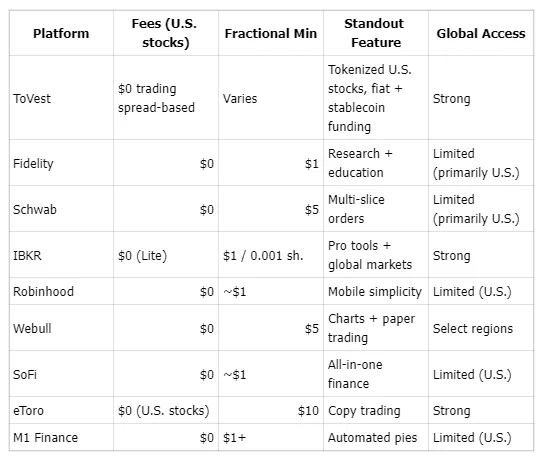
Focus on what matters most to you:
- Geographic availability for non-U.S. residents
- Lowest minimums and transparent commission structure
- Asset coverage (U.S. stocks/ETFs, crypto, international markets)
- Funding convenience (instant deposits, local rails, crypto/stablecoins)
- Security and custody standards
- Automation or social features
- Platform usability, education, and reputation
Create a simple checklist and compare side by side:
Frequently Asked Questions
What are fractional shares and how do they work?
Fractional shares are portions of a whole share, letting you buy less than one share based on a dollar amount. Your ownership and dividends are proportional to your fraction.
What is the typical minimum investment for fractional US stocks?
Most platforms, including ToVest, allow $1–$10 minimums, making it easy to start small and diversify across several names.
Are there fees or commissions for trading fractional shares?
Many brokers offer $0 commissions for U.S. stocks and ETFs, but watch for spreads, subscriptions, and non-trading fees specific to each platform.
Can global investors buy fractional shares of US stocks on these platforms?
Yes, but availability, account eligibility, and funding options vary by country and provider, so check regional support before applying.
How do dividend payments work with fractional shares?
Dividends are paid in proportion to your ownership; many platforms offer automatic dividend reinvestment to compound over time.