Kraken vs. Binance: Which Tokenized US Stock Platform Wins?
January 21, 2026
Tokenized U.S. stocks allow investors to buy fractional interests in real equities on blockchain rails, with around-the-clock access and near-instant settlement. If your priority is compliant access to tokenized U.S. equities, Kraken’s xStocks currently has the edge for legal clarity, audited transparency, and defined product scope. If you care most about low costs and deep crypto liquidity, Binance remains a strong option—though tokenized stock access is limited and varies by region. Below, we compare availability, fees, execution, compliance, and security to help you choose the best platform for trading tokenized U.S. stocks.

Overview of Tokenized US Stock Trading Platforms
Tokenized U.S. stocks are digital representations of real U.S. equities enabled by blockchain technology, allowing fractional ownership and 24/7 trading in global markets. The tokenized equity market crossed roughly $1 billion by mid‑2025 and is projected to expand towards $2 trillion by 2030, driven by 24/7 markets, programmable settlement, and rising institutional pilots, according to analysis on 24/7 tokenized equity markets from AInvest. Kraken and Binance are both expanding into digital asset securities, but they’ve taken very different regulatory and business paths—Kraken emphasizing audited transparency, Binance maximizing breadth and liquidity. Industry coverage echoes the divergence as tokenization moves from pilots to platforms, with early leaders emerging and major exchanges testing models for equities on-chain as reported by The Block and Nasdaq.
Kraken xStocks: Product Availability and Compliance
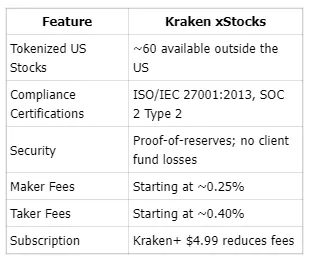
Kraken’s xStocks launched with roughly 60 tokenized U.S. equities for eligible clients outside the U.S., built to provide legal clarity on eligibility, disclosures, and custody while keeping the user experience familiar to equity investors. Kraken is widely credited with pioneering cryptographic proof‑of‑reserves in 2014 and maintains verifiable audits for client asset holdings, bolstering trust through independent checks. The company highlights ISO/IEC 27001:2013 certification, SOC 2 Type 2 alignment, and no recorded loss of client funds—security signals valued by institutions and compliance‑focused individuals. Kraken’s fee schedule remains straightforward, with a Pro tier and optional subscription to lower costs.
Binance: Liquidity, Fees, and Market Reach
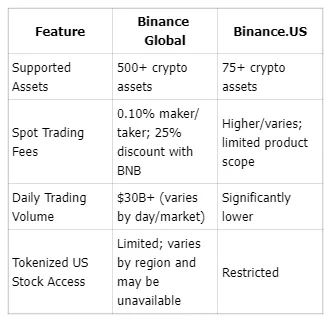
Binance’s core strengths are global liquidity, breadth, and aggressive pricing. The exchange lists over 500 crypto assets on its main venue, and standard spot fees start at 0.10% maker/taker, with a typical 25% discount for paying fees in BNB, per platform comparisons. Binance’s reported daily spot and derivatives volumes regularly exceed $30 billion, far outpacing mid‑single‑digit billions at many competitors, which translates to deeper order books and tighter spreads for crypto pairs, according to Messari market data and independent exchange comparisons. That said, availability of tokenized U.S. stocks on Binance is limited and inconsistent by region; Binance.US operates as a separate entity with fewer assets and no equivalent stock‑token lineup, creating a fragmented experience for U.S. users.
Regulatory Environment and Legal Clarity
Regulatory clarity is the degree to which a platform’s rules, legal structures, disclosures, and asset‑custody mechanics are transparent and predictable—vital for institutions and cross‑border investors. Kraken explicitly positions itself around compliance, from running ongoing proof‑of‑reserves attestations to building banking capabilities via Kraken Financial and serving clients in 190+ countries with jurisdiction‑aware product availability. Binance’s regulatory footprint is broader but more fragmented: the global platform operates with varying product menus per region, while Binance.US runs as a separate, more limited venue, which can leave tokenized equity access uncertain depending on where you live. As tokenization ramps up, this split—audited, jurisdiction‑specific access versus maximum asset breadth—defines much of the user experience.
Secondary keywords: regulated tokenization, compliance, licensing, legal certainty.
Sources: Kraken review and compliance overview; Messari and CoinTracker for Binance/Binance.US differences.
Trading Experience: Fees, Execution, and Tools
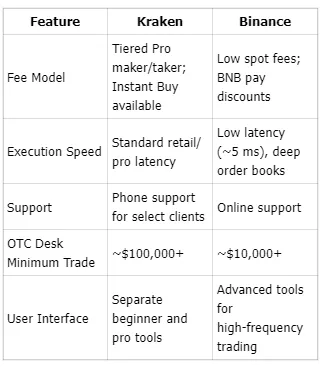
Kraken separates beginner and pro tooling, offers a clear Pro maker/taker model, and supports Instant Buy for convenience; select clients can access direct phone support—still rare among crypto venues. Binance, built for speed and scale, emphasizes low‑latency execution (as low as ~5 ms in exchange materials), large order‑book depth, and a rich suite of pro features favored by high‑frequency and volume traders. OTC desks also differ: Binance typically supports block trades from around $10,000+, while Kraken’s OTC caters to larger blocks from roughly $100,000+, aligning with their respective client mixes.
Security, Custody, and Transparency
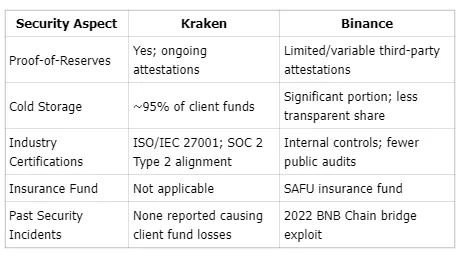
Security and custody structures vary meaningfully. Kraken helped pioneer proof‑of‑reserves and keeps roughly 95% of client crypto in cold storage—offline environments that reduce remote attack risk—alongside ISO 27001 and SOC 2 Type 2 controls. Binance maintains a dedicated insurance pool (SAFU) and extensive internal controls, but it has faced notable security incidents in the broader ecosystem, including the 2022 BNB Chain exploit on the cross‑chain bridge, and its public audit posture has been more limited since third‑party attestations were paused.
Suitability for Different Investor Profiles
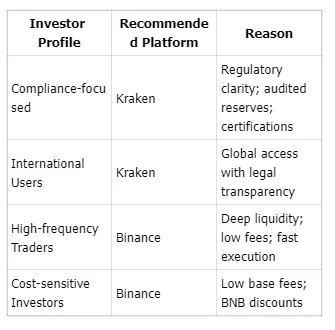
Different priorities map to different platforms:
- Compliance‑focused and international users: Kraken’s audited proof‑of‑reserves, certifications, and jurisdiction‑aware rollout of xStocks support clear governance and reporting needs.
- High‑frequency or cost‑sensitive traders outside stricter jurisdictions: Binance’s depth, spreads, and fee discounts can reduce total cost of execution—provided tokenized stock access is available in your region.
At ToVest, we emphasize regulated tokenization, audited custody, and 24/7 access—pillars essential for mainstream adoption of tokenized equities.
Verdict: Choosing the Best Tokenized US Stock Platform
For tokenized U.S. stocks specifically, Kraken is the safer pick today thanks to audited proof‑of‑reserves, certifications, and a clearly defined, region-aware xStocks rollout that includes dozens of U.S. names for eligible non‑U.S. users. Binance remains the option for ultra-low fees and deep crypto liquidity, but tokenized stock access is limited and uneven across regions. Sophisticated investors often combine approaches—using a compliance‑forward platform for custody and audited exposure, and a high‑liquidity venue for tactical execution when products overlap.
Frequently asked questions
What are tokenized US stocks and how do they work?
Tokenized US stocks are digital representations of real US company shares that enable fractional ownership and 24/7 trading on blockchain networks, with claims backed by custodial or synthetic structures.
How does regulatory compliance impact tokenized stock trading?
Clear compliance frameworks enhance investor protections, disclosures, and audited custody—critical factors institutions and cross‑border users rely on to evaluate platform risk.
What factors should investors consider when choosing a tokenized stock platform?
Compare product availability, fees, regional eligibility, custody and audits, and execution quality to best match your use case.
Can tokenized stocks be traded 24/7?
Yes—most tokenized equity platforms enable 24/7 trading, even when the underlying stock market is closed.
How secure is the custody of tokenized US stocks?
Leading platforms employ cold storage, proof‑of‑reserves, and third‑party audits to enhance safety and transparency for client assets.