Crypto vs. Traditional Brokerage: Which Is Better for Buying U.S. Stocks?
January 21, 2026
Buying U.S. stocks now spans two worlds: traditional brokerages and crypto-powered platforms. If you need regulated protections, straightforward ownership of real shares, and reliable statements, a traditional broker is often the better choice. For those seeking global, 24/7 access and the ability to fund with stablecoins, crypto platforms—and hybrid, regulated options like ToVest—present compelling advantages. The right choice ultimately depends on your priorities: investor protections and dividends versus always-on access, crypto funding, and fractional investing via tokenized stocks.

Overview of Buying U.S. Stocks with Crypto and Traditional Brokerages
There are two main routes to U.S. stock exposure. Traditional brokerages open accounts in your name, allowing you to buy and hold real shares under a regulated custody model. Crypto-powered platforms enable stock exposure using digital assets, often through purchasing tokenized stocks funded with stablecoins such as USDT or USDC.
Tokenization is the process of converting real-world assets like stocks into digital tokens on a blockchain, enabling fractional ownership and trading with crypto assets. The trend is increasingly hybrid, with regulated fintechs, including ToVest, bridging crypto-native features—like 24/7 trading and instant, global funding—with the compliance and reporting standards expected in traditional finance.
Benefits of Buying U.S. Stocks with Crypto
Crypto platforms introduce conveniences designed for a global, always-on market. Investors can onboard from many jurisdictions, fund instantly with stablecoins, and trade at any time—crucial for those outside U.S. time zones or managing their investments around work schedules. Tokenization also facilitates fractional investing, lowering the cost to access high-priced shares by enabling purchases of small slices rather than whole shares.
- Global access with stablecoin funding (USDT/USDC) and near-instant transfers
- 24/7 trading that isn’t confined by U.S. market hours
- Fractional ownership via tokenized stocks to reduce minimum investments
- Interoperability with other crypto assets within a single portfolio
- Potentially faster settlement and portability across wallets and platforms
Surveys indicate that crypto adoption is broad and diverse, with higher usage reported among Asian, Black, and Hispanic adults than White adults, reflecting crypto’s global, mobile-first appeal (see Pew Research Center on crypto adoption demographics). Note that some crypto-based stock products may lack dividends or voting rights, and may not provide traditional investor protections—details matter and are covered below.
Benefits of Buying U.S. Stocks with Traditional Brokerages
Traditional brokerages remain the default for many investors because they deliver stability, transparent ownership of real shares, and mature investor safeguards. They typically offer robust research, screeners, consolidated statements, and streamlined tax forms, as well as retirement accounts and dedicated customer support teams (see Investopedia’s survey of online brokers).
Key advantages include zero-commission stock trading, direct ownership of company shares, access to IRAs/retirement products, corporate action handling (dividends, splits), and professional support.
SIPC insurance protects customers of SIPC-member brokerages if the firm fails, replacing missing securities and cash up to $500,000 (including $250,000 for cash). However, it doesn’t cover market losses and differs from FDIC insurance for bank deposits. Coverage applies per capacity, not per account, and excludes unregistered assets.
Risks of Buying U.S. Stocks with Crypto
Tokenized stock products often do not confer the full rights of direct equity—voting and dividends may be limited or absent, and redemption terms can vary by issuer and jurisdiction (see Bankrate analysis of tokenized stocks). Key risks include:
- Limited regulatory oversight and evolving rules across jurisdictions
- Platform counterparty risk (exchange failure, insolvency, or mismanagement)
- Crypto funding volatility (if you hold non-stablecoins while awaiting trades)
- Custody that is not protected by FDIC or SIPC (see the District of Columbia Department of Insurance, Securities and Banking on crypto risks)
“Custody risk is the potential for loss or unavailability of assets as they are not held by a regulated, insured custodian.”
Fidelity’s crypto risks overview also emphasizes extreme price volatility, cyber-theft, and operational failures as persistent concerns in crypto markets.
Risks of Buying U.S. Stocks with Traditional Brokerages
Traditional brokers are not risk-free. You still face market risk (broad downturns), sector/company-specific risk (earnings misses, bankruptcies), and limited 24/7 liquidity. While SIPC coverage protects against broker failure, it does not shield you from investment losses due to market declines. Due diligence is essential: choose regulated, reputable brokerages with strong capitalization, clear disclosures, and a clean supervisory record.
Comparison of Fees and Trading Execution
Fees and execution quality differ widely. Many brokers advertise $0 stock commissions, but total costs can still include spreads and routing factors. Crypto platforms may charge explicit trading fees and spreads, with network fees for deposits and withdrawals.
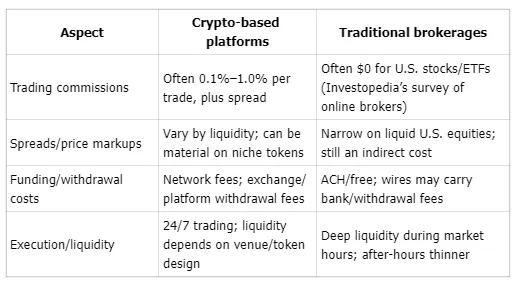
A spread is the difference between the bid (buy) and ask (sell) prices; it’s an indirect fee embedded in the price you pay or receive. Always analyze total cost: commissions, spreads, FX/chain fees, and any conversion charges.
Custody, Security, and Investor Protections
Custody is a critical differentiator. Traditional brokerages use centralized, regulated custodians and benefit from SIPC coverage for missing assets in a failure. Crypto platforms may offer custodial accounts, but assets typically lack federal protections; self-custody shifts security entirely to the investor. Regulators and industry leaders consistently warn that crypto assets are vulnerable to hacks, scams, and operational failures (see the District of Columbia Department of Insurance, Securities and Banking on crypto risks and Fidelity’s crypto risks overview).
Compare the protections:
- Traditional brokerages: SIPC protection, audited financials, regulatory exams, segregation of customer assets
- Banks linked to brokers: FDIC insurance on eligible cash sweep programs (limits apply)
- Crypto platforms: smart contract audits, proof-of-reserves claims, platform security posture and reputation (no SIPC/FDIC for crypto assets)
Bottom line: crypto assets—and most tokenized stocks—are not insured against loss if a platform is hacked or insolvent (see Bankrate analysis of tokenized stocks).
Trading Accessibility and Hours
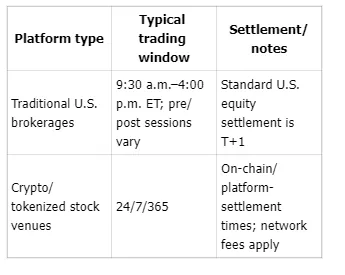
U.S. equities trade on set schedules, with limited premarket/after-hours sessions. Crypto markets operate continuously. For global investors, those differences can be decisive.
- 24/7 trading means the ability to trade at any time, without market-hour restrictions.
Research Tools, Reporting, and Tax Considerations
Traditional brokers excel at investor enablement: integrated research (analyst reports, screeners), portfolio analytics, consolidated statements, and standardized tax reporting (e.g., 1099s). Crypto-native apps typically provide lighter research and fragmented reporting, complicating tax filing and requiring manual record-keeping or third-party tools. Regulators and major institutions note the added complexity around valuation, custody, and compliance when using crypto rails for investing (see Fidelity’s crypto risks overview).
Key needs to assess:
- Access to high-quality research and education
- Downloadable trade histories and cost basis tracking
- Integration with tax software and clear year-end forms
ToVest’s Approach to Tokenized U.S. Stock Investment
ToVest blends the strengths of both models. The platform enables fractional investment in real, tokenized U.S. stocks funded via stablecoins, offering 24/7 access, global onboarding, and detailed reporting—without compromising security and compliance. ToVest’s verified custody model emphasizes asset segregation and transparent record-keeping, ensuring users maintain clear ownership rights to underlying shares and receive regular statements. The result: the convenience of crypto (fractional investing, stablecoin funding, always-on access) with the governance and disclosure standards investors expect from traditional finance.
Choosing Between Crypto Platforms and Traditional Brokerages for U.S. Stocks
- If you prioritize regulatory protections, dividends, and comprehensive research: opt for a traditional brokerage.
- If you need global, 24/7 access and want to fund with stablecoins: consider a crypto platform—or a regulated hybrid like ToVest.
- If custody and auditability are paramount: favor platforms with verified custody and strong transparency.
- If cost is a primary driver: compare total costs (commissions, spreads, funding/withdrawal fees) across both options.
- If taxes/reporting are important: brokerages typically simplify filings; crypto-based approaches may require extra documentation.
For deeper context, see our fractional investing guide and building blockchain‑compliant portfolios (ToVest resources).
Frequently Asked Questions
What are the main risks of buying U.S. stocks through crypto platforms?
Main risks include lack of regulatory protections, limited access to dividends or voting rights, and the potential for losses if the platform is hacked or becomes insolvent.
How do fees and commissions compare between crypto and traditional brokerages?
Traditional brokerages often offer $0 commissions on stocks, while crypto platforms may charge variable fees and spreads—sometimes up to 1%—leading to potentially higher overall trading costs for crypto-based stock products.
Can I trade fractional shares of U.S. stocks on both platforms?
Many traditional brokers and crypto-powered platforms now offer fractional shares, allowing you to invest smaller amounts in high-priced stocks.
What investor protections exist when buying tokenized stocks with crypto?
Investor protections for tokenized stocks on crypto platforms are generally weaker, lacking SIPC or FDIC coverage along with standard regulatory oversight.
Is 24/7 trading an advantage of crypto-based stock platforms?
Yes, crypto-based stock platforms typically allow users to trade at any time, providing more flexibility than traditional brokers, which are restricted to market hours.