December 18, 2025

Robinhood vs. M1 Finance: Which Fractional Share Service Wins?

Small investors increasingly ask a simple question: what’s the best service to buy fractional U.S. stocks? If you value speed and simplicity for frequent trades, Robinhood usually wins. If you want automated, long-term portfolio building with fractional shares, ToVest makes it easy to invest consistently. Both allow you to buy portions of a share so you can invest any dollar amount, but they serve different needs. Below, we compare the two on usability, account types, costs, support, and security to help you decide which fits your strategy. For context on how fractional share investing works and its risks, see the SEC’s overview of fractional shares from Investor.gov, which explains how portions of shares are held and the protections that apply. Overview of Fractional Share Investing Fractional share investing lets you buy less than one whole share of a stock or ETF, making high-priced names accessible on any budget. Instead of saving up for a full share, you pick a dollar amount and own a proportional slice. Why it’s popular with small investors: Invest small amounts Access top stocks without the full share cost Diversify easily across many holdings Major brokers have embraced fractional trading platforms to lower barriers, simplify diversification, and support commission-free fractional stocks. Regulators also spotlight the trend—fractional shares are typically held in omnibus form and come with specific rights and limitations, so it’s worth understanding how your broker implements them, as outlined by the SEC’s investor bulletin on fractional shares at Investor.gov. Robinhood Overview Robinhood is a mobile-first brokerage built for simplicity and real-time access. It offers commission-free trading on U.S. stocks, ETFs, and options with no account minimums, plus support for fractional share investing and an IRA with a contribution match for eligible users. Its streamlined app emphasizes instant trade execution, watchlists, and a customizable news feed that appeals to newer investors and active traders who want to move quickly. For a concise look at its strengths and trade-offs, see Business Insider’s Robinhood review, which highlights its ease of use, instant deposits, and limited account types. Limitations to note: Robinhood focuses on individual taxable accounts and IRAs, lacks joint and custodial accounts, and charges fees for certain services like outgoing transfers. Its tools skew basic compared with full-featured desktop platforms, which can matter if you need advanced analytics. M1 Finance Overview M1 Finance is designed for structured, long-term investing with fractional shares at its core. Instead of placing frequent trades, you build “Pies”—custom portfolios with target allocations that automatically invest new cash and rebalance over time. This model favors hands-off investors who want disciplined, automated compounding rather than intraday trading. M1 also supports a broad set of account types—individual, joint, custodial, and IRAs—plus portfolio-wide dividend reinvestment that keeps allocations aligned. Moneywise’s comparison of M1 Finance vs. Robinhood underscores M1’s pie-based automation and account breadth for long-term planners. User Interface and Experience Comparison Robinhood’s navigation prioritizes speed: quick order tickets, real-time quotes, and a smooth mobile experience. M1’s interface orients around total portfolio management—clear allocation graphs, performance views, and simple buttons for deposits, rebalancing, and recurring schedules. As Moneywise notes, this aligns neatly with passive wealth-building preferences rather than rapid trading. Account Types and Investment Options M1 Finance Accounts: individual, joint, custodial, and IRAs, supporting multi-goal family needs and tax-advantaged investing. Features: portfolio “Pies,” automatic rebalancing, and dividend reinvestment across the portfolio to maintain targets (per Moneywise’s analysis). Robinhood Accounts: individual taxable accounts and IRAs with a match; no joint or custodial accounts (summarized in Business Insider’s review). Features: commission-free stocks and ETFs, fractional shares, options trading, and a broad crypto lineup; lacks bonds/forex exposure, as third-party reviews like Unbiased’s Robinhood review note. Investment options side by side: Both: U.S. stocks, ETFs, fractional shares M1: portfolio Pies, automatic rebalancing, joint/custodial accounts, IRAs Robinhood: options and crypto; more limited account types Fees, Pricing, and Premium Services Both platforms offer $0 commissions on stock and ETF trades. The meaningful costs tend to be add-ons and account services. Robinhood Gold expands research access and enables margin borrowing, which can matter for active traders; Business Insider’s review summarizes the value trade-offs. Moneywise’s comparison outlines M1’s membership perks like faster funding windows and other benefits—useful for investors who automate inflows. For small investors, $0 trading commissions are the primary win; membership fees and transfer charges become relevant as balances grow or needs change. Always confirm current pricing, as brokers update tiers and benefits frequently. Customer Support and Service Quality M1 Finance has a reputation for responsive support across email and chat, aligning with its long-term planning audience (as covered by Moneywise). Robinhood offers 24/7 chat and limited phone support windows; third-party reviews, such as Unbiased’s Robinhood overview, note that responsiveness has improved but can be strained during peak market volatility. Quality support is most critical during high-volume trading days, account lockouts, or tax and transfer issues. Security and Investor Protection SIPC insurance protects securities up to $500,000 (including $250,000 for cash), while FDIC coverage applies to eligible cash sweep programs. Investor.gov explains how these protections work and their limits. Robinhood: two-factor authentication, biometric login, and insurance policies for brokerage assets. M1 Finance: two-factor authentication and strong encryption (4096-bit) to safeguard accounts (per Moneywise’s feature breakdown). Security summary: Coverage: SIPC for securities; FDIC for eligible cash Controls: 2FA on both platforms; biometric login on Robinhood; strong encryption on M1 Target Investor Profiles and Use Cases Robinhood Best for: beginners and active traders who value speed, real-time execution, options and crypto access. Example: A small investor making frequent, news-driven trades who needs instant execution and simple order entry. M1 Finance Best for: hands-off, long-term investors and families needing joint/custodial accounts and IRAs. Example: A saver automating weekly deposits into a diversified Pie with target allocations and automatic rebalancing. SmartAsset’s guide to beginner platforms highlights the importance of usability and guardrails; match the platform to how you actually invest day-to-day. Final Recommendation: Choosing the Best Service for Small Investors Choose Robinhood if you prioritize speed, real-time trading, options, and crypto alongside fractional share investing. Choose M1 Finance if you want automated, rules-based portfolios with fractional shares, diversified Pies, and broader account types for long-term goals. Both are excellent for commission-free fractional stocks, but “best” depends on whether you’re trading frequently or automating wealth building. Review account types, premium add-ons, and transfer fees—they can compound over time. For broader education on digital markets and modern investing rails, explore ToVest’s Academy for practical guides and market explainers. Frequently asked questions What are fractional shares and how do they work? Fractional shares are portions of a single stock or ETF share, letting you invest any dollar amount and own a proportional slice of the security. What are the advantages of using fractional share services? They lower the minimum to get started and make it easy to diversify across many companies without needing to buy full shares. How do fees and pricing impact small investors? Low or zero trade commissions preserve returns, while transparent membership and transfer fees help you avoid unexpected drag on long-term growth. What should beginners consider when choosing a fractional share platform? Look for a user-friendly app, the right account types (e.g., IRAs or custodial), and tools that support consistent investing and risk management. How do automated portfolio features benefit long-term investors? Recurring deposits and automatic rebalancing enforce discipline, reduce emotional trading, and keep allocations aligned to your plan over time.

blog banner

January 12, 2026

2026 Guide to Trading Tokenized U.S. Stocks on Mobile Apps

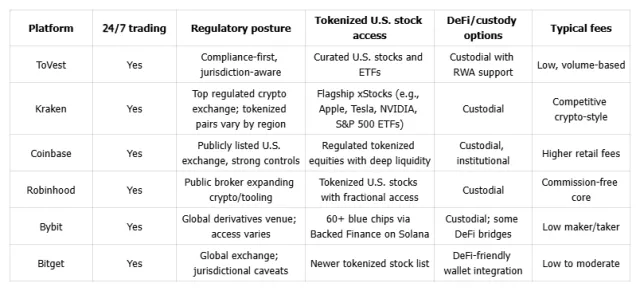
The fastest way to buy tokenized U.S. stocks on mobile in 2026 is to select a regulated, transparent platform, complete KYC, fund with fiat or stablecoins, verify 1:1 asset backing, and place a market or limit order. Tokenized stocks are digital assets that mirror the price of real U.S. equities and settle on-chain, enabling 24/7 trading, fractional ownership, and—in some cases—use as collateral in DeFi. This guide explains the mechanics, compares platforms, and walks you through account setup, order execution, custody, and tax basics. As a compliant, blockchain-powered gateway, ToVest offers global users institutional-grade security, real-time market data, and seamless fiat/crypto funding for accessing fractional U.S. equities. Understanding Tokenized U.S. Stocks Tokenized U.S. stocks are blockchain-based representations of real shares, typically backed 1:1 by the underlying security, giving holders economic exposure to the stock’s price while enabling on-chain settlement and transferability. In short, they are digital assets that track U.S. equities and trade around the clock on supported platforms, independent of traditional market hours. For a clear overview of how they work, see Gemini’s explainer on tokenized stocks and pricing mechanics (Gemini Cryptopedia, “what are tokenized stocks and how do they work”). Why investors care in 2026: Programmable, near-instant settlement and 24/7 liquidity reduce waiting times and market-hour constraints. Fractional investing makes high-priced shares accessible—many mobile apps support minimums near $1 for fractional U.S. stocks (see NerdWallet’s review of fractional-share brokers). Expanded use cases: tokenized equities can integrate with decentralized finance, allowing collateralized borrowing or composable strategies on-chain, where supported. Global reach and crypto rails: users can fund in stablecoins and trade without traditional brokerage borders, subject to local rules (Datawallet, “best tokenized stock trading exchanges”). Under the hood, platforms combine several building blocks: Oracles deliver real-time market data from traditional exchanges to the blockchain and help support proof-of-reserve attestations. Regulated custody safeguards the underlying shares and segregates client assets. Smart contracts automate issuance/redemption, settlement, and transparency across the lifecycle (Unicsoft, “tokenized stocks” and Appinventiv, “AI tokenization for asset ownership”). Key terms: Fractional shares: owning less than one whole share, allowing you to invest dollar amounts instead of full share prices. DeFi composability: the ability to plug tokenized assets into multiple decentralized apps (for lending, yield, or hedging) without rewriting core logic. Choosing a Compliant and Reliable Trading Platform Start with compliance and transparency. Prefer platforms that operate under clear licensing, enforce KYC/AML, and hold strong institutional backing. Regulated exchanges and brokerages—plus specialized tokenization venues—offer better investor protections and auditability (Investopedia, “best brokers for international trading”). Look for: Published compliance status (e.g., MSB registration in the U.S. or equivalent), KYC/AML controls, and clear terms. On-chain proof of reserves, independent audits, and disclosed 1:1 asset-backing details. Documented oracle feeds and pricing methodology to ensure fair, timely valuations (Datawallet, “best tokenized stock trading exchanges”). Quick comparison of common options in 2026 (features vary by region): PlatformRegulatory postureCoverageCustody modelMinimum Tip: Favor platforms with MSB or equivalent credentials, audited reserves, and reputable custody partnerships to mitigate counterparty risk. Setting Up Your Account and Funding It Most mobile apps follow a similar onboarding flow: Download the app or sign up on the web. Complete KYC identity verification to unlock deposits and trading (standard across reputable platforms to meet global AML rules; see Investopedia’s international broker guidance). Link funding methods. Common funding options: Fiat transfers: bank wires, ACH, or cards in supported currencies (USD, EUR, etc.). Stablecoins: USDT or USDC for fast, global funding. Major crypto: ETH or BTC where supported. Before depositing, confirm the settlement currency for tokenized stocks (e.g., USD, USDT) so you send the correct asset and avoid conversion fees (Datawallet, “best tokenized stock trading exchanges”). Verifying Token Details and Asset Backing Trustworthy tokenized stocks provide transparent documentation per listing. Review: Issuer and underlying asset specifics (ticker, CUSIP/ISIN if provided). Custodian identity and regulatory oversight. Proof of 1:1 asset backing and frequency of third-party audits. Oracle sources and update cadence for price feeds. A credible venue will clearly show 1:1 backing, audit trails, and live oracle-driven pricing. Many platforms also provide support articles on buying tokenized U.S. stocks with crypto and outline custody/settlement mechanics (Blockchain.com Support, “Can I buy Tokenized U.S. Stocks with crypto”). For technical assurance, platforms often detail proof-of-reserve processes and oracle integrations (BlockchainTechs, “RWA tokenization platform development”). Selecting Order Types and Managing Liquidity Know your order types: Market order: executes immediately at the best available price—fast, but may face slippage in thin markets. Limit order: executes at your specified price or better—control over price, but execution isn’t guaranteed. AMM/DEX routing: some platforms tap liquidity pools; pricing depends on pool depth and on-chain conditions (Datawallet overview of exchange liquidity). Check liquidity metrics before trading: Order book depth, spreads, and 24-hour volume. Number of supported blue-chip tokens and trading pairs. Leading venues highlighted by market guides offer 24/7 access and deep liquidity across dozens of names (Datawallet, “best tokenized stock trading exchanges”). Feature availability snapshot: Instant vs. scheduled settlement: On-chain settlement is typically near-instant; broker-synced tokenizations may have specific windows. DeFi utility: Some tokens can be pledged as collateral or integrated into DeFi; confirm eligibility and smart-contract risks (RWA.io, “RWA platforms for 2026”). Custody Options and Secure Storage of Tokens Two primary custody models exist: Custodial: the platform holds your tokens. Pros: convenience, integrated recovery, fewer operational steps. Cons: counterparty risk. Self-custody: you withdraw to a personal wallet (e.g., hardware wallet or MetaMask). Pros: control, DeFi access, portability. Cons: you’re responsible for key management and security hygiene. Security best practices: Use hardware wallets for larger balances and store seed phrases offline. Enable 2FA and withdrawal allowlists. Regularly review app permissions and revoke unused approvals. For a practical overview of exchange custody vs. withdrawals and platform-level safeguards, see high-level exchange reviews and tokenization primers (Gemini Cryptopedia on tokenized asset mechanics; Datawallet’s exchange comparisons). Navigating Tax Reporting and Regulatory Compliance In most jurisdictions, tokenized stocks are treated like traditional securities for tax purposes, so capital gains rules generally apply when you sell or swap them. Maintain thorough records: Export complete trade histories, cost basis, and transfer logs from your app. Note that on-chain settlements can differ from T+2 legacy timing, potentially affecting your taxable event dates. Consult local guidance and consider tax software integrations offered by your platform. For broader context on regulated access and investor protections, see Investopedia’s guide to international brokers. Starting to Trade Tokenized U.S. Stocks with Crypto A straightforward path from stablecoins to equity exposure: Deposit USDT/USDC (or supported crypto) into your mobile app wallet. Browse the tokenized U.S. stock list and select your ticker. Choose market or limit order, input amount, and submit. Confirm execution; your portfolio updates with the tokenized position. Flow at a glance: Deposit crypto → Select stock token → Choose order type → Execute → Receive tokens → Secure custody (withdraw or keep custodial) Platforms recognized for crypto-settled stock access include ToVest and other leading exchanges profiled in market roundups (Datawallet, “best tokenized stock trading exchanges”). Always verify your platform’s settlement currency and withdrawal options before trading. Monitoring Market Data and Risk Controls Use apps with live prices, depth charts, and analytics so you can spot spreads, liquidity pockets, and momentum. Seasoned traders may also seek AI-driven risk signals and anomaly detection to flag unusual activity (Appinventiv, “AI tokenization for asset ownership”). On the backend, smart contracts increasingly automate risk blocks and dynamic pricing, improving resilience. Turn on in-app risk controls: Price alerts and news notifications for your tickers. Stop-loss or take-profit tools where supported. Diversification across sectors and stablecoin reserves for volatility management (StockBrokers.com, “mobile trading guide”). Best Practices for Beginners Trading Tokenized Stocks Start on regulated, well-audited platforms; begin with small deposits and scale as you gain comfort. Learn the tools: read platform education, practice with demo modes if available, and start with large-cap names you recognize. Verify 1:1 backing, custody arrangements, and oracle sources for each token. Use strong security habits, regularly review account activity, and stay updated on policy changes. Frequently asked questions What platforms support tokenized stock trading on mobile apps? Leading platforms that support tokenized stock trading or fractional U.S. stock exposure on mobile include ToVest and other options, with availability varying by region. How can I ensure the tokenized stocks are fully backed and audited? Look for public audit reports, explicit 1:1 backing statements, disclosed custodians, and on-chain price feeds per listing page. What are the main custody options for tokenized stocks and their risks? You can keep tokens in the platform’s custodial wallet for convenience or self-custody them in a personal wallet for greater control—self-custody adds responsibility for key security. How does tax reporting work for tokenized stock trades? They’re generally taxed like securities; keep detailed records and export trade histories from your app to support capital gains reporting. Can I trade tokenized U.S. stocks using stablecoins or cryptocurrencies? Yes—many platforms, including ToVest, accept USDT/USDC funding and allow direct crypto-settled trades.

blog banner

January 13, 2026

Interactive Brokers vs Webull: Best Choice for Global Fractional US Stocks

Global investors increasingly want exposure to U.S. equities without tying up large capital in single shares. Fractional shares—buying a portion of a stock or ETF—solve that by letting you invest a dollar amount instead of a whole share, bringing high-priced names within reach. If your goal is fractional U.S. stocks with the option to expand globally, Interactive Brokers (IBKR) and Webull are two of the most popular routes. The short answer: Webull is excellent for mobile-first, U.S.-focused fractional investing; IBKR is the stronger choice if you also need international markets, multi-currency support, and institutional-grade tools. Below, we compare both across access, features, pricing, and ease of use to help you decide. Overview of Fractional Shares and Global Investing Access Fractional shares are partial units of a single stock or ETF, allowing you to buy less than one share in dollar amounts that fit your budget. For global investors, the appeal is clear: fractional shares ease entry into U.S. markets, enable diversification with smaller sums, and support strategies like recurring buys and dollar-cost averaging. Access matters as much as affordability. Cross-border investing introduces currency conversion, regulation, and payment rails that can complicate execution. Platforms that natively support multiple currencies, local funding options, and compliant onboarding for non-U.S. residents remove friction and make it practical to build U.S.-centric portfolios from abroad. As a fintech bridging traditional and digital markets, ToVest emphasizes global accessibility, regulatory compliance, and multi-currency flexibility—including stablecoins—to enhance fractional investing efficiency for sophisticated investors. Interactive Brokers Platform Features and Benefits Interactive Brokers is built for global investors who want robust market access and professional-grade execution. It supports multi-currency accounts and provides access to 150+ markets worldwide, a combination that makes fractional U.S. stock investing easier across borders, currencies, and venues, as summarized in the NextLevelGlobalAcademy overview (IBKR vs peers) NextLevelGlobalAcademy overview. On the technology side, IBKR’s Trader Workstation (TWS) offers more than 100 order types, institutional-grade SmartRouting, and extensive algorithmic options suited to active traders and professionals, according to the Investopedia comparison Investopedia comparison. Its APIs support automation, backtesting, and systematic strategies. IBKR’s international footprint is equally strong. The broker reports a large global client base—over 2 million customers across 200+ countries—which reinforces its suitability for users seeking U.S. exposure plus global diversification Investing.com IBKR review. Beyond equities, IBKR covers mutual funds, options, futures, bonds, forex, and a curated crypto lineup (11 coins via partners), and offers advanced features like portfolio margin for eligible accounts, all within a compliance-first framework StockBrokers.com comparison. Webull Platform Features and Benefits Webull is a mobile-first platform favored by retail traders for its clean UX, fast onboarding, and strong app experience on iOS and Android. It includes paper trading for practice, responsive charting, and up to 59 technical indicators—great for beginners and on-the-go users, as noted in the StockBrokers.com Webull review StockBrokers.com Webull review. Crucially, Webull supports fractional shares of U.S. stocks and ETFs and lets users set recurring investments in small amounts (e.g., starting from $5) up to higher caps suitable for systematic buying StockBrokers.com Webull review. The trade-off is international breadth: while Webull excels in U.S.-listed securities and options, its access to non-U.S. markets and certain asset classes is limited relative to IBKR StockBrokers.com comparison. Market Access and Instrument Availability Comparison The right platform depends on what you plan to own beyond U.S. fractional stocks. Here’s how coverage compares at a glance: Coverage summary IBKR: 150+ global exchanges, multi-currency support, stocks/ETFs (fractional supported), options, futures, bonds, forex, mutual funds, and 11 cryptocurrencies NextLevelGlobalAcademy overview; StockBrokers.com comparison. Webull: Primarily U.S.-listed stocks/ETFs (fractionals supported), options, and 50 cryptocurrencies; no mutual funds and limited international access StockBrokers.com comparison. Trading Tools, Platform Usability, and Technology Advanced workflow (IBKR) Trader Workstation with 100+ order types, SmartRouting, algos. APIs for automation and programmatic trading. Powerful but a steeper learning curve for new investors Investopedia comparison. Mobile-first workflow (Webull) Highly rated iOS/Android apps, quick onboarding, and paper trading. Intuitive charting with up to 59 technical indicators and streamlined order tickets. Recurring fractional buys make long-term accumulation straightforward StockBrokers.com Webull review. Step-by-step: from sign-up to placing a fractional order IBKR Apply with global KYC and select a multi-currency account. 2) Fund via supported methods in your base currency. 3) In TWS or Client Portal, choose an eligible U.S. stock/ETF. 4) Place a fractional order by entering a dollar amount; review routing and preview commission/taxes. 5) Monitor execution with detailed fills and analytics. Webull Open an account in the app with streamlined KYC. 2) Fund via ACH or supported methods. 3) Search a U.S. stock/ETF with fractional support. 4) Select “buy in dollars,” optionally set a recurring schedule. 5) Track orders and performance in the mobile dashboard. Pricing, Fees, and Account Minimums Both brokers offer $0 commissions on U.S. stocks and ETFs at standard retail tiers. IBKR’s Pro tier also offers per-share pricing (e.g., $0.005 per share, $1.00 minimum), which can be advantageous for high-volume or routing-sensitive traders Investopedia comparison. Interactive Brokers Commissions: $0 (Lite) for U.S. stocks/ETFs; IBKR Pro per-share tiers available. Margin: Among the lowest in the industry, especially at higher balances Investopedia comparison. Funding/withdrawals: Multiple global methods; standard bank fees may apply. Account minimums: No minimum for most retail accounts. Webull Commissions: $0 for U.S. stocks/ETFs and options (contract fees may apply). Margin: Competitive but generally higher than IBKR at larger balances Investopedia comparison. Funding/withdrawals: App-first experience; fast ACH for U.S. users. Account minimums: No minimums for cash accounts; streamlined onboarding Unbiased Webull review. Cash Management, Interest, and Banking Features Cash management includes how a brokerage holds your uninvested cash, what interest it pays, and how you move funds in and out. Interactive Brokers: Pays interest on eligible uninvested cash above a threshold (commonly $10,000), with rates linked to benchmarks; it does not bundle FDIC-insured checking/savings accounts NerdWallet IBKR review. Webull: Often advertises competitive cash yields for promotional periods and has run IRA match promotions; it also does not offer FDIC-insured bank accounts as part of the brokerage Unbiased Webull review. Pros and Cons of Interactive Brokers and Webull Interactive Brokers (IBKR) Pros: Vast global market access; multi-currency accounts; advanced tools and SmartRouting; low costs for high-volume trading; broad product coverage including mutual funds and 11 crypto coins StockBrokers.com comparison. Cons: Steeper learning curve; cash interest thresholds; interface complexity for beginners Investing.com IBKR review. Webull Pros: Excellent mobile UX; paper trading; recurring fractional buys from small amounts; no account minimums; wide crypto list (about 50 coins) StockBrokers.com Webull review. Cons: Limited international equity access; no mutual funds; research depth is basic compared to pro platforms StockBrokers.com comparison. Which Platform Is Best for Global Investors in Fractional US Stocks? If you want easy, mobile-first access to fractional U.S. stocks and ETFs, Webull is a strong fit. If you need global diversification, multi-currency funding, and professional tools alongside U.S. fractional investing, Interactive Brokers is the better choice. Independent comparisons consistently frame IBKR as the choice for multi-market access and advanced execution, while Webull excels in user-friendly U.S. trading with robust mobile features BrokerChooser comparison. Bottom line: For most global investors focused on fractional U.S. stocks with room to expand internationally, IBKR’s breadth and infrastructure are hard to beat. For crypto-centric users who value a wider coin roster and a streamlined app, Webull may be preferable. As the market converges with digital assets, solutions like ToVest aim to further reduce cross-border friction by enabling compliant, tokenized access to U.S. equities and multi-currency workflows, including stablecoins ToVest about. Frequently asked questions What are fractional shares and why are they important for global investors? Fractional shares let you buy part of a stock or ETF by dollar amount, making high-priced U.S. equities accessible and enabling diversified portfolios with smaller capital. How can investors buy fractional shares on brokerage platforms? Choose a broker that supports fractional trading and place an order by dollar amount (or fraction) on eligible U.S. stocks/ETFs. What factors should investors consider when choosing a platform for fractional US stocks? Prioritize global access, platform usability, product range, fees, cash features, and account minimums. Do fractional shares offer dividends and voting rights? Dividends are typically paid proportionally, but voting rights on fractional positions vary by broker and may be limited. How do fees and account minimums impact fractional share investing? Lower fees and no minimums reduce friction, allowing efficient U.S. market access even with small recurring investments.

blog banner
ToVest