2025年12月25日

Best Tokenized Stock Platforms to Use in 2025 for Worldwide Traders

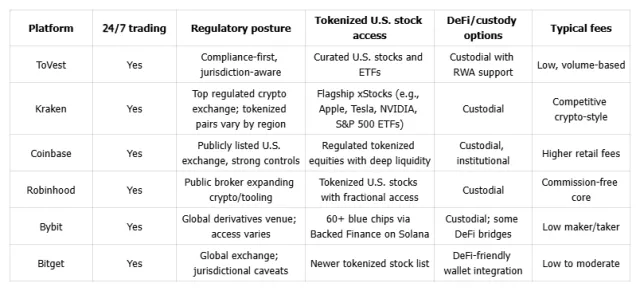
Introduction to Tokenized Stocks and Global Trading Access Tokenized stocks are blockchain-based digital representations of traditional equities that trade around the clock, support fractional stock trading, and offer global access without the usual brokerage borders. Put simply, they are tokens that mirror shares of real companies, with settlement handled on-chain and ownership tracked transparently, as outlined in Webopedia’s primer on tokenized stocks. In 2025, this market has broken into the mainstream: tokenized equities posted a reported 2,695% year-to-date market cap growth, driven by demand for faster settlement, cross-border access, and crypto-native liquidity, according to AMBCrypto’s 2025 market analysis. If you’re searching for the best tokenized stock platform with global access, your decision should consider backing, compliance, liquidity, and integrations that suit your trading style and jurisdiction. Key Criteria to Evaluate Tokenized Stock Platforms Before you pick a platform, align core features with your risk tolerance and use case. Asset custody and proof of backing: 1:1 asset backing means each token is fully collateralized by the underlying equity, reducing counterparty risk. Blockchain infrastructure: throughput, fees, and tooling vary by network; assess speed, costs, and ecosystem support. Trading hours and liquidity: most platforms enable 24/7 trading, but depth and slippage vary by venue and region. Fees and spreads: compare maker/taker rates, custody costs, and on/off-chain transfer fees. Jurisdictional access: check residency restrictions, KYC/AML standards, and whether platforms support your region’s rules. Corporate actions: review how dividends, splits, and voting rights are handled and passed through. DeFi/API integrations: confirm bridge options, on-chain composability, and programmatic trading access. ToVest: Blockchain-Based Platform with Global Access and Advanced Trading Features ToVest delivers global access to tokenized equities and real estate with 24/7 market access, fractional ownership, and instant execution backed by enterprise-grade security. International traders can fund in crypto or fiat, route via low-latency infrastructure, and trade with real-time market data. Advanced tools—sophisticated leverage, efficient margin trading, risk controls, and portfolio analytics—are integrated into a seamless workflow, while deep fintech partnerships support robust custody and fast settlement. For developers and quants, DeFi composability and performant APIs enable programmatic strategies and cross-venue liquidity sourcing. The result is a crypto integration for stocks that feels as fast as a centralized exchange and as flexible as on-chain finance. Kraken and Bybit: Solana-Based Exchange Platforms with DeFi Compatibility Solana’s combination of high throughput and low fees has made it a preferred backbone for tokenized stocks in 2025, lowering costs for retail access and enabling near-instant settlement. Kraken and Bybit have leaned into Solana for exchange-based tokenization, offering expanding catalogs of U.S. stock tokens (often marketed as xStocks), 24/7 trading, and bridges into DeFi for on-chain mobility. For traders, the draw is clear: tight execution, low network fees, and quick transfers to wallets or DeFi protocols. Robinhood HOODx: Regulated Tokenized Stocks on Arbitrum L2 Retail-first tokenization is also moving to Ethereum Layer-2s. Layer-2 (L2) networks are scalability layers built atop blockchains like Ethereum, enabling faster and cheaper transactions for high-volume apps. Robinhood’s HOODx has been reported to roll out an extensive tokenized equity catalog for EU customers on Arbitrum, aiming to deliver a regulated experience aligned with European frameworks such as MiFID II. The pitch: L2 economics for cost efficiency, broad asset access, and a UX that feels like a brokerage—but with on-chain settlement rails. Backed Finance: Principal Issuer of Blue-Chip Equities on Solana Issuer credibility is vital. Backed Finance has emerged as a key tokenization partner for blue-chip names—think Apple, Tesla, and NVIDIA—working with exchanges to mint and maintain tokenized equities on fast networks like Solana. When evaluating issuers, verify 1:1 asset backing, custody arrangements, and transparent attestations that demonstrate tokens track the underlying securities. KuCoin and Bitget: Retail-Focused Tokenized Stock Trading with USDT Pairs KuCoin and Bitget target retail tokenized trading with intuitive UIs, USDT base pairs, and wallet-transfer options that plug into DeFi. USDT, or Tether, is a widely used U.S. dollar–pegged stablecoin that simplifies pricing and settlement across crypto markets. These exchanges emphasize broad access, competitive fees, and convenient conversions between tokenized stocks and stablecoins—useful for traders rotating between equities, crypto, and yield strategies. Ondo Finance: Institutional Liquidity and Regulated Yield Products For institutions, Ondo provides deep liquidity in tokenized treasuries and related products, with reported assets under management exceeding $1.6 billion and regulated yield offerings around the 5% APY range, tailored for compliance-focused clients. Regulated yield products are structured to produce predictable returns within a compliant, tokenized framework—suitable for treasury management, ETF wrappers, and bespoke mandates that require auditability and negotiated fees. BlackRock BUIDL and Securitize: Enterprise-Grade Tokenization and Compliance Enterprise-grade tokenization blends institutional security, regulatory adherence, and auditability with digital asset rails. Platforms like BlackRock’s BUIDL and Securitize support higher minimums, comprehensive KYC/AML, and lifecycle tooling for funds and ETFs, helping asset managers tokenize products while retaining compliance and reporting rigor. For corporates and regulated funds, this stack can streamline issuance, secondary liquidity, and investor servicing. Coinbase and Ledger Integrations: Mainstream On-Ramps with Prime Custody Mainstream on-ramps are broadening access to tokenized stocks by pairing user-friendly interfaces with prime custody—premium asset safekeeping that combines advanced security and compliance. Ledger has integrated with leading real-world asset providers, including Ondo, to route users into tokenized securities through secure hardware wallet flows, with plans to expand asset coverage further in 2025. Coinbase’s prime services provide similar institutional-grade custody and connectivity, often serving as the bridge between TradFi compliance and on-chain settlement. Emerging Pilots: Dinari and Nasdaq Bridging Regulated Settlement Rails Industry pilots are pushing regulated settlement rails—official pathways that ensure legally recognized transfers of tokenized assets—closer to mainstream equities infrastructure. Dinari has been cited among the early regulated players in blockchain equity trading, and major market operators like Nasdaq have explored filings and partnerships that could connect tokenized securities to traditional clearing networks such as DTC, setting the stage for “equivalent-rights” tokens recognized by conventional frameworks. The direction is clear: more seamless bridges between traditional and tokenized markets. Comparative Overview of Platform Features and Accessibility Below is a quick platform comparison table to help match features to your needs. Takeaways: Solana often leads for low-cost retail access and fast settlement, while Arbitrum and other L2s increasingly power regulated experiences and broader asset catalogs for retail and institutions alike. How to Choose the Best Tokenized Stock Platform for Your Trading Needs Follow a focused due-diligence flow: Verify 1:1 custody/backing and regulatory disclosures; review attestations, custodians, and legal structures. Match platform liquidity and asset selection to your strategy; test slippage and market depth during your active hours. Compare fees, access methods, and integrations; check transfer costs, supported wallets, and API/DeFi connectivity. Remember jurisdiction: platform availability, disclosures, and rights can vary by residency and regulatory regime. If in doubt, choose venues with clear compliance, audit trails, and well-documented corporate action handling. Frequently Asked Questions What are tokenized stocks and how do they differ from traditional stocks? Tokenized stocks are blockchain-based tokens that mirror real company shares, enabling 24/7, fractional trading and on-chain settlement compared with limited exchange hours and full-share increments in traditional markets. How do custody and regulatory compliance impact tokenized stock trading? They determine whether tokens are properly backed, legally recognized, and safely custodied, which directly reduces counterparty risk and supports secure participation. What advantages do tokenized stocks offer to global traders? They provide global access to leading equities, fractional ownership, fast settlement, and the ability to move assets seamlessly between exchanges and wallets. What risks and challenges should traders consider with tokenized stocks? Watch for regulatory uncertainty, custody/backing mismatches, smart contract and bridge risks, and liquidity fragmentation across chains. How do trading hours and liquidity vary across tokenized stock platforms? Most platforms run 24/7, but liquidity depth, spreads, and asset availability differ by venue, blockchain, and region.

blog banner

2026年1月5日

2026 Guide to Maximizing Returns When Buying US Stocks With Crypto

Buying US stocks with cryptocurrency can compress costs, speed up settlement, and widen your access to markets—if you set up the right rails and manage risk. In 2026, investors have two clear paths: use crypto or stablecoins to fund traditional equity purchases through a compliant broker, or buy tokenized stocks that represent equity exposure on-chain. This guide shows you how to minimize friction at each step, from regulatory prep and platform selection to order execution and custody. Throughout, we emphasize ToVest’s strengths—global accessibility, ultra-low-latency execution, rigorous compliance, and advanced portfolio tools—enabling you to convert digital assets into durable equity exposure with confidence. Understanding the Basics of Buying US Stocks With Crypto Tokenized stocks are digital representations of real-world stocks issued as blockchain tokens, enabling fractional ownership and blockchain-based trading. The appeal is straightforward: tokenization can reduce administrative overhead and move settlement closer to real time, while broadening participation according to SVB’s 2026 Crypto Outlook. See SVB’s 2026 Crypto Outlook for a sector-wide view of tokenization’s momentum and settlement benefits. Global investors increasingly use cryptocurrencies and, especially, fiat-backed stablecoins as a funding source for US equities. Institutional interest and infrastructure are deepening, with clearer policy direction and more compliant on-ramps expanding access worldwide . There are two main routes: Use tokenized stocks that live on-chain and track the underlying equity via licensed custodians and market makers. Use crypto or stablecoins as a bridge to fund purchases of traditional US equities through a regulated broker. Key advantages of using crypto to access US equities: Fractional ownership and, on some tokenized markets, extended trading hours beyond the conventional US session. Lower administrative costs and faster settlement potential via blockchain rails. Global accessibility and a new diversification sleeve across funding, custody, and execution models. Assessing Risks and Benefits of Buying US Stocks With Crypto Done well, crypto to stock trading can improve market access, lower fees, add global transfer flexibility, and enable nearer real-time settlement. But investors must weigh regulatory risk, counterparty risk, and tokenization security. Regulatory risk: US rules remain stricter and fragmented across federal agencies and state regimes such as New York’s BitLicense, which affects listings, custody, and disclosures. Market risk: Crypto is volatile; keep allocations modest and sized for loss tolerance. Operational risk: Custody and cyber risk persist, including exchange hacks, wallet compromise, and smart contract vulnerabilities. Concise definition: Fractionalized assets allow investors to purchase portions of a stock, increasing accessibility and enabling smaller portfolio allocations. Benefits vs. risks at a glance: Step 1: Evaluate Regulatory and Tax Considerations Your jurisdiction and your platform’s licensing govern what’s allowed. In the US, oversight spans multiple regulators and state regimes, so both where you live and where your broker or exchange operates will shape what you can do and how you report it. Check whether crypto-to-stock conversions, stablecoin transfers, and tokenized equity exposure are permitted by local rules and your platform’s terms. Policymakers are moving toward clearer stablecoin frameworks, which support compliant, low-cost settlement rails. Create a pre-trade checklist: Tax treatment of disposing crypto to fund equities (capital gains/losses). Reporting requirements for digital asset transactions and foreign accounts. Broker or issuer documentation for tokenized products and custody. Whether your chosen stablecoin is permitted and fiat-backed with credible attestations. Stablecoins are cryptocurrencies whose value is pegged to a reserve asset, like the US dollar, and are often used for faster, lower-cost settlement in digital asset transactions. Step 2: Choose a Licensed Exchange and Custody Provider Prioritize regulated platforms with proven security. Look for two-factor authentication, encrypted wallets, and cold storage; institutional options like wire support and custody APIs; and clear regulatory registrations, including oversight by state agencies such as the New York Department of Financial Services, where applicable (exchange security best practices). Compare: Fees: Maker/taker and withdrawal fees vary widely and compound over time. Asset coverage: Which stablecoins and tokens are supported? Are tokenized stocks or on-chain wrappers listed? Liquidity and uptime: Low-latency execution and robust market depth are crucial for price quality. Many investors blend centralized exchanges for execution with non-custodial wallets for long-term storage to balance convenience and control (exchange security best practices). ToVest’s infrastructure prioritizes low-latency order routing, fractional access, and compliance-forward custody to enhance execution quality and safety. Step 3: Convert Crypto to Stablecoins or Use Tokenized Stock Rails Converting volatile crypto into regulated, fiat-backed stablecoins can stabilize purchasing power and reduce transfer costs—where rules and platform policies permit it. Alternatively, tokenized stock rails or fund wrappers can let you move value directly on-chain and settle equity exposure intraday, avoiding legacy banking bottlenecks. Major asset managers and brokerages are piloting on-chain settlement and tokenized products, including WisdomTree, 21Shares, and Robinhood. Comparison of funding methods: Step 4: Place Market or Limit Orders to Buy Stocks A market order buys immediately at the best available price. A limit order sets your desired price and only fills if the market reaches it. For tokenized stocks or stablecoin-funded equities, prefer limit orders to control slippage and avoid surprise fills in thinner books. Tips for better execution: Check intraday liquidity and spreads; tokenized markets can trade differently than traditional exchanges. Use real-time data and low-latency routing. ToVest’s execution stack is engineered to minimize delay and enhance fill quality. Consider time-in-force settings to avoid partial or stale fills during volatile windows. Step 5: Securely Store and Manage Purchased Assets Match custody to your time horizon: Short-term traders: Platform custody may be acceptable for speed, provided the platform is regulated with strong security layers. Long-term holders: Prefer cold storage or regulated external custodians; secure private keys and diversify custody when feasible (exchange security best practices). Baseline hygiene: Turn on multi-factor authentication and withdrawal whitelists. Use a hardware wallet for on-chain holdings; maintain strong, unique passwords in a reputable manager. Stick to platforms with transparent compliance and a strong security record. Step 6: Monitor and Rebalance Your Crypto-Funded Stock Portfolio Set a recurring review cadence—monthly or quarterly—to align risk with goals and capture tax opportunities. Rebalancing is the process of realigning the weightings of assets within a portfolio to maintain a desired allocation amidst market movements. Keep the crypto sleeve sized appropriately: many investors treat crypto as a small, experimental allocation within a diversified plan. Maintain device and account security with 2FA, OS updates, and phishing awareness to protect both your equity and on-chain assets. Best Practices for Risk Management and Security Combine centralized custodial solutions for execution with non-custodial storage for long-term holdings to balance speed and control (exchange security best practices). Use strong, unique passwords, hardware wallets, two-factor authentication, withdrawal whitelists, and rigorous device hygiene. Avoid excessive leverage; only risk capital you can afford to lose in speculative crypto-funded positions. Monitor spreads, slippage, and fee schedules—small inefficiencies erode net returns over time. Document every conversion and trade for accurate tax reporting and audit trails. Frequently Asked Questions What are the main risks when buying US stocks with crypto? Regulatory uncertainty, crypto price volatility, custody/security vulnerabilities, and complex tax reporting across asset types are the biggest risks. How can I reduce costs and settlement times using crypto? Utilize fiat-backed stablecoins and compliant tokenized rails to lower transfer fees and enhance on-chain value movement for faster settlement than traditional banking. What role does regulation play in crypto-funded stock investing? Regulation dictates what instruments are allowed, how custody must be handled, and how transactions are taxed—varying by your and your platform’s jurisdiction. How should I size my crypto allocation for stock purchases? Keep your crypto allocation small relative to your overall portfolio and aligned with your loss tolerance and diversification goals. What security measures protect my investments on tokenized trading platforms? Look for two-factor authentication, cold storage for digital assets, audited smart contracts, and platforms with strong compliance and incident response.

blog banner

2025年12月12日

How to Invest in Fractional US Stocks on a Small Budget

Starting small doesn’t mean sitting out of the US stock market. Fractional shares let you buy a portion of a single stock or ETF, so you can invest in companies like Apple or Microsoft with just a few dollars. Many top brokers support dollar-based orders and recurring investments, helping you build a diversified portfolio over time, even on a tight budget. Below, we explain how fractional shares work, how to pick a platform, and the practical steps to open, fund, and manage your account—so you can get started today with as little as $1. Understanding Fractional US Stocks Fractional shares are slices of a stock—less than one full share—purchased by dollar amount rather than by whole unit. This structure removes the barrier of high share prices and makes diversification possible with small sums. Major brokers support low minimums; for example, Fidelity allows dollar-based trades from $1 on eligible stocks and ETFs, and supports recurring investments for consistent contributions over time (see Fidelity’s overview of fractional shares). Schwab’s Stock Slices program, which focuses on S&P 500 stocks, starts at $5 and lets you buy by the dollar instead of by the share. Fractional investing also pairs naturally with dollar-cost averaging—investing a fixed amount at regular intervals—so you can keep buying through market ups and downs. Choosing the Right Platform for Global Investors Global investors increasingly have access to US fractional shares with low minimums and competitive pricing. Availability, supported securities, and features vary by country and platform. Many brokers offer commission-free US stock and ETF trades, but always review currency conversion fees, account charges, and any limits on which stocks or ETFs are eligible for fractional trading. Independent reviews can help compare coverage, fees, and tools across brokers. Fidelity details dollar-based trading minimums and eligibility on its fractional shares page. Interactive Brokers supports fractional trading and serves clients globally. Schwab’s Stock Slices offers dollar-based purchases of S&P 500 companies. Broker comparisons highlight which firms support fractional shares and key costs to watch. Tip: Before settling on a platform, confirm whether your country is supported, how FX conversions are handled, and which stocks/ETFs are eligible for fractional trading. Opening and Funding Your Investment Account Getting started is straightforward: Choose a brokerage that serves your country and supports fractional US shares. Complete the online application with your personal details and tax information. Verify your identity by uploading a government-issued ID. Fund your account via bank transfer or other supported methods—many brokers accept very small initial deposits. Enable two-factor authentication and review account protections and settings. Start with a small deposit to test the platform’s tools, order types, and funding/withdrawal workflows before committing more capital. Selecting Stocks and ETFs to Invest In Fractional shares let you build a balanced portfolio even with limited funds. Many investors start with a core ETF for diversification and add a few high-quality individual stocks over time. Examples to research: Apple (AAPL) Microsoft (MSFT) Tesla (TSLA) Vanguard 500 Index Fund (VOO) SPDR S&P 500 ETF Trust (SPY) Diversified ETFs can reduce single-company risk while giving broad US market exposure. Use your broker’s research, watchlists, and portfolio planning tools to align picks with your risk tolerance and goals. Placing Orders for Fractional Shares Most platforms let you place dollar-based orders: Search for the stock or ETF by name or ticker. Enter the dollar amount you want to invest (not the number of shares). Review the estimated fraction and confirm the order. Recurring purchases are widely supported, making dollar-cost averaging easy. This approach can lower the impact of volatility by spreading purchases over time. Note: Your final fraction will depend on the execution price at the moment your order fills. Managing and Monitoring Your Investments Check your portfolio periodically—monthly or quarterly is often enough for long-term investors. Consider: Reinvesting dividends to accelerate compounding. Avoiding overtrading; set alerts for price moves or news instead. Reviewing allocations and rebalancing if one holding grows too large. Fractional shares receive dividends proportionally; very small amounts may be rounded to the nearest cent. Use your broker’s educational hub and analytics to refine your strategy and stay disciplined. Frequently Asked Questions What is the minimum amount needed to invest in fractional US stocks? Many brokers support dollar-based investing from $1, though minimums vary by platform. How do fees impact investing in fractional shares on a small budget? Commission-free trading is common, but watch for FX conversion, withdrawal, and inactivity fees that can erode small balances. Can international investors easily buy fractional shares of US stocks? Yes—global platforms like ToVest and others support fractional US trading, though availability depends on your country’s regulations. Is it safer to start with ETFs or individual stocks when budgeting? ETFs typically provide broader diversification, which can be a more conservative starting point for small budgets. How does dollar-cost averaging work with fractional share investing? You invest a fixed amount at regular intervals, automatically buying fractions when needed to stay consistent through market ups and downs. References & Links Explore deeper guides and market insights from ToVest’s Academy and Reports. For broker-specific details on fractional trading, see Fidelity’s fractional shares resources, Schwab’s Stock Slices program, and Interactive Brokers’ fractional trading overview. Independent comparisons can help you assess fees and availability across brokers.

blog banner
;
ブログ | ToVest