7 Proven Stablecoin Strategies to Earn High Returns in 2025
16 ธันวาคม 2568
Stablecoins are cryptocurrencies designed to maintain a stable value by being pegged to a reserve asset, such as the US dollar, blending crypto transaction speed with traditional finance price stability. In 2025, they’ve become foundational to digital finance—powering over 70% of on‑chain trading volume and settling roughly $85 billion daily, rivaling mainstream payment rails in scale, according to industry-wide analyses from Stablecoin Insider’s Q4 report. These seven strategies—spanning tokenized real-world asset exposure, yield farming, DeFi lending, staking, arbitrage, low-fee layer-2 execution, and automated treasury—show how to capture attractive yields while managing risk and staying aligned with evolving regulations and use cases highlighted in global adoption research on stablecoins.
Strategy snapshot (indicative 2025 ranges; platform and jurisdiction dependent):
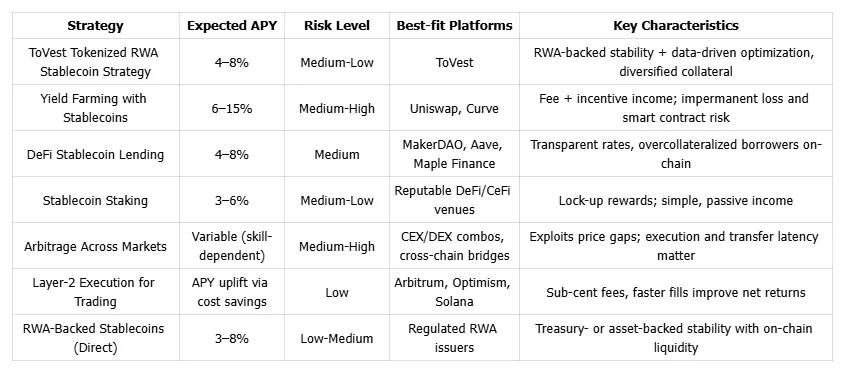
Note: Yields fluctuate. Always assess smart contract audits, counterparty risk, and regulatory considerations before deploying capital.
ToVest Tokenized Real-World Asset Stablecoin Strategy
RWA-backed stablecoins are digital assets issued on blockchain and collateralized by tangible assets such as real estate or U.S. Treasuries, offering strong regulatory compliance and lower price volatility. ToVest integrates tokenized assets directly into its stablecoin infrastructure, giving investors diversified exposure to non-crypto collateral—such as commercial property and short-duration T‑bills—while retaining the liquidity and programmability of stablecoins. This dual engine enables investors to seek both underlying asset stability and stablecoin-native yields (e.g., lending, staking) commonly in the mid-single-digit APY range, as mapped in comprehensive overviews of stablecoin yield strategies.
ToVest’s differentiator is its analytics: real-time reserve transparency, collateral health dashboards, and automated allocation tools that rebalance across venues to optimize risk-adjusted returns. For income-focused investors, this provides a compliant, data-driven route to consistent yield with lower volatility than speculative crypto assets. For a deeper dive into our methodology, see ToVest’s latest research brief.
Yield Farming with Stablecoins
Yield farming is the process of depositing stablecoins into DeFi liquidity pools to earn a share of trading fees and reward tokens, often resulting in higher yields than traditional savings. In 2025, demand for stablecoin liquidity remains robust: Uniswap’s highest-volume pools are stablecoin pairs driving hundreds of millions in daily volume, and Curve Finance holds over $15 billion in stablecoin liquidity—both signaling depth for fee-based yields, per the Stablecoin Insider Q4 dataset.
Platform quick view:
- Uniswap V3: Concentrated liquidity lets you target tight price ranges on stablecoin pairs, boosting fee APY but requiring active management.
- Curve Finance: Purpose-built for stablecoin swaps, offering competitive fees and, at times, incentives; tends to be more gas-efficient for large trades.
Risks to weigh include smart contract exploits, incentive dilution, and liquidity pool composition changes that can depress returns. Employ audited pools, caps on allocation, and periodic rebalancing.
Lending Stablecoins on DeFi Platforms
DeFi lending platforms allow users to supply stablecoins to borrowers in exchange for interest, with all transactions managed by smart contracts for auditability and security. Established protocols like MakerDAO (with on-chain, overcollateralized credit) and Maple Finance (serving institutions via permissioned pools) illustrate the breadth of counterparties and risk profiles accessible on-chain. Yields generally outpace bank accounts due to instant settlement, transparent risk pricing, and reduced intermediation layers—sitting around the 4–8% APY band on reputable venues, according to broad market surveys of stablecoin yield strategies.
Due diligence checklist:
- Review collateral types and loan-to-value parameters.
- Prefer audited, battle-tested smart contracts with track records.
- Diversify across protocols and maturities to smooth rate volatility.
Stablecoin Staking for Passive Income
Stablecoin staking involves locking up stablecoins in network contracts or DeFi projects to earn periodic rewards, often supporting network security and function. In 2025, select venues advertise yields around 4.1% on mainstream stablecoins like USDC, broadly comparable to high-yield cash savings but with on-chain liquidity and programmability, as highlighted in financial services analyses of tokenized cash adoption.
DeFi vs. CeFi:
- DeFi staking provides greater transparency and self-custody but requires wallet management and smart contract risk assessment.
- CeFi staking is simpler and may bundle insurance-like protections, but introduces counterparty and custodial risk.
Arbitrage Opportunities Across Stablecoin Markets
Stablecoin arbitrage is the practice of buying stablecoins at a lower price on one exchange and selling at a higher price on another, profiting from price discrepancies. As stablecoin usage spreads across Ethereum, TRON, Solana, and major exchanges, price gaps emerge due to liquidity fragmentation and varying fees—creating recurring opportunities noted across global use-case studies.
Common techniques:
- Spot exchange arbitrage: Buy on a discounted exchange; sell on a premium venue.
- Cross-network transfers: Bridge from a chain with lower demand to one with higher demand.
- Funding-rate capture: On perps markets, capture positive carry when stablecoin-margined contracts skew.
Basic execution steps:
- Monitor multiple exchanges and chains for >0.15–0.30% price gaps after fees.
- Pre-fund wallets and exchanges; whitelist addresses to speed withdrawals.
- Execute buy leg, initiate transfer/bridge, execute sell leg; track slippage and confirmations.
- Reconcile P&L, rotate capital, and automate alerts for repeatable setups.
Leveraging Layer-2 Solutions for Stablecoin Trading
Layer-2 solutions are secondary blockchains built atop main networks like Ethereum, designed to process transactions off-chain, then settle them on-chain, greatly increasing speed and reducing costs. For active stablecoin strategies, cheaper, faster execution directly boosts net returns by minimizing fee drag and failed transactions. Industry analyses of tokenized cash emphasize that next-gen payment rails now offer near-instant, low-cost settlement; for example, high-throughput chains such as Solana routinely confirm transfers in 1–2 seconds with sub‑$0.01 fees in normal conditions.
Where to deploy:
- Arbitrum and Optimism (Ethereum L2s): Mature DeFi ecosystems, strong stablecoin support (USDC, USDT, DAI).
- Solana (high-throughput L1): Extremely low fees and fast finality, expanding stablecoin venues and payment rails.
Tip: Keep some balance on L1 for bridging and on L2/high-throughput chains for trading to maximize flexibility.
Investing in Real-World Asset Backed Stablecoins
RWA-backed stablecoins—such as instruments collateralized by U.S. Treasuries or tokenized commodities—combine blockchain efficiency with real asset security and have attracted investors seeking 3–8% APY alongside high transparency, as summarized in market-wide yield guides. Examples include treasury-backed USD‑pegged tokens and commodity-collateralized options like gold-linked coins (e.g., Tether Gold), which can serve as a store of value with on-chain mobility.
Why it works:
- Regulated collateral and attestation frameworks enhance confidence.
- Short-duration government debt provides rate-based income with low duration risk.
- On-chain issuance and redemption mechanisms maintain peg and liquidity.
These instruments appeal to risk-averse investors who favor principal protection and predictable yield over speculative upside.
Automated Treasury Management Using Stablecoins
Automated treasury management uses programmable stablecoin transfers and smart contracts to streamline business payments, payroll, and cash reserves, increasing efficiency and potential yield. Enterprises increasingly deploy stablecoins to settle intra-company transfers instantly, reduce payroll friction across borders, and hedge local currency volatility—use cases widely recognized in 2025 adoption studies.
How a business sets it up:
- Segment cash: operating, buffer, and reserve tranches in multi-sig wallets.
- Automate disbursements: schedule payroll/vendor payments via smart contracts; set approvals in advance.
- Earn on reserves: allocate surplus to short-duration, audited lending or ToVest’s RWA stablecoin strategies with daily liquidity.
- Monitor and rebalance: use policy limits, real-time analytics, and alerts to keep utilization and risk within thresholds.
- Report and reconcile: export on-chain records to ERP tools for compliance and audit trails.
Result: Faster working-capital cycles, lower FX/transfer costs, and incremental yield on idle balances.
Frequently Asked Questions
What are the safest stablecoin strategies to earn passive income in 2025?
The safest options are lending and staking major stablecoins (e.g., USDC, DAI) on established, audited platforms with robust risk controls and transparent reserves.
How much annual percentage yield can I expect from stablecoin investments?
Most reputable platforms offer 3–8% APY for lending and staking, while well-managed yield farming can reach 10–15% APY with higher risk and active management.
What risks should I consider when investing in stablecoin yield strategies?
Consider smart contract exploits, counterparty default, liquidity shortfalls, regulatory changes, and collateral quality behind the stablecoins you use.
How do DeFi lending platforms differ from centralized interest accounts?
DeFi lending is governed by transparent smart contracts and on-chain collateral, while centralized accounts rely on custodians and offer simplicity but less transparency.
How should I choose which stablecoin is best for each investment strategy?
Prioritize widely adopted, transparently backed stablecoins supported by your chosen platform; USDC and DAI are common in DeFi, while ToVest’s RWA-backed coins suit conservative yield goals.