How On-Chain Stock Purchases Solve Access Barriers for International Investors
2 กุมภาพันธ์ 2569
Introduction to On-Chain Stock Purchases
On-chain stock purchases are tokenized representations of equities: real-world shares issued or mirrored as digital tokens that move on a blockchain. These tokens can be held in a wallet, transferred peer-to-peer, and governed by smart contracts, bringing transparency, programmability, and global reach to traditional securities.
The appeal is clear for international investors: tokenized stocks compress settlement times, remove geographic friction, and enable small-ticket, multi-currency participation. Institutional pilots have accelerated the trend—major asset managers and fintechs have explored tokenization of funds and public equities, with industry overviews noting a rapid expansion in real-world asset flows and tokenized fund experiments by blue-chip names like KKR’s healthcare strategy, which was fractionalized for broader access (see the World Economic Forum’s analysis of asset tokenization in financial markets). In short, tokenized stocks and digital securities put global access front and center, making blockchain investing a practical on-ramp for international portfolios.
Barriers International Investors Face in Traditional Markets
Cross-border brokerage access has long been constrained by geographic restrictions, complex onboarding, and fragmented post-trade plumbing. Legacy systems rely on multiple intermediaries, leading to extended settlement cycles, foreign exchange friction, and opaque fees.
Common access hurdles:
- Geographic restrictions and local brokerage limitations
- Complex onboarding/paperwork and slow approvals
- Multi-day settlement cycles (historically T+2/T+3; even as some markets move to T+1, cross-border cash and FX still add days)
- Currency conversion costs, spreads, and intermediary fees
- Minimum investment sizes that exclude smaller portfolios
Traditional vs. on-chain access at a glance:
- Traditional cross-border investing
- Location-gated onboarding via local broker/depository
- Fixed market hours; orders processed in limited windows
- Settlement via multiple intermediaries (clearing houses, custodians)
- FX and correspondent banking introduce delays and extra costs
- Minimums often high relative to local purchasing power
- On-chain access
- Wallet-based participation from nearly anywhere with connectivity
- 24/7 orderability and transferability
- Near-instant settlement on-chain
- Stablecoin rails reduce FX and bank friction delays
- Fractional ownership lowers entry thresholds
These frictions are amplified in dollar-centric flows: a large share of cross-border commerce and investment still leans on USD rails, and FX plus correspondent banking typically add multi-day settlement and reconciliation overhead, especially for emerging-market investors navigating limited dollar access (see Visa’s analysis of stablecoin-enabled, 24/7 settlement and reduced cross-border frictions).
How On-Chain Stock Purchases Address Access Challenges
Tokenized stocks enable programmable, borderless investing. By representing equities as digital tokens governed by smart contracts, platforms like ToVest can reduce or remove many bottlenecks in traditional cross-border investing.
Key mechanisms that reduce access barriers:
- Fractionalization for lower minimums
- 24/7 market access independent of exchange hours
- Near-instant, T+0 settlement
- Transparent, verifiable ownership records
- Automation of corporate actions and compliance workflows
- Stablecoin funding for faster, multi-currency participation
Each of these advantages is explored below with practical examples and implementation details.
Fractional Ownership and Lower Investment Minimums
Fractional ownership divides a high-value security into small token units—often purchasable for as little as a few dollars—so investors can buy precisely the exposure they want without the burden of whole-share minimums. Smart contracts administer issuance, transfers, and economic rights transparently, allowing auditable on-chain cap tables and clear ownership provenance.
Industry examples underscore the direction: KKR’s healthcare fund was tokenized to expand access to smaller tickets, and RWA platforms continue to attract sizable inflows as fractionalization lowers thresholds for global investors (summarized in the World Economic Forum’s tokenization report). Chainlink’s overview of fractional ownership details how smart contracts enforce divisibility and transfer rules while preserving economic entitlements.
A simple $5 flow on ToVest:
- Open a ToVest account (no minimums) and complete quick KYC.
- Fund with fiat or stablecoins (USDC/USDT).
- Select a tokenized stock and enter $5 as your purchase amount.
- Confirm; your wallet receives fractional tokens representing your pro-rata economic interest.
- Track holdings in real time; buy or sell additional fractions anytime.
Continuous 24/7 Global Market Access
Traditional equity markets operate in fixed windows—e.g., U.S. exchanges run Monday–Friday during set hours—forcing international investors to trade at inconvenient times or wait. On-chain markets, including those on ToVest, operate continuously.
Quick comparison:
- Traditional hours: Limited daily windows, weekend/holiday closures, and after-hours liquidity constraints.
- On-chain access: Around-the-clock trading and transfers that meet investors where they are, regardless of time zone.
This always-on design reduces idle periods and lets emerging-market investors react to news events in real time, rather than waiting for a distant market to open (see tokenization finance overviews tracking the 24/7 turn in digital markets).
Near-Instant Settlement and Reduced Costs
A settlement cycle is the time it takes to finalize ownership transfer and payment after a trade. While leading markets have shortened timelines, cross-border flows still involve multiple intermediaries, netting/batching, and FX legs that add delays. On-chain settlement is typically T+0, finalizing in minutes or seconds as transactions are validated on the ledger.
As one legal overview puts it, “On-chain direct settlement enables securities to be transferred and finalized nearly instantly, bypassing legacy clearing systems.” Blockchain rails compress back-office workflows, reduce batch-based processing, and can lower both transaction and counterparty costs by minimizing intermediaries. Visa’s research on stablecoin infrastructure further highlights how programmable, 24/7 settlement can remove multi-day currency conversion delays and reduce frictions that disproportionately affect non-local investors.
Enhanced Transparency and Auditability
Blockchains create public, tamper-resistant ledgers that show issuance, transfers, and current balances. This transparency allows real-time verification of holdings and a shared source of truth across participants.
Why this matters for international investors:
- Real-time audits of token supply and transactions
- Direct verification of share ownership without opaque sub-custody chains
- Simplified due diligence and monitoring of counterparties
Academic and industry research has consistently found that immutable ledgers lower fraud risk and improve trust in digital financial services—critical when investing across borders with limited recourse (see research on blockchain’s impact on financial services).
Automation of Corporate Actions
Corporate actions—dividends, splits, voting, and cap table updates—often involve manual workflows, custodial messaging, and reconciliation across borders. Smart contracts can automate these steps.
Example: automatic dividend distribution
- Record date is captured on-chain; token holders at that block height are eligible.
- A smart contract calculates each holder’s pro-rata entitlement.
- Funds (e.g., stablecoins) are disbursed automatically to eligible wallets.
- An immutable record of distribution is written to the ledger for audit.
This automation reduces errors, shortens timelines, and lowers the paperwork burden that often deters smaller, international investors.
Access to Stablecoins and Multi-Currency Funding
Stablecoins are cryptocurrencies designed to maintain a peg to fiat currencies (commonly the U.S. dollar). They enable rapid, borderless value transfer and programmable settlement.
For global investors, stablecoins unlock:
- Real-time funding and repatriation without multi-day bank wires
- Reduced FX friction and fewer correspondent links
- 24/7 participation in markets, including weekends and holidays
Visa’s analysis of stablecoin settlement describes how programmable, always-on payments can streamline cross-border investment flows. ToVest supports both fiat funding and major stablecoins (USDT/USDC), helping international users fund and trade instantly—no account minimums, multi-currency rails, and near-instant settlement by design.
Key Advantages of On-Chain Stocks for Global Investors
The benefits of tokenized stocks compound: fractional entry, 24/7 access, instant settlement, transparent records, and automated corporate actions—plus stablecoin-based funding—combine to create a borderless, investor-friendly experience.
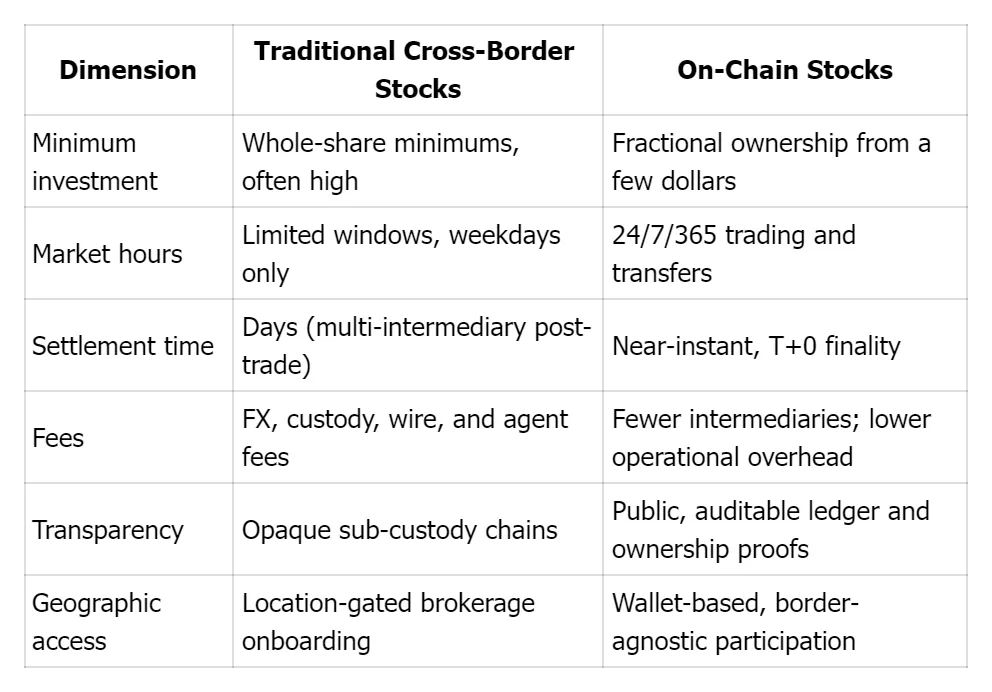
This is blockchain accessibility in action: instant settlement, borderless trading, and global stock investing that meets users where they live and transact.
Regulatory and Custodial Considerations
Hybrid tokenization models are common today. Legal title to underlying shares often remains off-chain with a regulated custodian or SPV, while the on-chain token reflects economic ownership and transfer rights. This structure bridges new and legacy systems, but it also raises design and compliance questions that are still evolving (see practical legal guides to stock tokenization).
Key issues to understand:
- System of record: Which ledger (on-chain vs. transfer agent) is definitive for ownership?
- Custody: How tokens map to beneficial ownership and how assets are safeguarded.
- Jurisdiction: How local securities laws treat tokenized instruments and cross-border transfers.
- Investor protections: Disclosures, suitability, and recourse mechanisms for retail investors.
- Interoperability: Integrating on-chain rails with existing clearing, settlement, and banking systems.
Regulatory considerations at a glance:
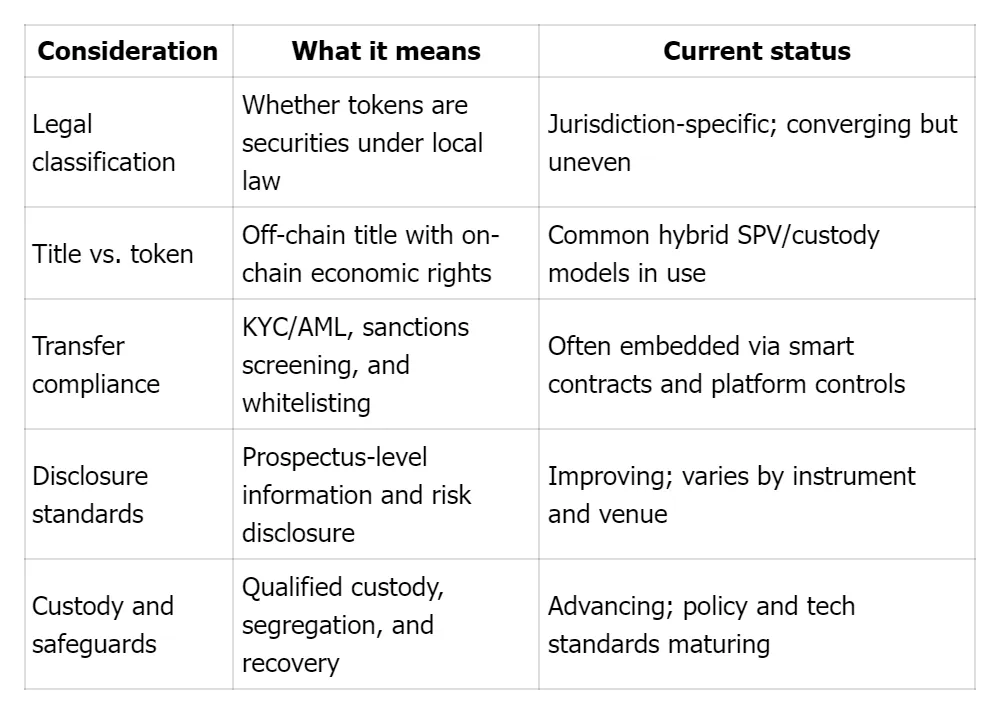
Authoritative academic work surveys these questions and the path toward harmonized frameworks and investor protections in tokenized securities.
Current Market Trends and Adoption for Tokenized Stocks
Pilots and institutional actions are expanding:
- Tokenized funds and equities: KKR’s healthcare strategy tokenization demonstrated how fractionalization can open access to traditionally gated vehicles (reviewed in the WEF tokenization report).
- RWA momentum: Platforms across major chains report rising inflows into tokenized treasuries, funds, and equities as infrastructure matures.
- Market size and forecasts: Industry analyses estimate hundreds of millions in tokenized stock float today, with broader asset tokenization expected to surge—some outlooks cite a multi-trillion-dollar on-chain asset base by 2030 as infrastructure and regulation mature.
Select milestones and direction of travel:
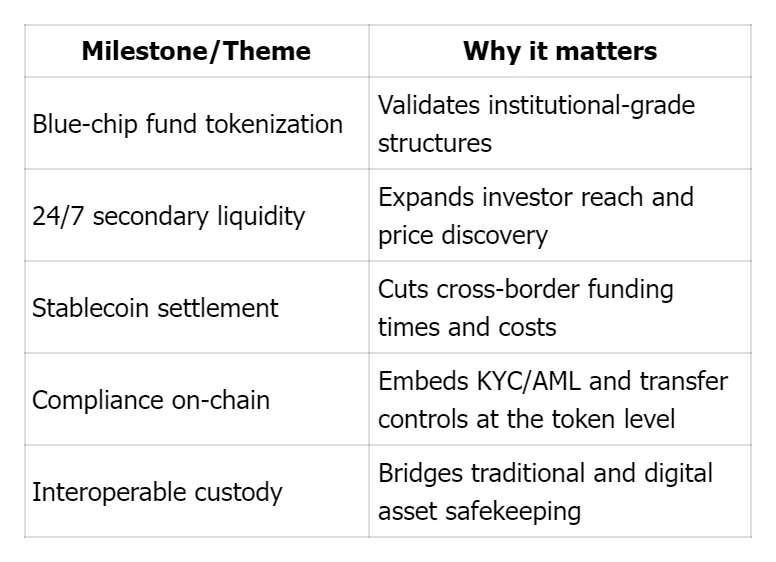
For deeper snapshots of adoption, see overviews tracking tokenization finance and legal roadmaps for stock tokenization.
Future Outlook for On-Chain Stock Investments
Forecasts suggesting trillions of dollars in tokenized assets by 2030 indicate a durable shift toward next-generation capital markets. If realized, this could democratize global investing by compressing ticket sizes, settlement times, and geographic barriers—especially for international retail and long-tail institutions.
What must improve:
- Clear, interoperable regulatory frameworks
- Deeper liquidity and robust market-making
- Scalable, interoperable custody and identity solutions
- Seamless integration with banking, FX, and market data
Likely trends:
- Greater institutional participation and standardized token formats
- Regulatory clarity that formalizes hybrid models and investor protections
- A gradual blurring of borders as 24/7, wallet-native rails become mainstream
Risks remain—policy divergence, custody recovery mechanics, and platform concentration—so investors should evaluate regulatory status, safeguards, and governance before participating (see legal and academic perspectives on tokenized securities).
Frequently Asked Questions
What Are On-Chain Stock Purchases?
On-chain stock purchases are digital tokens that represent shares of a company and trade on a blockchain, enabling transparent, programmable access to traditional equities.
How Do On-Chain Stocks Remove Geographic and Regulatory Barriers?
Investors can use blockchain wallets to buy and sell worldwide, with compliance integrated into smart contracts, minimizing reliance on location-bound brokerages and intermediaries.
Can International Investors Trade On-Chain Stocks Anytime?
Yes. Tokenized equities can trade 24/7, allowing investors in any time zone to participate without waiting for foreign exchange hours.
How Is Security and Compliance Ensured on Blockchain Platforms?
Platforms utilize auditable ledgers, smart contract controls, and integrated KYC/AML to align with securities rules and protect investors.
What Are the Risks and Limitations for International Investors?
Key risks include evolving regulations, custody recovery mechanics, and varying liquidity; review a platform’s regulatory posture, disclosures, and safeguards before investing.