How to Invest Worldwide Using Only USDT in Five Simple Steps
18 ธันวาคม 2568
Investing worldwide using only USDT is both practical and fast. As a stablecoin pegged 1:1 to the U.S. dollar, USDT allows you to move value across borders in minutes, trade 24/7, and access a diverse range of markets without currency conversion. In five steps—buying USDT, choosing trading pairs, executing orders, tapping DeFi, and monitoring your portfolio—you can build a globally diversified strategy powered by a single asset. As a regulated fintech, ToVest bridges traditional finance and blockchain by offering 24/7 access to tokenized shares and compliant USDT-based trading, providing investors with a modern alternative beyond conventional stock exchanges. Below is a crisp, stepwise playbook to get started, featuring best practices to keep costs low and risks in check.
Step 1 Purchase USDT on a Reputable Exchange
USDT (Tether) is a widely used stablecoin pegged to the U.S. dollar, designed to provide price stability and seamless digital transactions. The most secure way to acquire it is through major, compliant exchanges. On platforms like ToVest, Binance, Coinbase, or Kraken, the flow is straightforward: create an account, complete identity verification (KYC), deposit fiat via bank transfer or card, and execute a USDT purchase. A practical walkthrough of account setup, KYC, funding methods, and fee trade-offs is available in the beginner-friendly guide from 99Bitcoins on how to buy USDT.
Bank transfers typically offer lower fees; cards are faster but can cost more. Some users opt for P2P marketplaces to buy USDT without KYC, but that comes with higher fraud risk—always verify seller ratings, escrow protections, and platform security. If you intend to invest across regulated venues (including tokenized assets), sticking to reputable exchanges and maintaining clean KYC records will aid ongoing compliance and facilitate smoother withdrawals.
Step 2 Choose Suitable USDT Trading Pairs for Global Markets
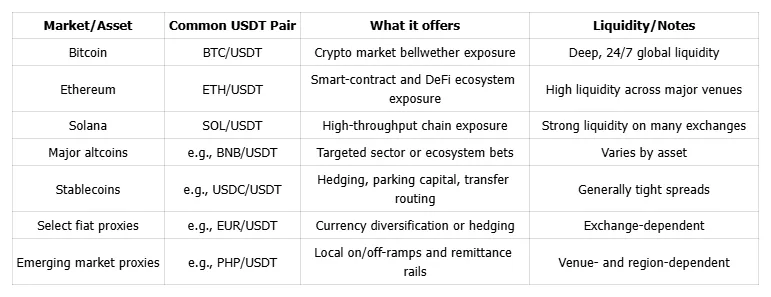
A trading pair lets you exchange one asset for another (for example, BTC/USDT to buy Bitcoin using USDT). Given USDT's ubiquity, USDT trading pairs are among the most liquid in global cryptocurrency markets—helpful for fast execution and tight spreads. Your selection of pairs should align with your target exposure: crypto majors for broad market beta, stablecoin pairs for hedging, or fiat pairs (where available) to express currency views—altogether providing global optionality through digital asset liquidity.
Typical USDT pairs you’ll encounter
Regulated platforms like ToVest also offer USDT-denominated access to tokenized shares, enabling around-the-clock exposure to digitized equities alongside traditional crypto pairs. For a deeper primer on tokenized markets and methods, see the ToVest Academy.
Step 3 Execute Trades Using USDT for Efficient Transactions
Order types define how you enter the market. Market orders execute immediately at the current price—useful when speed matters. Limit orders let you set an exact price to buy or sell, improving cost control in fast-moving markets. A practical approach: use market orders for small, time-sensitive trades; use limit orders when sizing up or targeting a specific entry/exit.
USDT’s stable nature reduces the need to time conversions and enables near-instant, cross-border value transfer with lower fees than many bank wires. For moving USDT between platforms, networks like TRON (TRC-20) or Solana are often preferred for speed and low costs; Coins.ph’s guide to mastering USDT covers network choices, fees, and risk tips for trading and transfers. For real-world use cases (payments, remittances, settlement) that highlight why USDT is effective for global participation, see this overview of practical USDT applications from Material Bitcoin.
Simple trading flow:
- Fund your exchange wallet with USDT.
- Choose the target pair (e.g., ETH/USDT).
- Select order type: Market for instant fills; Limit to control price.
- Confirm fees, set size, and place the order.
- Withdraw or redeploy USDT as needed, selecting fast, low-fee networks for transfers.
Step 4 Utilize DeFi Platforms to Maximize USDT Investment Returns
Decentralized finance (DeFi) provides non-custodial financial services—lending, borrowing, and yield opportunities—without intermediaries. On established protocols such as ToVest, Aave, or Compound, you can supply USDT to earn passive income, or borrow against USDT to access leverage or liquidity without selling core holdings. Typical flow: connect a wallet, choose USDT markets, review variable APYs, and deposit with a clear exit plan.
Key advantages include borderless access, 24/7 markets, and granular control of funds. However, DeFi carries risks: smart contract vulnerabilities, collateral liquidation, stablecoin de-pegging, and changing incentives. A thorough USDT investment analysis from The Standard discusses peg dynamics, transparency debates, and risk considerations—use it to inform platform selection and position sizing. Favor audited protocols, diversify across venues, and size conservatively relative to your risk tolerance.
Common use cases to explore:
- DeFi USDT yield via lending pools
- Borrowing against USDT for working capital or hedged strategies
- Providing liquidity in balanced pools to earn fees (with impermanent loss awareness)
Step 5 Monitor and Adjust Your USDT Investment Portfolio
A USDT-only strategy still requires active oversight. Track portfolio performance, exchange fees, network costs, and the relative yields you’re earning on DeFi platforms. Monitor stablecoin market news, protocol audits, and Tether’s reserve disclosures to stay ahead of risk. When conditions change—spreads widen, yields compress, or regulations shift—rebalance promptly.
Practical adjustment ideas:
- Diversify stablecoin exposure (e.g., part USDT, part USDC/DAI) to distribute issuer and regulatory risk.
- Rotate between venues with better liquidity, fees, or yields.
- Set automated alerts for price, funding rates, and APY shifts.
- Keep detailed records for tax and compliance, especially if operating across jurisdictions.
Sample weekly routine:
- Review positions, P&L, and fee impacts.
- Rebalance target allocations and stablecoin mix.
- Check DeFi health factors and collateral buffers.
- Test small withdrawals on your chosen network to validate routes.
- Update a compliance checklist and store reports centrally.
Best Practices for Investing Worldwide with USDT
- Prefer reputable, compliant exchanges and audited DeFi protocols; security and compliance discipline minimize operational surprises. The Standard’s comprehensive USDT analysis emphasizes why platform and issuer risks should be integral to your plan.
- Expect regulatory differences across countries; stay informed and document your activity.
- Diversify within stablecoins and across platforms to reduce concentration risk.
- Use automation (rules-based rebalancing or bots) to execute consistently and mitigate emotional decisions; Coinrule’s automation toolkit serves as a practical example of rules-based crypto trading.
- Optimize transfers by selecting low-fee, high-speed networks and batching moves when possible.
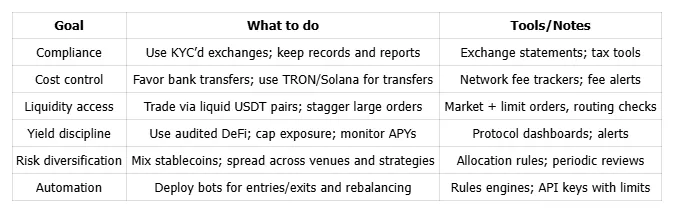
Best practices at a glance
For deeper education on tokenized assets and risk management, explore the ToVest Academy and market reports.
Frequently Asked Questions
Is USDT safe for worldwide investments?
USDT is widely used due to its dollar peg and liquidity, but it's essential to consider peg, platform, and regulatory risks while choosing compliant venues.
How can I buy USDT securely for international investing?
Open an account with a reputable exchange, complete KYC, fund using trusted payment methods, and compare fees before purchasing.
What types of global investments accept USDT deposits?
Exchanges, DeFi platforms, and regulated tokenization venues accept USDT for trading crypto, earning yields, and accessing tokenized assets.
What are the risks of relying solely on USDT for worldwide investing?
Key risks include a potential de-peg, protocol or counterparty failures, and regulatory changes; diversify and monitor disclosures to mitigate.
How can I effectively manage my USDT portfolio for global markets?
Set a review cadence, automate alerts and rules, rebalance as conditions change, and maintain thorough records for compliance.