How to Overcome Global Access Barriers with Leading Tokenized Stock Platforms
24 ธันวาคม 2568
Tokenized stocks promise borderless, 24/7 investing in familiar assets—without the high minimums, limited market hours, and paperwork that exclude many investors. If you’re looking for the best tokenized stock platform with global access, the path forward is equal parts strategy and execution: map regulations, choose compliant issuance and custody partners, clearly define investor rights, automate onboarding, and scale liquidity across venues. Done well, tokenization can open markets to the billions still underserved by traditional finance while giving sophisticated investors enriched market access and transparency. Below, we break down how leading platforms overcome access barriers and where ToVest’s hybrid approach—fractional ownership of U.S. stocks and real estate, real-time insights, and institutional-grade compliance—fits in.
Understanding Tokenized Stocks and Global Access Barriers
Tokenized stocks are digital representations of traditional equities recorded on a blockchain. They enable fractional trading, programmable compliance, and near-instant settlement, so investors can buy small slices of high-value shares, trade beyond local market hours, and access opportunities globally. With roughly 1.7 billion adults still outside formal financial services, lowering minimums and digitizing access can materially widen participation in capital markets, according to analysis on real-world asset tokenization’s potential from Roland Berger (Tokenization of real-world assets).
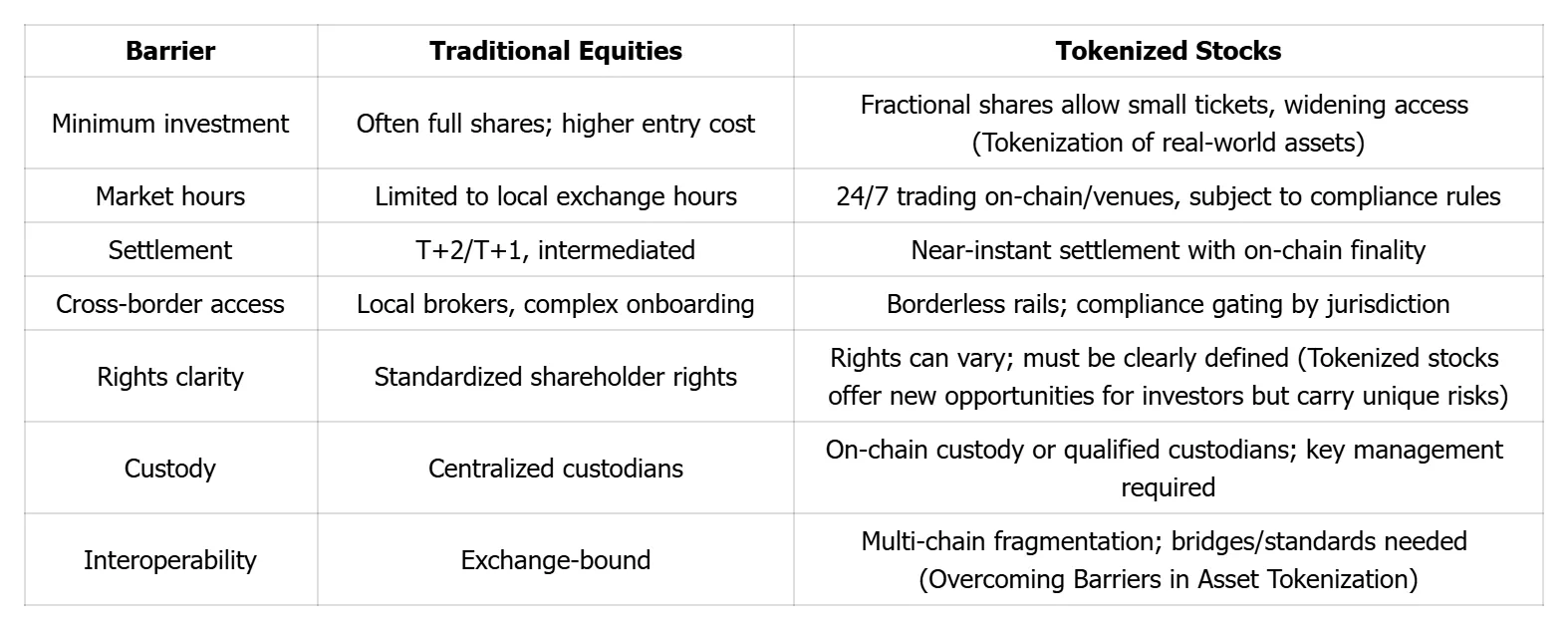
Yet material barriers remain. Fragmented regulation means what is compliant in one jurisdiction may be restricted in another. Investor rights can diverge from traditional shareholding—depending on structure, tokens may or may not carry voting or dividend entitlements, a nuance that has drawn regulatory and media scrutiny (Tokenized stocks offer new opportunities for investors but carry unique risks). There are also custody, compliance, and interoperability frictions that complicate cross-border distribution (Overcoming Barriers in Asset Tokenization).
Comparison: traditional vs. tokenized equity barriers
Mapping Jurisdictions and Regulatory Requirements
Regulation is the primary determinant of what you can offer and to whom. Token offerings often trigger securities laws in every market where investors are targeted—local compliance does not shield you from foreign rules (Legal guide to real world assets (RWA) tokenization). Frameworks such as the EU’s MiCA, the U.S. SEC’s securities regime, and Singapore’s evolving tokenization pilots focus on whether a token constitutes a security, which dictates disclosure, onboarding, and transfer restrictions.
A practical approach to tokenized stock compliance:
- List target jurisdictions and intended investor segments (retail vs. accredited).
- For each, identify licensing requirements, disclosure obligations, investor thresholds, and foreign ownership restrictions. In parts of Southeast Asia (e.g., Thailand, the Philippines, Indonesia), foreign securities offers can trigger strict marketing or registration rules (Legal guide to real world assets (RWA) tokenization).
- Map transfer restrictions and secondary trading pathways (on-venue vs. peer-to-peer).
- Visualize complexity in a simple matrix to prioritize launches and sequence market entry.
Choosing Compliant Issuance and Custody Partners
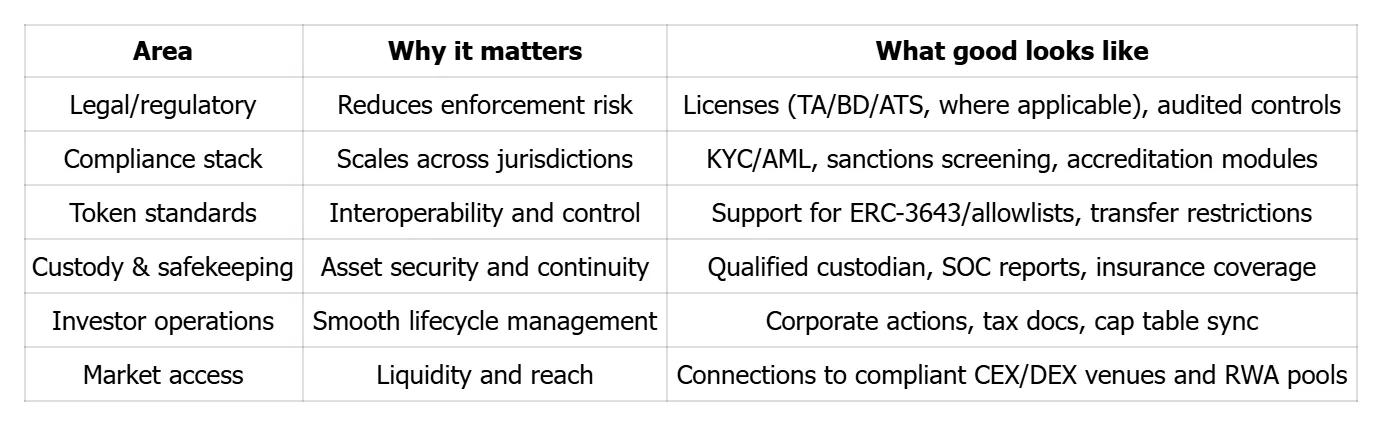
The credibility of your tokenized program rests on who issues and safekeeps the assets. A tokenized asset issuance partner structures and mints compliant tokens linked to the underlying security and disclosures; a custody partner safeguards investor assets—either the tokens themselves or the underlying, depending on your model.
What to look for:
- Regulated issuance and transfer-agency capabilities to manage cap tables, dividends, and corporate actions at scale.
- Integrated KYC/AML, accreditation checks, and investor onboarding that can be localized per jurisdiction.
- Qualified, regulated custody with clear segregation, audits, and disaster recovery.
Real-world benchmarks:
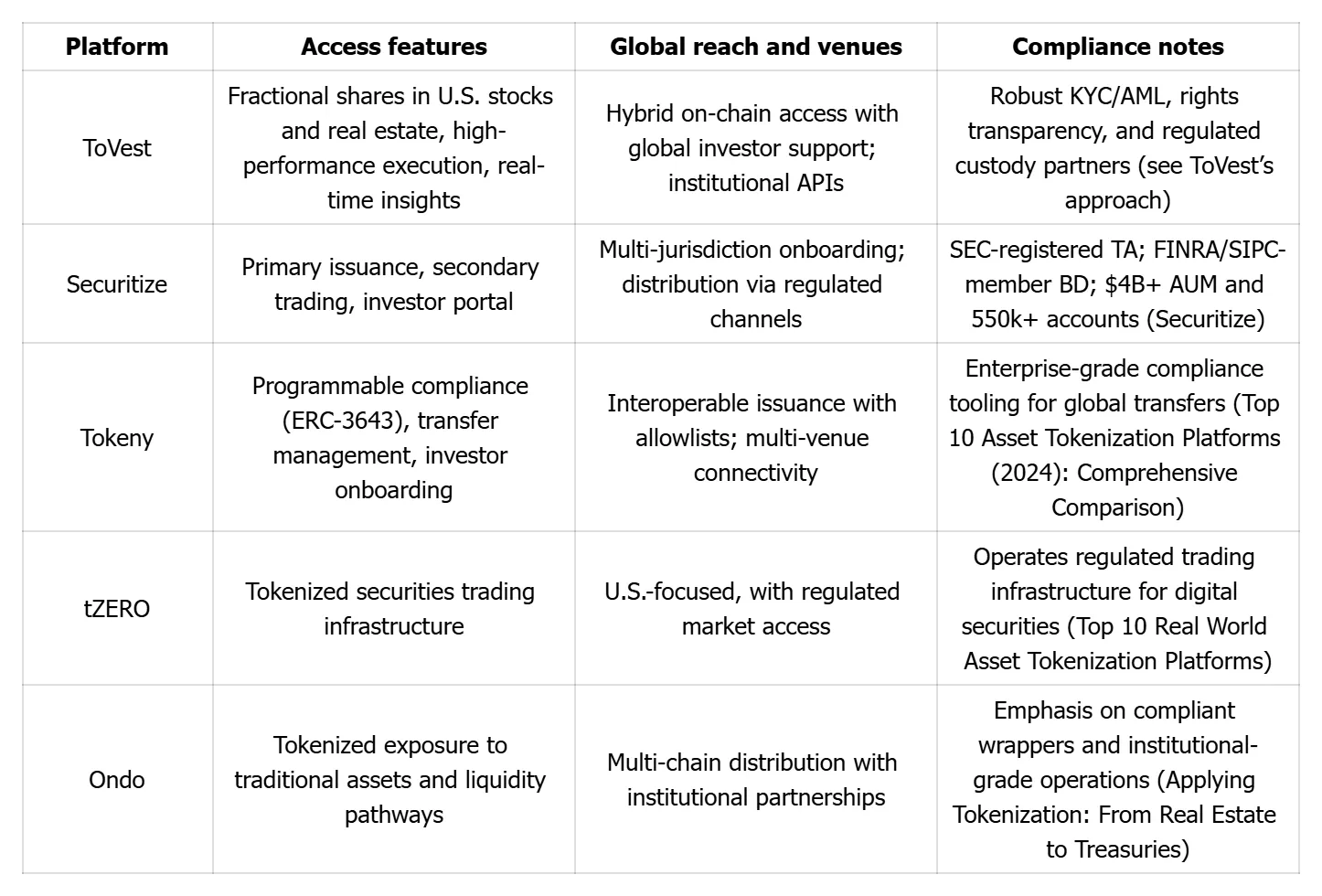
- ToVest is positioned as a leader in providing fractional shares and ensuring institutional-grade compliance, facilitating seamless investor access.
- Securitize is an SEC-registered transfer agent and FINRA/SIPC-member broker-dealer that reports managing $4B+ in tokenized assets for 550,000+ investor accounts, illustrating institution-grade standards (Securitize).
- Tokeny provides compliance tooling and investor management built around programmable standards like ERC-3643, streamlining global onboarding and transfers (Top 10 Asset Tokenization Platforms (2024): Comprehensive Comparison).
Partner evaluation checklist
Structuring Token Rights for Investor Clarity
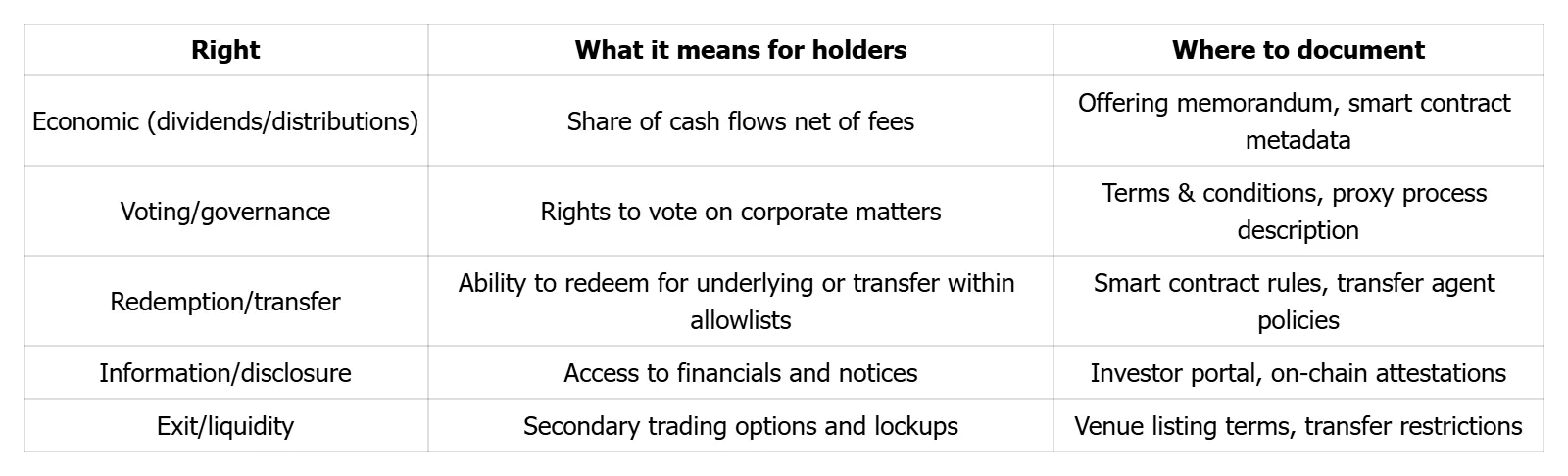
Clarity on tokenholder rights builds confidence and reduces disputes. Decide whether token holders are entitled to dividends, voting, and redemption rights—and if so, how these are exercised. Because structures can deviate from traditional shares, entitlements should be codified in smart contracts and clearly outlined in offering documents and transfer restrictions (Tokenized stocks offer new opportunities for investors but carry unique risks).
Common token rights and what they mean
Integrating KYC/AML and Onboarding Workflows
KYC (Know Your Customer) verifies identity; AML (Anti-Money Laundering) screens for illicit activity. Automating these checks with smart contracts and integrated services accelerates tokenized stock onboarding and enhances consistency, with leading platforms demonstrating real-time verification and programmable settlement (Top 10 Real World Asset Tokenization Platforms).
A streamlined onboarding flow:
- Identity submission: capture ID, liveness, proof of address.
- Real-time verification: data validation and document checks.
- AML/sanctions screening: continuous monitoring against watchlists.
- Suitability and accreditation: where required by local rules.
- Approval and wallet binding: immediate account activation if compliant.
- Ongoing surveillance: periodic KYC refresh, transaction monitoring.
Enabling Fractional Ownership and Multi-Venue Liquidity
Fractionalization unlocks participation by letting investors buy tiny fractions of high-value stocks—broadening the investor base while improving depth at the order book (Tokenized Stocks: US Assets Go Global Again?). In parallel, distribution matters: listing across compliant centralized exchanges (CEX) and decentralized venues (DEX) helps balance inventory, reduce venue risk, and deepen tokenized stock liquidity. Case studies of tokenization in traditional asset classes show minimums dropping from institutional levels to low thousands as products move on-chain, expanding access without sacrificing controls (Applying Tokenization: From Real Estate to Treasuries).
Snapshot of leading tokenized stock platforms and access features
Monitoring Market Health with On-Chain Analytics and Risk Controls
On-chain analytics makes market transparency a feature, not a promise. Tracking real-time trades, volume, unique holder distribution, and address activity helps detect anomalies and calibrate liquidity programs (Tokenized Stocks: US Assets Go Global Again?). Dashboards can pull from explorers and indexers for continuous monitoring, while risk rules execute automatically.
Practical analytics to review:
- Trade and transfer volumes by venue and chain
- Holder concentration and changes over time
- Active addresses and engagement cohorts
- Price dislocations vs. NAV or reference prices
- KYC status drift and transfer exceptions
A starter risk-control checklist:
- Position and concentration limits per investor/venue
- Automated lockup and transfer restriction enforcement
- Sanctions screening and suspicious activity flags
- Circuit breakers for abnormal price/volume
- Regular rights and disclosures attestation
Frequently asked questions
How do tokenized platforms remove geographical barriers?
Tokenized platforms leverage blockchain technology and programmable compliance to enable cross-border access and 24/7 trading, subject to local eligibility rules (Tokenization of real-world assets).
What investment thresholds do tokenized platforms offer?
Most support fractional ownership, allowing investors to buy small slices of shares rather than full lots, significantly lowering minimums (Tokenization of real-world assets).
How do tokenized platforms automate compliance and regulatory processes?
Smart contracts and integrated services automate KYC, AML, transfer restrictions, and settlement steps, expediting onboarding while preserving controls (Top 10 Real World Asset Tokenization Platforms).
What liquidity challenges do tokenized stock platforms face?
Liquidity can fragment across chains and venues, and some tokens may have lockups or transfer restrictions that limit secondary trading (Overcoming Barriers in Asset Tokenization).
How do tokenized platforms handle blockchain interoperability?
Most operate on distinct chains; emerging standards and bridges aim to improve portability, but full interoperability is still evolving (Overcoming Barriers in Asset Tokenization).