Earn Consistent High Returns by Staking Stablecoins on Trusted Exchanges
17 ธันวาคม 2568
Stablecoin staking has become a go-to strategy for investors who want predictable yield without the wild price swings of most crypto. With USDT, USDC, and other large stablecoins now representing the vast majority of stablecoin market value, liquidity and access are broadening across vetted venues, making it easier to earn from tokenized cash while managing risk through diversification and controls (see this overview showing six largest stablecoins account for most market value). ToVest’s mission is to democratize digital asset investing through secure infrastructure and clear guidance, helping investors identify stablecoin investment opportunities and stake confidently on trusted exchanges. In this guide, you’ll learn what stablecoin staking is, how to start, where to stake, how to maximize returns, and how leading platforms manage risk for principal protection.
Understanding Stablecoins and Their Role in Investing
Stablecoins are digital tokens pegged to fiat currencies like the US dollar, typically backed by reserves and attestation reports. Their design aims to hold a steady value, limiting volatility relative to other cryptocurrencies and enabling efficient, programmable money flows often described as tokenized cash. For a deeper primer, see McKinsey’s analysis of tokenized cash and payments.
Unlike traditional cryptocurrencies that can swing dramatically, stablecoins function more like on-chain cash: a medium of exchange, unit of account for trading pairs, and a yield-bearing asset when lent or staked. USDT, USDC, and DAI are among the most used—powering lending, staking, and acting as on-ramps into DeFi and tokenized investment platforms. For risk-conscious investors, staking stablecoins can provide steady returns while keeping price exposure low, especially when diversified across regulated venues and audited protocols.
Choosing a Trusted Exchange for Stablecoin Staking
Selecting where to stake is as important as what to stake. Focus on:
- Reputation and regulatory status (licenses, jurisdictions, MiCA readiness)
- Audits and proof-of-reserves disclosures
- Security posture (hardware security modules, cold storage, 2FA/U2F)
- Clear fee schedules and transparent reward mechanics
- Payout terms (frequency, lockups, early withdrawals)
- User experience and customer support
To compare options, start with a best crypto staking platforms comparison that tracks APYs, lockups, and fees across major exchanges and yield products. For a broader view of stablecoin markets and venue quality, a stablecoin exchanges overview can help you assess liquidity, pairs, and security practices.
What is a staking platform? In practice, it’s a venue—centralized or decentralized—that aggregates user deposits of digital assets and routes them into yield sources (e.g., lending desks, market-making, DeFi pools), returning rewards on a schedule. Centralized exchanges and crypto lenders such as ToVest, Binance, Kraken, and Nexo streamline onboarding with KYC and often offer flexible withdrawals, while DeFi protocols favor self-custody and transparency over ease of use.
Illustrative comparison (rates vary by region and change frequently):
- ToVest: Competitive APY options with a focus on user support; no lock; regular payouts
- Coinbase: USDC up to ~5.1% APY; no lock; regular payouts; USDC-focused
- Kraken: USDC around mid–single-digit APY where available; bi‑weekly payouts; instant unstake
- Binance: flexible and fixed promotions; tiered APY; broad stablecoin support
- OKX: wide asset coverage; time-limited promos that can reach higher APYs
Regulation matters. In Europe, MiCA is shaping stablecoin issuance, disclosures, and risk management, which in turn influences how platforms structure yield and pass returns to users (see tokenized cash insights from McKinsey).
ToVest differentiates by integrating vetted partners, emphasizing security-by-design, and providing clear workflows and education so investors can onboard, stake, and monitor positions within a transparent, regulated fintech framework.
Setting Up Your Account and Completing Verification
Getting started is straightforward:
- Create an account on your chosen exchange or lender.
- Complete identity verification (KYC/AML) by submitting a government ID and, if required, proof of address.
- Enable security controls: 2FA (authenticator app), withdrawal allowlists, and anti-phishing codes.
- Connect or whitelist your wallet and preferred networks (e.g., Ethereum, Tron, Base).
- Review proof-of-reserves and security pages; understand fees and payout cadence.
KYC—“Know Your Customer”—is a regulatory requirement that verifies your identity to prevent fraud and money laundering. All major centralized exchanges require KYC; most DeFi protocols do not. A practical staking stablecoin guide explains how regulated venues improve principal security while DeFi prioritizes self-custody and permissionless access. Leading exchanges protect user data with encryption, strict access controls, and periodic security audits.
Depositing Stablecoins and Selecting Staking Options
Funding your account:
- Deposit via bank transfer to buy USDC/USDT (where available) or transfer stablecoins from your wallet.
- Confirm the network (ERC-20, TRC-20, Solana, etc.) and mind gas fees and any platform-specific deposit charges.
- Wait for confirmations; then allocate to your chosen staking or earn product.
Common staking choices:
- Flexible staking: withdraw anytime; typically lower APY but high liquidity.
- Fixed/locked staking: higher APY for committing funds for a set term.
- DeFi lending pools and liquidity mining: protocols where users supply capital to smart contracts that lend or facilitate trading; returns come from interest and fees, but risks are higher due to smart contract and market dynamics. A staking stablecoins guide outlines these mechanisms for newcomers.
Representative yields and terms (illustrative; subject to change):
- ToVest: Competitive rates tailored for stability and security; APY may vary
- Coinbase (USDC): up to ~5.10% APY; instant access
- Kraken (USDC): ~5.5% APY; bi‑weekly payouts; instant unstake
- OKX: promos up to ~20% APY on select terms
- Aave (DeFi USDC): ~4–7% APY; no minimum deposit
- Maple Finance (institutional lending): up to ~23% APY; higher risk
For current ranges and how to source them, see this USDC yield guide that compares centralized and DeFi options. Always review lock-up periods, minimums, tiered rates, and incentive programs that can boost APY for limited allocations.
Monitoring Your Staking Returns and Managing Risks
Stay proactive:
- Check staking dashboards weekly to confirm balances, APY changes, and payout frequency.
- Track announcements for promotions, rate revisions, and security updates.
- Reassess venue concentration and counterparty exposure monthly.
APY—Annual Percentage Yield—is the compounded yearly return you earn from staking or lending assets.
Key risks to manage:
- Platform risk: hacks, insolvency, operational failures
- Smart contract risk in DeFi: bugs, exploits, oracle failures
- Regulatory risk: new rules may affect yields or product availability
- Stablecoin de‑pegging: loss of the 1:1 peg can impact principal
A concise stablecoins investing overview explains why these risks exist and how conservative allocation and diversification help. For DeFi products, a stablecoin yield strategies explainer stresses reviewing audits, bug bounties, and protocol track records.
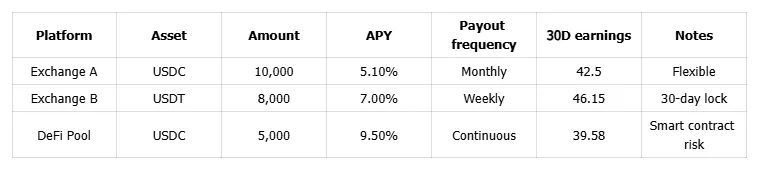
Sample tracking template:
Withdrawing or Reinvesting Your Earnings for Growth
Most trusted platforms support flexible withdrawals or scheduled redemptions, giving you liquidity for rebalancing or taking profits. If compounding is your goal, auto-compounding products can reinvest rewards for you; for example, OUSD auto-compounding credits yield directly into your balance without manual locking, simplifying growth while you maintain token liquidity.
Decide periodically whether to:
- Reinvest to compound and target higher long-term returns
- Rotate into higher-yield, higher-risk opportunities with capped allocations
- De-risk by moving a portion into more conservative venues or cashing out to fiat
Best Practices to Maximize Stablecoin Staking Returns
- Diversify across venues and strategies: split allocations among trusted exchanges (CeFi) and audited DeFi pools to reduce concentration risk.
- Monitor regulatory updates (e.g., MiCA), platform upgrades, and time-limited campaigns.
- Favor platforms with rigorous audits, proof-of-reserves, and clear collateral policies.
- Practice wallet security: password managers, 2FA/U2F, hardware wallets for un-staked funds.
- Match strategy to risk profile. Examples tracked by practitioners include Balancer GO/USDC pools (often mid-teens APY, low complexity), Ether.fi Cash for autonomous cash-like yields, and advanced “Core” strategies that can exceed 30% APY but demand expert risk controls; see stablecoin yield strategies for 2025 for concrete, risk-tagged playbooks.
- Sanity-check sustainability: if an offer looks too good to be true, it usually is. Validate sources of yield, counterparty risk, and capacity caps.
For deeper education and research-backed frameworks, visit ToVest Academy.
Frequently Asked Questions about Staking Stablecoins
What are stablecoins and why are they considered stable?
Stablecoins are cryptocurrencies designed to track a reference value—usually $1—by holding reserves or using mechanisms that stabilize price, making them far less volatile than typical crypto.
How does staking stablecoins work on centralized and decentralized platforms?
You allocate stablecoins to an exchange or protocol that lends or deploys them; in return, you earn interest. Centralized platforms abstract the mechanics and custody, while decentralized platforms use smart contracts you interact with via a wallet.
What returns can I realistically expect from staking stablecoins?
Across mature venues, 3%–10% APY is common; promotional offers and advanced DeFi strategies can be higher but typically carry more risk and complexity.
What are the main risks involved in staking stablecoins?
Risks include exchange or lender failure, smart contract exploits, regulatory changes affecting products or yields, and the possibility of a stablecoin losing its peg.
How do I choose a secure and reliable platform for staking stablecoins?
Prioritize regulatory compliance, third-party audits, proof-of-reserves, clear fees, strong security features, and a track record of operational transparency.