How to Overcome Residency Barriers and Trade US Stocks Worldwide
29 ธันวาคม 2568
Global investors can buy U.S. stocks without a U.S. address by using international-friendly brokers, local platforms with U.S. market access, or tokenized equity rails. The keys are eligibility checks, correct tax forms (notably W‑8BEN), and efficient funding, including stablecoins where supported. Default U.S. dividend withholding is 30%, but treaty filings can reduce it. ToVest alleviates many residency frictions by offering fractional, tokenized exposure to U.S. stocks with crypto funding and real-time settlement—ideal for investors facing currency controls or limited local broker options. Below, we outline the practical steps, documents, platforms, and safeguards that help non-U.S. residents trade and manage U.S. equity exposure confidently.
Understanding Residency Barriers in US Stock Trading
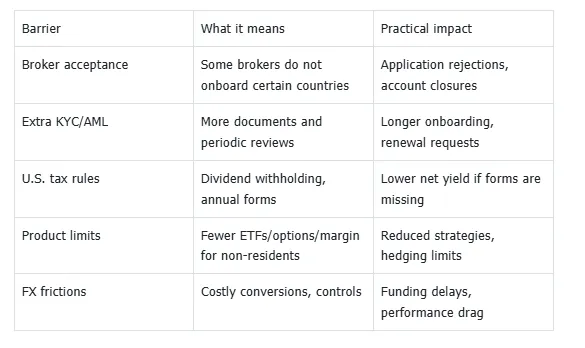
Residency barriers are the extra restrictions non‑U.S. clients face when accessing U.S. markets—broker acceptance limits, added documentation, tax withholding rules, and higher risk of account closure. Many U.S. brokers have restricted or closed non-resident accounts in recent years due to compliance complexity and cost (e.g., FATCA) and shifting global rules, a trend noted in analyses of why some U.S. brokers close non‑resident accounts. Countries that streamline access to foreign brokers tend to attract more cross-border capital, improving investor choice and returns, as shown in research on how market accessibility affects international capital flows.
Common barriers for non-U.S. investors:
- Broker restrictions (country bans, product limits)
- Tax compliance (W‑8BEN, withholding, reporting)
- Instrument access (ETFs, options, margin availability)
- Currency/FX risk (funding in local currency, conversion spreads)
Table: Typical residency barriers and their impact
Verifying Legal and Broker Eligibility for International Investors
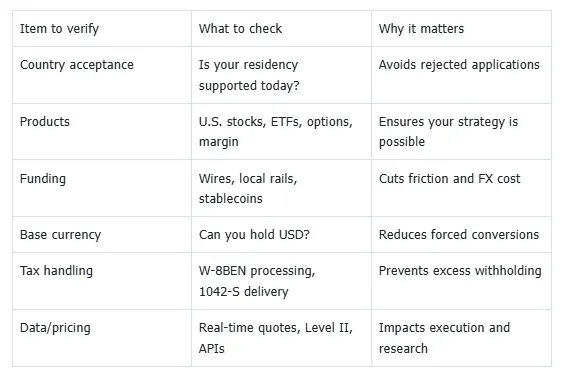
Start by confirming whether a broker accepts clients from your country—before you fill out any forms. Reputable firms publish eligibility pages and outline country-specific policies in resources like Schwab’s overview of international brokerage.
Two main entry routes:
- Use a local broker that offers access to U.S. markets.
- Open directly with an international-friendly broker that accepts non-residents.
Each provider sets unique rules by country and product. Always check official eligibility lists and, if unclear, contact support.
Eligibility checklist
Preparing Required Documentation and Tax Forms
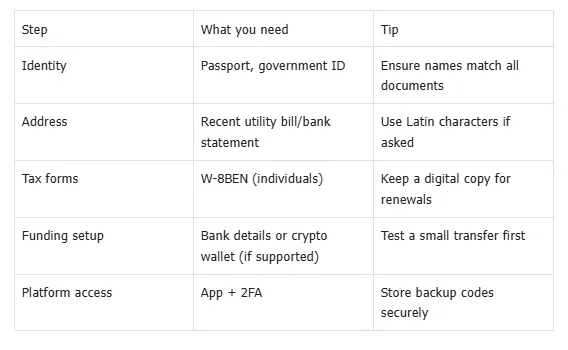
Most non-U.S. applications require a passport, proof of address (utility bill or bank statement), and U.S. tax forms. The core document is Form W‑8BEN—an IRS form where non-U.S. investors declare foreign status and claim treaty benefits to reduce dividend withholding. Brokers typically prompt for renewals before expiry and issue Form 1042‑S annually to report U.S.-source income and withholding, as summarized in Schwab’s overview of international brokerage.
Account-opening workflow
Choosing the Right Platform to Trade US Stocks Globally
For non-U.S. residents, platform availability and compliant onboarding are crucial. Look for clear international support, multi-currency accounts, and transparent custody.
Broad platform choices:
- Retail brokers with established non-U.S. onboarding (e.g., global-first firms).
- Institutional/execution platforms for advanced users needing multi-venue routing and APIs; see this overview of institutional tools for trading.
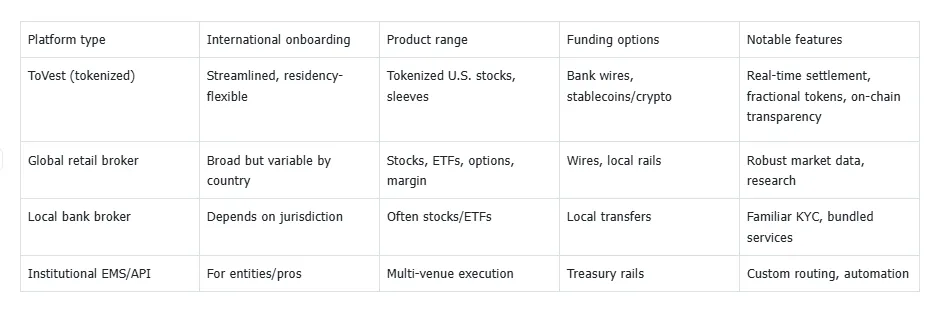
Compare by product range, custody, margin access, data, and automation. ToVest offers a differentiated path via blockchain tokenization, fractional access, and crypto funding, essential where traditional brokers are unavailable or slow to onboard.
Platform snapshot for global access
Funding Your Account with Traditional and Crypto Methods
Most investors fund via bank wire, SWIFT, or SEPA, and some transfer existing securities in-kind. Stablecoins—digital assets pegged to fiat, often the U.S. dollar—can cut cross-border friction and settlement times. Platforms like ToVest provide crypto funding, which is beneficial in countries with currency controls or limited correspondent banking. To minimize FX costs:
- Fund or hold balances in USD where possible.
- Compare your bank’s FX spread vs. fintech remitters.
- Avoid forced conversions by choosing USD-denominated accounts.
- Batch transfers to reduce fixed bank fees.
Executing Trades and Managing Your Portfolio Worldwide
A typical execution flow:
- Log in with 2FA and confirm account status.
- Research ideas using screeners and charts.
- Place a limit or market order; specify time-in-force.
- Verify execution price and fees.
- Monitor P&L, risk, and rebalancing.
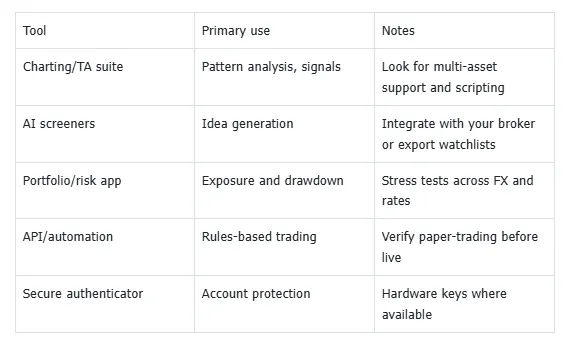
Advanced analytics streamline this process. Many traders use AI and automation alongside charting; see this roundup of top AI tools for traders. For technical analysis, platforms covered in overviews of the best technical analysis platforms include robust charting, scanning, and backtesting useful for global execution. If your strategy is sensitive to custody risk, maintain backup sleeves via ETFs or pooled funds to preserve exposure during any platform transition.
Essential tools for international active investors
Navigating Tax Withholding and Reporting Obligations
By default, the U.S. withholds 30% on dividends paid to non-U.S. persons; filing W‑8BEN to claim treaty benefits can reduce this to as low as 0–15% depending on your country. Withholding tax is a pre-deduction from payouts against potential tax liabilities. Non-residents typically do not owe U.S. capital gains tax on stock trades, though local tax rules still apply. The usual cycle: submit W‑8BEN at onboarding, respond to renewal notices before expiry, and receive Form 1042‑S each March for prior-year income and withholding, consistent with Schwab’s overview of international brokerage. Consult local and U.S. tax advisors to optimize treaty claims and reporting.
Building a Contingency Plan for Account Restrictions
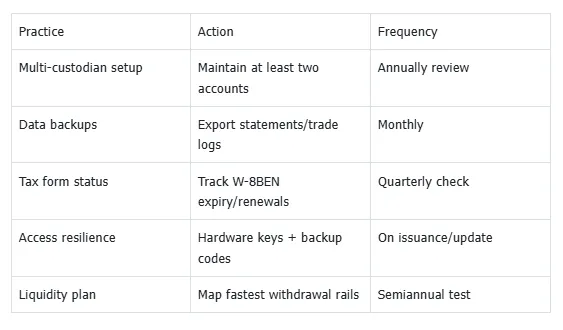
Policies change. Even established U.S. firms have limited or closed non-resident accounts amid evolving global rules and compliance burdens. Protect continuity by:
- Keeping secondary accounts with a different custodian.
- Holding an ETF sleeve or pooled exposure you can trade locally.
- Monitoring your broker’s residency policy updates and regulator notices.
- Documenting emergency contacts and withdrawal procedures.
Account security and continuity checklist
Leveraging Blockchain and Tokenized Stocks for Global Access
Tokenization turns real-world assets like stocks into digital tokens, enabling fractional ownership, faster settlement, and borderless access. For non-U.S. residents, tokenized U.S. stocks can reduce capital minimums and residency friction while preserving transparent, auditable records on-chain. ToVest’s blockchain infrastructure couples real-time, low-latency execution with stablecoin funding and on-chain transparency to make U.S. equity exposure accessible worldwide. Learn more about ToVest’s mission and technology on our about page.
Benefits at a glance:
- Fractional access for smaller tickets
- Faster, programmable settlement
- Global funding via stablecoins
- Immutable audit trails and improved traceability
Maintaining Compliance and Managing Risks as a Non-Resident Trader
Stay proactive: periodically review broker eligibility lists and product limits for non-residents, since offerings (options, margin, data) can differ by country and change over time. Manage currency exposure with hedges or USD funding, and diversify custodians to reduce operational risk. Schedule annual compliance and tax reviews, keep digital copies of W‑8BEN and 1042‑S, and respond quickly to any KYC refresh requests. Consistent documentation and multi-provider access are your best defense against policy shifts.
Frequently Asked Questions
Can non-US residents open and maintain US brokerage accounts?
Yes. Many U.S. and international brokers accept non‑U.S. clients who provide identity documents and tax forms such as W‑8BEN.
How can I minimize US dividend tax withholding as an international investor?
File IRS Form W‑8BEN to claim treaty benefits; depending on your country, the 30% default withholding can drop to around 0–15%.
What funding options are available for buying US stocks from abroad?
Bank wires and SWIFT/SEPA are standard, and platforms like ToVest also support stablecoins or crypto for faster, borderless funding.
Are there risks specific to trading US stocks as a foreign resident?
Yes—eligibility changes, added tax paperwork, FX costs, and sometimes reduced product access or protections compared to U.S. residents.
How does tokenization improve access to US stocks worldwide?
It enables fractional, digital ownership with faster settlement and crypto funding, lowering both capital and residency hurdles for global investors.