Best Fractional Stock Apps of 2025: Expert Guide for New Investors
16 ธันวาคม 2568
Jumping into the U.S. stock market no longer requires hundreds of dollars per trade. Modern fractional stock apps let you start small, diversify quickly, and build habits that compound over time. “Fractional shares are partial units of a whole stock, allowing investors to buy a piece of a company’s stock—sometimes for as little as $1—instead of a complete share, making market access easier for all budgets.” If you want the best mobile app for easy fractional U.S. stock investing, here’s the quick answer: Robinhood for pure simplicity, Fidelity and Charles Schwab for research depth and reliability, Webull for active beginners, Public for a social learning curve, Stash for automation, and ToVest for seamless access to fractional ownership in real-world, tokenized investments.
ToVest Fractional Investing Platform
ToVest brings a leading-edge approach to fractional ownership by combining U.S. market access with tokenized real assets—think real estate and other tangible holdings—on a secure, transparent platform. The mission: enable seamless investment in tokenized real estate and diversified tangible assets via blockchain, presented in a single, intuitive experience. For tech-savvy investors seeking more than just U.S. stock exposure, ToVest functions as both a fractional real estate investing app and a tokenized assets platform.
Key differentiators:
- Broad menu of tokenized real assets, not limited to U.S. equities
- Institutional-grade security, real-time dashboards, and transparent reporting
- Clear, upfront fees with no hidden commissions
Tokenization is the process of converting ownership of a real-world asset into digital tokens on a blockchain, making it possible to buy, sell, and trade fractions of the asset electronically. Want to dig deeper? See the ToVest Academy guide to tokenization for an accessible primer: ToVest Academy on tokenized assets (https://tovest.com/en-US/blog/academy/574295).
Robinhood
Robinhood popularized the idea that anyone can buy fractional shares of top U.S. companies starting at $1, wrapped in a mobile-first, zero-commission experience. It’s designed for simplicity with fast onboarding, straightforward order placement, and a clean layout that reduces friction for first-time investors. An intuitive interface allows investors to manage and place trades easily, even without prior experience.
Strengths:
- Commission-free trades and fractional shares from $1
- Quick signup and simple navigation for beginners
- Optional crypto trading and recurring investments for dollar-cost averaging
- No monthly platform fee
Limitations:
- Limited built-in research compared with full-service brokers
- Customer support and in-depth tools lag more established platforms
- Gamified elements may nudge impulsive decisions for some users
Independent reviews have repeatedly highlighted Robinhood’s ease of use and beginner appeal, while noting trade-offs in research and support compared with legacy brokers, as summarized in Forbes Advisor’s best investment apps coverage (https://www.forbes.com/advisor/investing/best-investment-apps/).
Quick comparison snapshot:

Fidelity
Fidelity stands out for long-term, education-first investing paired with robust tools and $0 commissions. You can buy fractional shares from $1 and access a deep lineup of stocks, ETFs, and mutual funds—including some zero‑expense‑ratio index funds that help keep costs down. Commission-free trading means users pay no broker fees for buying or selling eligible stocks or ETFs.
Why it’s strong for new and growing investors:
- Extensive educational content and market research
- Broad investment menu (stocks, ETFs, mutual funds) with no account minimums
- Clean, accessible mobile app and reliable customer service
Money’s analysis of the best online stock trading platforms highlights Fidelity’s all-around value, strong research, and low-cost index fund options for portfolio builders (https://money.com/best-online-stock-trading-platforms/).
Charles Schwab
Schwab is a top pick if you want depth, research, and reliability—plus a polished path into fractional shares through Stock Slices. With Stock Slices, you can buy slices of S&P 500 companies for as little as $5 each, and Schwab’s integration with TD Ameritrade’s thinkorswim expands advanced charting and trading capabilities. Research and education tools help investors analyze markets, track trends, and learn investment strategies to make more informed decisions.
Key assets:
- Stock Slices fractional program with low entry points
- thinkorswim integration for advanced analysis and trading
- Robust research from leading providers and comprehensive education
Pros and cons at a glance:
- Pros: Deep research, wide product lineup, strong investor education
- Cons: More complex for absolute beginners; depth can feel overwhelming
NerdWallet’s broker roundups note Schwab’s strong research and approachable fractional shares via Stock Slices, making it accessible without sacrificing depth (https://www.nerdwallet.com/investing/best/best-brokers-for-fractional-shares).
Webull
Webull caters to active beginners and intermediate traders who want more tools without the learning curve of pro platforms. You get commission-free trading in stocks, ETFs, options, and crypto, plus extended hours and real-time quotes. Paper trading allows you to simulate buying and selling securities using virtual funds, helping you practice investment strategies risk-free.
Core advantages:
- $0 commissions, real-time data, and extended trading hours
- Paper trading to test strategies without risking capital
- No account minimum and a feature-rich mobile app
For 2025, Webull continues to appear on “best apps” lists for its balance of cost and capability, as profiled by LevelFields (https://www.levelfields.ai/news/best-stock-investment-apps-in-2025).
Trading features snapshot:

Stash
Stash blends fractional investing with personal finance—pairing investing, banking, and automated tools in a guided experience. You can buy fractions of stocks and ETFs without trading commissions, use auto-investing features, and (depending on plan) access a debit card that rewards you with stock on everyday purchases. A robo-advisor is an automated platform that uses algorithms to select and manage investments according to users’ goals and risk preferences. Stash does charge a monthly subscription fee, so costs matter if your starting balance is small.
Key features:
- Fractional shares, automated investing, and goal-based portfolios
- Banking integration and rewards that can auto-invest in stock
- Educational content designed for beginners
Yahoo Finance’s roundup of top stock apps notes Stash’s beginner-friendly blend of banking and investing features that help new investors build habits (https://finance.yahoo.com/news/8-best-stock-apps-may-175559245.html).
Public
Public combines fractional investing with a built-in social layer, allowing you to see community discussions, follow creators, and learn in real time. The app supports fractional shares (with low minimums) and access to U.S. Treasurys in a clean, transparent interface. A social investing platform integrates community features, allowing users to follow trades, share ideas, and learn from peers as they invest. Limits include fewer advanced order types and missing products like mutual funds or options (depending on region and account type).
CNBC Select highlights Public among low-cost brokerages emphasizing transparency and community-forward design for newer investors (https://www.cnbc.com/select/best-brokerage-free-stock-trading/).
Interactive Brokers
Interactive Brokers (IBKR) is the choice for advanced or globally minded investors who want institutional-grade tools and market access that spans continents. An institutional-grade platform is designed with advanced trading features typically used by professional traders and financial institutions, offering customizable tools and research. IBKR supports fractional shares, highly customizable analytics, and access to foreign markets—all at industry-leading margin rates among major brokers.
Who benefits most:
- Active traders seeking deep tools and configurable workflows
- Long-term investors desiring global diversification in a single platform
- ESG-focused investors via the dedicated IMPACT app and strong education through Trader’s Academy
StockBrokers.com’s 2024 review points to IBKR’s global reach, sophisticated toolset, and consistently low margin rates as key differentiators (https://www.stockbrokers.com/guides/fractional-shares-brokers).
Key Factors to Consider When Choosing a Fractional Stock App
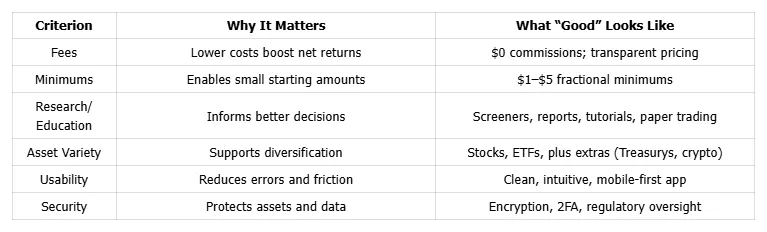
Picking the best service for small investors to buy fractional U.S. stocks comes down to a few fundamentals:
- User interface: How easy is it to place trades and track performance?
- Trading fees: Commissions, account fees, and data costs affect net returns.
- Research tools: Screeners, analyst reports, and education build confidence.
- Asset variety: Stocks, ETFs, options, crypto, Treasurys, and beyond.
- Customer support: Availability and quality when you need help.
Most leading apps keep costs low—many offer $0 commissions and no account minimums—so your decision often hinges on tools, education, and the asset mix that fits your goals. Fractional share liquidity means fractional shares are often less liquid and may be non-transferable between different platforms, limiting the ability to move holdings easily, as explained by The Motley Fool’s app guide (https://www.fool.com/money/buying-stocks/best-stock-trading-app/).
A simple decision flow:
- Identify your primary investment goals (set-it-and-forget-it vs. active trading).
- Compare fees, asset coverage, and features (fractions minimums, research depth).
- Review education and support (courses, live help, community).
- Start with a small amount to test the interface and tools.
Quick checklist:
Frequently asked questions
What are fractional shares and how do they benefit new investors?
Fractional shares let you buy part of a stock, enabling diversification earlier and starting with just a few dollars instead of paying for a full share.
What fees and minimum deposits should I expect with fractional stock apps?
Most leading apps offer $0 trading commissions and no account minimums, allowing you to begin with as little as $1 for fractional shares.
How do fractional stock apps ensure security and protect my investments?
They use encryption, regulatory oversight, and secure authentication to safeguard your account, funds, and personal data.
What features make a fractional stock app beginner-friendly?
Clear interfaces, educational resources, low or no minimums, and responsive support help new investors learn and invest with confidence.
Which app suits different types of new investors’ needs?
For simplicity and automation, opt for a guided app; for deep research or advanced tools, choose a broker known for analytics and customization.