The Definitive Expert Guide to Safely Purchasing US Stock Tokens
15 ธันวาคม 2568
US stock tokens let you gain exposure to American equities through blockchain-based instruments while using crypto rails for funding and settlement. Yes, you can buy US stock tokens with cryptocurrencies like USDT, ETH, or BTC on supported platforms. The safest way is to use a compliant, transparent venue that proves 1:1 asset backing (or clearly discloses a synthetic model), employs audited smart contracts, and performs standard KYC/AML checks. This guide distills ToVest’s institutional perspective into a practical playbook—covering platform due diligence, wallet security, legal considerations, and risk management—so you can trade with confidence.
Understanding US Stock Tokens
US stock tokens are blockchain-based digital tokens that represent direct or synthetic exposure to US company equities, allowing trading via crypto platforms without conventional brokers. Mechanically, they come in two main forms: asset-backed tokens that correspond to real shares held with a licensed custodian, and synthetic stock tokens that track a stock’s price via derivatives or oracles rather than custody of the underlying shares. For example, Solana wallets like Phantom support trading tokenized stocks such as TSLA via integrated DEXs and brokers, illustrating how tokenized US equities can be accessed on-chain with familiar wallet flows (see Phantom’s guidance on trading tokenized stocks). Ethereum-based versions also exist through projects and exchanges that list real-world asset tokens and synthetic stock tokens, as summarized in Finder’s overview of tokenized stocks.
Why investors use them:
- 24/7 markets: tokenized stocks can trade around the clock, unlike traditional exchanges that close daily and on weekends (Kraken’s xStocks emphasizes always-on access).
- Fractionalization: buy smaller amounts than one full share, lowering minimums and expanding access.
- Global reach: investors in more jurisdictions can gain exposure without opening a traditional US brokerage account.
- Programmability: tokens integrate with DeFi—enabling collateralization, automated strategies, and instant settlement—subject to regulatory constraints.
For a deeper primer on how tokenized stocks work, see Gemini’s plain-English explainer on tokenized stocks and their mechanics.
Using Crypto to Purchase US Stock Tokens
Buying with crypto is straightforward on platforms that support crypto-to-stock-token pairs.
- Supported funding: major cryptocurrencies such as USDT, ETH, and BTC are commonly accepted. Platforms like Blockchain.com explicitly allow purchasing tokenized U.S. stocks with crypto, subject to availability and compliance.
- Wallet compatibility: multi-chain wallets (e.g., Bitget Wallet) streamline cross-chain swaps and settlement for tokenized assets, as shown in Bitget’s step-by-step guide to buying tokenized stocks.
Simple flow to purchase:
- Deposit crypto: transfer USDT/ETH/BTC into your exchange or non-custodial wallet.
- Select tokenized stock: choose the ticker (e.g., a TSLA token) and confirm whether it’s asset-backed or synthetic.
- Execute trade: review slippage, network fees, spreads, and minimum order size; then submit the order.
- Confirm storage: verify receipt in your wallet’s token list; if custodial, confirm your account balance and any withdrawal limits.
Advantages include near-instant settlement, global accessibility, and flexible order sizes. Always review quoted prices, fees, and blockchain confirmation times before executing.
Choosing a Secure and Reputable Trading Platform
A secure choice starts with compliance, custody transparency, and auditability. Favor platforms that:
- Are regulated or operate under recognized licenses and conduct KYC/AML.
- Use audited smart contracts, transparent token contracts, and publish regular attestations.
- Disclose custodian arrangements if tokens are asset-backed (e.g., shares held with licensed custodians).
- Utilize decentralized price oracles for accurate valuations where appropriate; Chainlink Proof of Reserve and oracle feeds can enhance transparency by verifying reserves and prices on-chain.
- Provide clear product labeling: “asset-backed” versus “synthetic.”
Platform due-diligence checklist
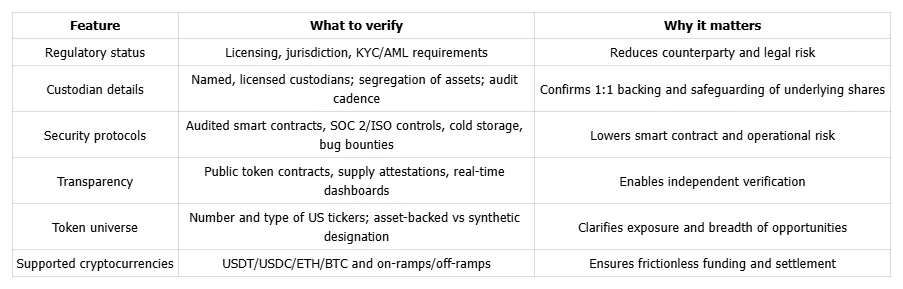
Kraken’s xStocks, for instance, highlights 24/7 access and a familiar broker-like flow to tokenized equities, reflecting the direction of secure crypto trading platforms bridging public equities with on-chain rails.
Setting Up a Secure Wallet for Token Storage
A digital wallet is a software or hardware tool that lets you store, transfer, and manage ownership of digital assets—including US stock tokens. For flexibility and safety, prefer wallets with cross-chain support, robust encryption, and strong authentication. Bitget Wallet, for example, emphasizes cross-chain tokenized stock access via its xStock feature in its step-by-step guide.
Core security essentials:
- Multi-factor authentication and strong, unique passwords
- Full private key control (self-custody) when appropriate
- Encrypted backups of seed phrases; secure, offline storage
- Regular firmware/software updates; phishing protection
Wallet compatibility overview
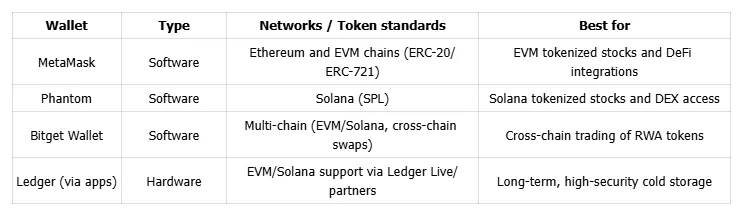
"A collection of comparative tables detailing investment services. The content classifies financial brokers into three main types (Crypto-to-stock, Crypto-only, and Traditional) and benchmarks four leading platforms (ToVest, Fidelity, Charles Schwab, Webull) based on critical criteria: Supported Assets (including RWA), Minimum Trade Requirements, Commissions, and Regulation & Security support. It also compares popular wallets by Network Support and Best Use Case."
Verifying Token Legitimacy and Underlying Asset Backing
Prioritize tokens with clear, verifiable backing. For asset-backed models, look for strict 1:1 issuance versus shares held by regulated custodians or US-registered broker-dealers, with regular attestations or audits. Bitget’s tokenized stock guides demonstrate the type of documentation and process detail reputable platforms publish.
How to verify:
- Review documentation: whitepapers, offering pages, and FAQs should disclose whether tokens are asset-backed or synthetic, who the custodian is, and how redemptions work.
- Check audits and attestations: look for third-party reports, on-chain supply proofs, and reserve attestations.
- Inspect token contracts: use blockchain explorers to confirm contract addresses, total supply, and mint/burn events.
- Look for compliance badges: participation in recognized compliance programs and legal opinions.
Signs of legitimacy:
- Clear disclosures, named custodians, and regular third-party audits
- Transparent token economics and governance
- Consistent on-chain data with published supply/attestation figures
Navigating Legal and Regulatory Considerations
Securities regulation is the legal framework governing the issuance, trading, and ownership of financial securities—including tokenized stocks—under authorities such as the US SEC and international counterparts. Many tokenized stocks will be deemed securities, triggering KYC, AML, and securities law compliance, which can differ by jurisdiction. A practical overview of RWA legal obligations—registration pathways, transfer restrictions, and investor protections—is outlined in Buzko Legal’s RWA tokenization guide.
Key considerations:
- Complete KYC/AML with your chosen platform.
- Understand offering type: public offering, private placement, or exempt distribution.
- Be mindful of geofencing and cross-border restrictions; some products are available only in specific regions.
- Use platforms like ToVest that facilitate compliant onboarding, transfers, and record-keeping.
Regulatory frameworks are evolving. Expect changes to impact how synthetic models are marketed, who can access certain tokens, and secondary trading rules.
Executing Safe Transactions and Reviewing Purchase History
Treat every trade as an auditable event.
- Execute on audited smart contracts when possible; reputable venues publish code audits and detail fee structures.
- Verify order parameters—ticker, amount, slippage tolerance, fees—before confirming.
- Maintain records: download statements and export transaction histories with timestamps, hashes, and costs. Many platforms (and wallets) offer real-time notifications and CSV exports to reconcile holdings and taxes.
- Prefer atomic transactions (single, all-or-nothing on-chain operations) to reduce settlement risk and partial fills in DeFi contexts.
Regular reconciliation helps detect discrepancies early and supports clean audit trails.
Monitoring Market Conditions and Managing Risks
Tokenized markets operate 24/7, so prices may adjust rapidly to after-hours news and macro events. Use dashboards, alerts, and liquidity monitors to track price, spreads, and depth. Finder’s guide notes that tokenized stock availability and liquidity vary by platform; monitor pairs and venues relevant to your holdings.
Risk management playbook:
- Diversify across tickers and platforms to reduce idiosyncratic risk.
- Use limit orders and, where available, stop-loss or stop-limit orders to manage downside.
- Size positions prudently when liquidity is thin; avoid large market orders.
- Consider hedging with derivatives (e.g., options, perpetuals) where regulations and access permit.
- Reassess counterparty risk regularly (platform solvency, custodial concentration, oracle dependencies).
Quick checklist:
- Set price and news alerts
- Review liquidity/volume before trading
- Predefine risk limits per position
- Document exit rules
Best Security Practices for Protecting Your Stock Tokens
- Use hardware wallets for significant balances; keep private keys and seed phrases offline.
- Enable two-factor authentication on all accounts; rotate strong, unique passwords with a manager.
- Keep wallet and platform software up to date; verify URLs and use anti-phishing tools.
- Back up seeds securely (encrypted 1–2 copies in separate locations).
- Segment wallets for trading vs. long-term holding; minimize hot-wallet exposure.
Security is a process: schedule periodic reviews of permissions, connected dApps, and allowance approvals.
Ensuring Liquidity and Efficient Trading on Secondary Markets
Liquidity is the ease of buying or selling an asset without moving the price significantly. Choose platforms and venues with deep order books or robust AMM pools so you can enter and exit positions efficiently. Some platforms provide centralized order books for tokenized stocks, while decentralized venues like Uniswap support ERC-20 token trading; certain NFT-structured receipts may appear on marketplaces like OpenSea, but fungible stock tokens typically trade on DEXs or centralized exchanges. Kraken’s xStocks highlights centralized access to tokenized equities with broker-like interfaces, while Solana DEXs accessed via Phantom enable SPL-based trading.
Centralized vs. decentralized venues
- Centralized (CEX)
- Pros: Deeper liquidity, fiat on/off-ramps, customer support, consolidated reporting
- Cons: Custodial risk, jurisdictional restrictions, potential downtime/maintenance
- Decentralized (DEX)
- Pros: Self-custody, composability with DeFi, transparent on-chain settlement
- Cons: Smart contract risk, variable liquidity/slippage, wallet and gas complexity
Staying Informed with Educational Resources and Market Insights
Tokenized assets evolve quickly. Stay current by combining trusted explainers, platform webinars, and regulatory updates.
- ToVest Academy: practical guides and research on tokenized markets and risk management
- ToVest Research: data-driven insights and quarterly market structure updates
- Gemini’s tokenized stocks explainer: clear mechanics and risk considerations for newcomers
- Bitget Academy’s guide to buying tokenized stocks: wallet steps, cross-chain tips, and funding flows
- Kraken’s xStocks page: an example of 24/7 tokenized equity access and product positioning
- Community channels: developer forums, governance discussions, and oracle provider updates (e.g., Chainlink Proof of Reserve)
Frequently Asked Questions
What are US stock tokens and how do they differ from traditional stocks?
US stock tokens are blockchain-based tokens representing fractional ownership or synthetic exposure to US equities; unlike traditional stocks, they trade 24/7 and often support smaller minimums.
How can I use cryptocurrency to buy US stock tokens safely?
Choose a reputable platform like ToVest, fund with major crypto (e.g., USDT/ETH/BTC), verify whether tokens are asset-backed or synthetic, and store them in a secure wallet after purchase.
What legal regulations should I be aware of when purchasing US stock tokens?
Most tokenized stocks are treated as securities and require KYC/AML and adherence to local securities laws, which vary by country and can affect access and secondary trading.
How do I verify the legitimacy of a tokenized stock asset?
Confirm 1:1 backing with regulated custodians (or clear synthetic disclosures), check third-party audits/attestations, and verify token contracts and supply on-chain.
What security measures should I take to protect my digital stock tokens?
Use hardware wallets, enable 2FA, secure and back up seed phrases offline, and keep wallet/platform software updated to mitigate theft and loss.