7 Key Risks and Benefits of Buying US Stocks with Crypto
15 มกราคม 2569
Buying U.S. stocks with crypto means using digital assets to fund equity purchases—either by converting crypto to cash at a broker or by acquiring tokenized representations of U.S. shares on-chain. This intersection matters because it blends two very different asset classes: regulated equities and 24/7 global crypto markets. The upside is access, speed, and diversification; the trade-offs include volatility, tax complexity, and evolving regulation. Below, we unpack seven key risks and benefits to help you decide if this route fits your strategy.

At a glance, here’s what you’ll learn:
- Volatility and return potential: why crypto funding magnifies timing risk and reward.
- Liquidity and execution: 24/7 transfers versus conversion bottlenecks.
- Fees and pricing transparency: all-in costs that can erode returns.
- Regulatory and custody risk: gaps in insurance and oversight.
- Tax reporting and complexity: taxable events and recordkeeping.
- Security and fraud exposure: private keys, scams, and irreversibility.
- Portfolio diversification and correlation: when crypto helps—and when it doesn’t.
ToVest’s Approach to Buying US Stocks with Crypto
ToVest enables secure, compliant access to fractional, tokenized U.S. stocks using either crypto or fiat—designed for global investors who want transparent rails and continuous availability. The platform pairs on-chain auditability with regulated, segregated custody and automated portfolio tools so investors can fund, allocate, and monitor with confidence.
How this maps to the challenges in crypto–stock investing:
- Risk and volatility: recurring buys and allocation rules help reduce timing risk.
- Liquidity and execution: 24/7 crypto funding plus clear settlement workflows.
- Fees and pricing: transparent fee schedules and real-time cost breakdowns.
- Regulatory and custody: compliance-first infrastructure, KYC/AML, and attestations.
- Tax and reporting: exportable histories that support crypto-capable tax software.
- Security: multi-layer controls, strong authentication, and custody protections.
- Diversification: fractional shares and automated rebalancing to right-size exposure.
1 Volatility and Return Potential
Volatility is the tendency of an asset’s price to change rapidly over time, often measured as annualized standard deviation of returns. Higher volatility means larger and more frequent price swings and greater uncertainty around expected outcomes for a given holding period. Morgan Stanley estimates crypto’s volatility near 55%, roughly four times that of the S&P 500, underscoring the added risk when using crypto to fund stock purchases (Morgan Stanley).
Because crypto markets run 24/7, your purchasing power can rise or fall between the moment you acquire crypto and when your stock trade settles—especially outside normal market hours (U.S. Bank). This can hurt short-term timing or amplify gains if crypto appreciates before conversion. The result is an added layer of return dispersion versus funding with cash.
Illustrative volatility snapshot:
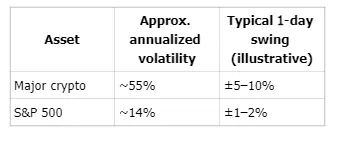
Note: Ranges are indicative; actual outcomes vary by asset and market conditions.
2 Liquidity and Execution Speed
Liquidity is how quickly and easily you can buy or sell an asset without meaningfully moving its price. Execution speed is how fast your order or transfer completes at the intended price.
Advantages:
- Crypto rails can move funds globally, nearly instantly, and 24/7 to fund tokenized stocks or brokerage accounts (M1).
- Around-the-clock availability can improve responsiveness to market news.
Trade-offs:
- If you must convert crypto to fiat for stock settlement, extra steps can slow execution and add costs relative to direct cash trades (M1).
- Some digital assets are thinly traded, making large orders harder to fill without slippage—especially during stress (FINRA).
Pros and cons summary:
- Pros: fast global transfers; 24/7 funding; potential access to fractionalized equities.
- Cons: conversion delays; network congestion; spreads and slippage; inconsistent liquidity in smaller tokens.
3 Fees and Pricing Transparency
Transaction fees are the direct costs to send, convert, or trade one asset for another on an exchange or blockchain. When funding stock purchases with crypto, your all-in cost can include:
- Network fees (blockchain gas)
- Conversion spreads (crypto-to-fiat or crypto-to-tokenized stock)
- Platform fees and broker commissions
- Slippage from fast-moving or illiquid markets
“Digital asset products can have higher fees or expenses than many traditional investments” (Morgan Stanley). Without a clear breakdown, these costs can quietly erode returns.
Illustrative cost comparison (one $5,000 order):
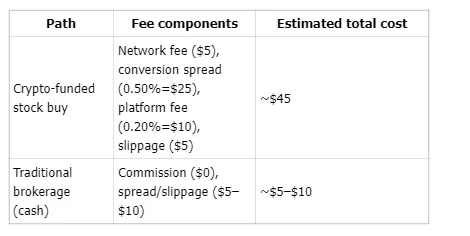
Actual fees vary by network congestion, venue, and order size. The takeaway: compare transparent, itemized costs across platforms.
4 Regulatory and Custody Risk
Custody risk is the possibility that assets become inaccessible due to fraud, bankruptcy, or operational failures at the custodian or platform holding them. Unlike brokerage cash or securities, most crypto is not insured by FDIC or SIPC—treat crypto funds as at-risk capital (Fidelity).
Many crypto venues operate with less investor protection than licensed broker-dealers, and disclosures, market surveillance, and recourse may be limited (FINRA). Access can also change quickly due to regional policy shifts and evolving rules, as seen in periodic crackdowns and licensing updates (UCB Bank).
A quick due-diligence checklist:
- Verify licensing, jurisdiction, and regulatory oversight.
- Confirm segregated client asset custody and third-party attestations.
- Review insurance disclosures (what is—and isn’t—covered).
- Assess transparency on reserves, audits, and on-chain proof of assets.
- Test withdrawal speed and customer support responsiveness.
- Prefer platforms like ToVest that adopt a compliance-first, audit-ready model.
5 Tax Reporting and Complexity
A taxable event occurs when a transaction triggers a tax liability—such as selling crypto or converting it to another asset. Funding U.S. stock purchases with crypto typically requires disposing of some crypto, which can create capital gains or losses and corresponding reporting obligations (e.g., on Form 1099 when applicable).
For investors managing both crypto and equities, recordkeeping becomes more complex: every conversion price, timestamp, and cost basis entry matters, and multi-venue activity increases the chance of errors (Fidelity Learning Center). Practical steps:
- Keep complete logs of every crypto transfer and conversion.
- Use tax software that supports crypto cost-basis tracking.
- Consolidate activity where possible to reduce reconciliation work.
- Consult a tax professional familiar with digital assets and cross-asset reporting.
6 Security and Fraud Exposure
A private key is a string of data that grants control over crypto assets; if it is lost or stolen, funds may be permanently unrecoverable. Loss or theft of private keys can render crypto inaccessible to its owner (Morgan Stanley). Crypto transactions are final and irreversible, unlike many traditional broker protections.
Common threats include Ponzi schemes, pump-and-dumps, fake tokens, phishing, and “pig-butchering” scams (FINRA). Practical precautions:
- Use regulated custodians or hardware wallets you control.
- Enable strong authentication and withdrawal allowlists.
- Never share private keys or seed phrases.
- Verify URLs, smart contracts, and counterparty claims before transferring funds.
- Start with small test transfers when using a new venue.
7 Portfolio Diversification and Correlation
Asset correlation measures how similarly two assets move; low or negative correlation can reduce overall portfolio risk. Crypto can behave as an uncorrelated asset at times, providing diversification benefits, but correlations with equities often spike during market stress, reducing the hedge effect (M1; U.S. Bank).
Illustrative correlation dynamics:
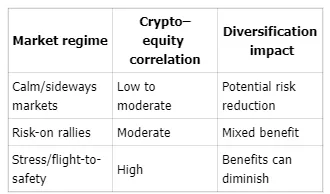
Position sizing matters. In a simple model, allocating 5% to a 55%‑volatility crypto sleeve alongside equities can lift overall portfolio volatility by roughly 30%—use disciplined sizing, rebalancing, and long horizons. ToVest’s fractional allocations, recurring buys, and automated rebalancing can help maintain targets as markets move.
Frequently Asked Questions
What are the main tax implications of using crypto to buy US stocks?
Using crypto to buy U.S. stocks may trigger capital gains tax on the crypto sold or converted, even before any stock profits are realized. Track every transaction’s cost basis and proceeds for accurate reporting.
How can investors minimize risks when purchasing stocks with crypto?
Use reputable, regulated platforms, keep meticulous records, enable strong security practices, and limit exposure to amounts you can afford to lose. Consider recurring buys to manage timing risk.
What should investors know about custody and investor protections?
Most crypto lacks FDIC/SIPC coverage, so platform failures can result in total loss. Choose regulated custodians with clear asset segregation, audits, and reliable withdrawal processes.
How does crypto volatility impact stock purchase timing?
High crypto volatility means your buying power can change quickly, affecting how many shares you can ultimately purchase. This timing risk is most acute outside traditional stock market hours.
Can crypto provide meaningful diversification in a US stock portfolio?
Yes, when correlations are low, crypto can diversify equity risk, but during market stress correlations often rise, diminishing the benefit. Right-size allocations and rebalance regularly.