Crypto vs US Stocks 2026: Risks, Benefits, and Smart Strategies
15 มกราคม 2569
Buying US stocks with crypto is no longer fringe—it’s a practical route for global investors who want speed, access, and fractional exposure. In 2026, the choice is not crypto or stocks, but how to combine them intelligently. This guide explains how crypto-funded access to US equities works, the trade-offs you should weigh, and the strategies that can help you manage risk while pursuing growth. We compare market structures, settlement, custody, regulation, and tax treatment—and show where tokenized stocks and instant settlement can meaningfully improve the investor experience. As a platform built for this moment, ToVest enables multi-currency funding in fiat and stablecoins with ultra-low latency execution and transparent, fractional exposure to tokenized US stocks, allowing sophisticated investors to act nimbly across both markets.
Overview of Crypto and US Stocks
Cryptocurrencies are decentralized digital assets built on blockchain networks. US stocks are traditional equity instruments that represent ownership in a company, including rights to earnings and sometimes dividends. In 2026, investors increasingly consider tokenized stocks—blockchain-based representations of traditional equities—because they enable fractional ownership, instant settlement, and global access without the frictions of legacy banking.
Historical returns highlight the difference in risk and reward profiles: Bitcoin rose from $320.43 in 2015 to $93,425.10 in 2025 (+29,056.16%), while the S&P 500 advanced from 2,072.36 to 5,770.20 (+178.43%) over the same period, according to Ledn’s overview of crypto vs stocks (Ledn analysis). Yet market size still favors traditional equities: global stock markets are roughly $106 trillion versus about $2.6 trillion for crypto as of 2021, per Corporate Finance Institute estimates. This scale gap shapes liquidity, regulation, and investor protections.

Risks of Investing in Crypto
Crypto’s appeal is matched by its risks. Crypto markets show extreme bull and bear cycles with rapid, large price swings; that volatility can magnify both gains and losses (Motley Fool guide). Volatility is the degree of variation in an asset’s price over time, with higher volatility implying bigger and more frequent price swings.
Security and custody risks are material. Hacks, scams, exchange failures, and user errors such as losing private keys can result in permanent loss. The regulatory landscape is also evolving, with rules varying widely across jurisdictions and changing as policymakers respond to market developments (Coinstash overview).
Key risks to consider:
- Regulatory uncertainty (changing rules, evolving compliance needs)
- Security risks (hacks, scams, loss of access)
- Tax complexity (different treatment by country; in the U.S., crypto gains are taxed as property per Ledn analysis)
Risks of Investing in US Stocks
US stocks carry their own set of risks. Market risk—the risk that the overall market will decline, impacting the value of all investments regardless of company performance—can be pronounced during recessions or sector downturns. Concentrated positions in single stocks face company-specific risks, including the possibility of total loss if the business fails (Ledn analysis).
Non-U.S. investors must also manage currency fluctuations that can amplify or offset returns when converted back to home currencies, and equities tend to be sensitive to interest rate changes. Broad stock indexes, however, are generally less volatile than crypto and diversify away company-specific risks (Bankrate’s analysis).
Benefits of Buying US Stocks with Crypto
Using crypto to buy US stocks can simplify cross-border investing:
- Global, borderless funding: Crypto rails bypass traditional banking constraints, enhancing access for international investors (Maryville University explainer).
- ToVest advantage: Fund in multiple currencies, including fiat and stablecoins like USDT/USDC, then allocate into tokenized US stocks with ultra-low latency and transparent pricing.
- Faster settlement: Crypto rails can enable near-instant settlement, compared to multi-day cycles in legacy markets (tokenized stocks explainer).
Funding and settlement, at a glance:
- Crypto rails: 24/7 availability, instant on-chain settlement
- Traditional stock rails: Set exchange hours, multi-day settlement (e.g., T+2 historically)
These features help investors buy US stocks with crypto, access fractional equities, and act swiftly across time zones.
Benefits of Investing in Crypto
Crypto offers asymmetric return potential. From 2015 to 2025, Bitcoin’s gains vastly outpaced broad US stocks, though with much higher volatility (Ledn analysis). Crypto also opens doors to novel features: 24/7 trading, programmable smart contracts, and decentralized finance tools that operate without traditional intermediaries (Motley Fool guide). DeFi, or Decentralized Finance, refers to blockchain-based financial services that operate without traditional intermediaries.
Capped supply assets like Bitcoin are sometimes used as an inflation hedge, given their issuance constraints and transparent monetary policy (Soma Finance primer).
Comparing Market Access and Trading Features
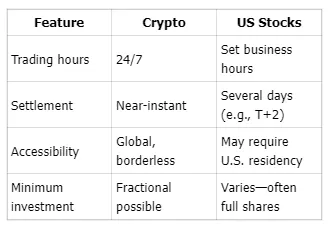
Fractional ownership through tokenization makes high-priced equities accessible with smaller amounts. Even when stock orders execute promptly, official settlement can still take multiple days, which affects when funds are truly available (tokenized stocks explainer). Decentralized exchanges enable direct peer-to-peer crypto trading but introduce added smart contract and counterparty risks to weigh carefully.
Regulatory and Tax Considerations
Capital gains tax is a tax on the profit realized from the sale of an asset.
Stocks operate within well-defined regimes: public companies publish audited financials, and brokerages adhere to detailed disclosure and investor protection rules (Maryville University explainer). Crypto regulation varies significantly. In the U.S., crypto gains are taxed as property, and other countries offer different treatments—for example, some provide tax exemptions after certain holding periods (Ledn analysis). Regulated access is expanding: the SEC’s 2024 approvals of Bitcoin and Ethereum ETFs broadened mainstream channels for crypto exposure (Motley Fool guide).
Jurisdictional differences to note:
- United States: Crypto taxed as property; ETFs expand regulated access.
- Germany: Certain long-term holdings may receive favorable treatment.
- Australia and U.K.: Distinct capital gains regimes; detailed record-keeping required.
- Emerging markets: Rapidly evolving rules; licensing and exchange access can change quickly.
Always keep accurate records and consult local guidance.
Security and Custody Risks
Custody risk is the risk of losing access to assets, whether through brokerage failure (stocks) or private key loss (crypto). Stocks are generally held via regulated brokerages and clearinghouses, while crypto can be self-custodied or stored with exchanges—introducing hack, mismanagement, and human error risks (Motley Fool guide). Secure custody choices and multi-factor authentication materially improve protection (Ledn analysis). In crypto, lost private keys or exchange compromises can be irreversible.
A quick crypto custody checklist:
- Choose reputable, well-audited platforms
- Use hardware wallets for large or long-term holdings
- Keep encrypted backups in separate, secure locations
- Enable multi-factor authentication and withdrawal allowlists
- Regularly update firmware and review access permissions
Smart Strategies for Combining Crypto and US Stocks in 2026
- Diversify deliberately: Combine broad US equity exposure with a measured crypto allocation aligned to your risk tolerance and time horizon (Bankrate’s analysis).
- Automate discipline: Dollar-cost averaging and periodic rebalancing can smooth volatility and keep allocations on target.
- Use regulated wrappers: Consider ETFs and high-quality tokenized assets to reduce raw custody risks while maintaining exposure.
- Mind liquidity and settlement: Use platforms like ToVest for multi-currency funding, instant settlement, and ultra-low latency execution to minimize slippage and funding delays.
- Review regularly: Monitor tax obligations, regulatory updates, and concentration risk; adjust allocations as conditions change.
Frequently asked questions
What are the main risks when investing in crypto compared to US stocks?
Crypto investing carries higher volatility, greater risk of hacks or loss, and more regulatory uncertainty than US stocks, which are generally more stable and regulated.
How can investors use crypto to access US stock markets effectively?
Investors can use platforms like ToVest to fund accounts with stablecoins or other crypto, buy tokenized US stocks directly, and take advantage of rapid settlement and global access.
What are the benefits of diversification between crypto and US stocks?
Diversification balances crypto’s growth potential and volatility with the stability, earnings power, and income of equities.
How should investors approach tax and regulatory compliance in crypto and stock investments?
Understand your jurisdiction’s rules, keep meticulous records, and plan for capital gains taxes that may differ across asset classes and countries.
What safety measures should investors consider for custody and trading?
Use reputable platforms, secure custody options like hardware wallets, enable multi-factor authentication, and back up keys and recovery phrases safely.