Comparing Liquidity Across the 7 Leading Tokenized Asset Platforms
21 มกราคม 2569
Liquidity is the make-or-break metric for tokenized assets because it governs how quickly investors can enter or exit positions without eating into price. Asset tokenization converts physical or digital assets into blockchain-based digital tokens, enabling fractional ownership and 24/7 transferability across venues that support compliant trading. As institutions and global retail investors assess platforms, they increasingly compare liquidity enablers: onboarding speed, exchange connectivity, custody choices, and DeFi access. This review compares seven leading platforms on those dimensions—and neutrally situates ToVest among them. Our bottom line: liquidity concentrates where regulated issuance meets automated compliance, strong secondary-market links, and interoperable token standards, with Securitize currently setting the institutional pace on tokenized funds while DeFi-focused players like Centrifuge widen depth through composability.

ToVest
ToVest emphasizes regulated access to tokenized U.S. stocks and real estate with 24/7 trading and stablecoin rails (USDC, USDT). Fractional ownership lowers minimums and broadens the buyer pool, supporting tighter spreads and more resilient secondary markets. Compliant onboarding—KYC/AML, whitelisting, and transfer restrictions—reduces counterparty risk and enables cross-border participation within regulatory guardrails. Stablecoin settlement simplifies funding and payouts across time zones, helping market makers maintain inventory and quote liquidity continuously. This design makes ToVest highly attractive to both institutions needing compliance assurance and global retail users seeking fast, low-friction access to U.S. assets.
Securitize
Securitize is a leading institutional venue for real-world asset tokenization, recognized for automated investor onboarding, compliance, and exchange integrations that translate into high secondary-market trading activity. In 2025, Securitize-led products dominated tokenized funds: “Securitize leads tokenized funds at $2.2B, driven by institutional products like BlackRock’s BUIDL,” according to The Defiant’s coverage of the RWA boom in 2025. That scale signals reliable order books and frequent prints, which is critical for price discovery and professional execution. Securitize supports permissioned transfers aligned with standards used for compliant assets (e.g., the ERC‑1400/3643 family), reinforcing transferability within regulated venues and issuer-defined constraints.
Tokeny
Tokeny provides enterprise-grade infrastructure for issuing, transferring, and managing tokenized assets with a heavy emphasis on legal compliance and transferability, including the ERC‑3643 standard for permissioned tokens. By aligning issuers to regulated venues and interoperable standards, Tokeny can open access to deeper liquidity pools while maintaining auditability and transfer controls. While thorough compliance may add some onboarding steps upfront, the long-term payoff is market trust, standardized transfer rules, and easier connectivity to regulated secondary markets—conditions that tend to sustain liquidity rather than spike it temporarily.
Polymath
Polymath is a capital platform supporting the full lifecycle of digitized real-world assets, with compliance and identity embedded at the protocol layer via Polymesh. On-chain governance, role-based permissions, and granular transfer rules help reduce settlement failures and post-trade exceptions—key friction points that sap liquidity. By addressing identity, compliance, and corporate actions natively, Polymath/Polymesh aim to make secondary-market trading of regulated tokens behave more like modern market infrastructure than ad hoc smart contracts, improving time-to-settle and investor confidence.
Bitbond
Bitbond’s Token Tool takes a multi-chain, non-custodial approach that reduces barriers for issuers and traders using common Web3 wallets. It supports major EVM networks (Ethereum, Polygon, BNB Chain, Avalanche) and popular token standards (ERC‑20, ERC‑1400, ERC‑721), broadening the potential trading venues and wallet compatibility. Non-custodial issuance and management let issuers retain control while enabling faster integrations with on-chain liquidity sources—conditions that can increase activity and improve depth, especially for smaller offerings that benefit from ubiquitous wallet access.
Tokenforge
Tokenforge offers code-free tokenization toolkits that streamline compliant issuance and lifecycle management. By compressing time-to-deploy and standardizing compliance artifacts, Tokenforge helps issuers reach tradable markets faster—often the difference between a dormant cap table and an actively traded token. Liquidity outcomes ultimately depend on integrations (exchanges, ATSs, or AMMs) and transfer standards, but Tokenforge’s simplified workflows reduce initial friction, a prerequisite for sustained secondary-market activity.
Centrifuge
Centrifuge specializes in tokenizing and pooling real-world assets for use as DeFi collateral, enabling liquidity to form through decentralized credit markets rather than only on centralized secondary venues. Composability—plugging tokenized assets into AMMs, money markets, and credit pools—expands trading depth beyond traditional order books. This DeFi channel has grown significantly, with RWAs becoming a gateway for institutions and the sector surpassing $2.5B in TVL by 2025. The result: issuers gain funding diversity, and investors benefit from additional exit options and price signals.
Vertalo
Vertalo’s tokens-as-a-service model and open APIs focus on integrating tokenized assets directly with exchanges, transfer agents, and wallets. The platform’s API-centric design and keyless custody help issuers and broker-dealers connect compliant securities to trading venues with less operational friction, potentially boosting liquidity by making listings and investor access more seamless. Compatibility with standard ERC‑20 wallets further broadens the addressable investor base without sacrificing the transfer controls required by regulated markets.
Key Liquidity Factors in Tokenized Asset Platforms
- Secondary-market access and exchange partnerships: Direct ATS/exchange links and automated listings correlate with more frequent trading and larger visible order books.
- Onboarding friction and compliance automation: Investor KYC/whitelisting may slow initial trading but reduce risk; automation shortens time-to-trade without sacrificing controls.
- Interoperability and composability with DeFi: Standardized tokens that work across chains and DeFi venues unlock more venues and encourage market-maker participation.
Definitions:
- Liquidity: The ability of an asset to be quickly bought or sold at stable prices without significant value loss.
Summary table of liquidity drivers:
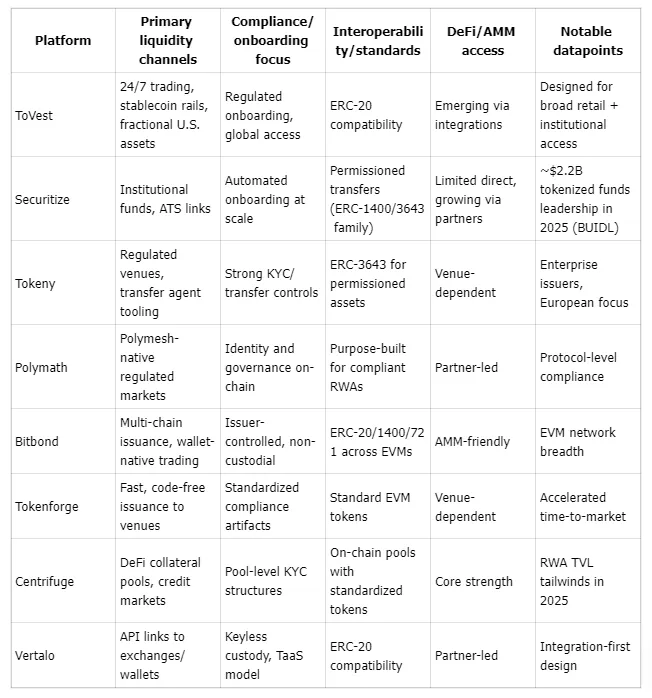
Note: Evidence on market structure and provider capabilities can be found in platform overviews such as AlphaPoint’s review of tokenized asset providers and other industry analyses.
Market Connectivity and Secondary-Market Access
Platforms that integrate with active exchanges and automate secondary-market listings tend to show more frequent trading and larger visible order books because they reduce coordination costs between issuers, brokers, and market makers. In contrast, issuer-centric portals without exchange connectivity may see sporadic prints and wider spreads. Secondary-market liquidity refers to how easily tokens can be traded after their initial issuance, typically on supported exchanges. For institutional programs, robust ATS relationships can be as important as the token standard itself.
Onboarding and Compliance Impact on Liquidity
KYC/AML checks, whitelisting, and transfer restrictions reduce counterparty risk and support institutional mandates, but they can slow early trading and narrow initial market depth. Automation mitigates that trade-off: streamlined investor onboarding and permissioned transfer frameworks compress time-to-trade while preserving regulatory compliance. Compliance-first platforms attract larger allocators over time, and that steady participation generally improves liquidity resilience during volatile markets.
Reference: AlphaPoint’s overview of tokenized asset platforms and compliance workflows.
Interoperability and Token Standards
Interoperability is the capacity for tokenized assets to move freely between different blockchains and platforms, supporting multiple trading venues. Standardized protocols such as ERC‑20 (fungible tokens), ERC‑1400 (security tokens with transfer rules), and ERC‑721 (non-fungible) increase token transferability and wallet/exchange support. Where standards diverge or are applied inconsistently, liquidity fragments across chains and venues. Gaps in standardization and cross-chain protocol maturity can restrict transfers and limit market-maker participation.
Custody, Settlement, and Fiat Integration
Fast on-chain settlement, integrated fiat onramps, and stablecoin rails reduce friction for both retail and professional liquidity providers. Custody is the method by which digital assets are securely stored, either by the investor (non-custodial) or a third party (custodial). Non-custodial options enable immediate token movement across venues; regulated custodians can unlock larger institutional flows. Platforms that combine instant settlement with fiat and stablecoin funding make it easier for market makers to inventory assets and quote tighter spreads.
DeFi Composability and Its Effect on Liquidity
Composability is the characteristic allowing tokenized assets to interact and be utilized across DeFi applications for functions like trading, lending, and collateralization. Listing RWAs in AMMs or money markets deepens liquidity by tapping algorithmic market makers and on-chain credit demand; without DeFi access, trading often relies on direct bilateral matches. Examples include tokenized credit pools and on-chain funds being used as collateral to unlock stablecoin liquidity, broadening exit options and price discovery beyond traditional ATSs.
Practical Considerations for Issuers and Investors
Checklist to evaluate liquidity potential:
- Secondary-market access: Which exchanges, ATSs, or AMMs are integrated? Are listings automated?
- Interoperability: Does the platform support ERC‑20/1400/721 and cross-chain deployment where relevant?
- Onboarding: How automated are KYC/AML, accreditation checks, and whitelisting? What’s the typical time-to-trade?
- Custody/settlement: Are non-custodial options available? Are fiat and stablecoin rails integrated for funding and payouts?
Selection flow:
- Define target investor base and jurisdictions.
- Map required compliance controls and transfer restrictions.
- Prioritize venues (ATS, AMM, or both) and token standards.
- Evaluate custody preferences and settlement rails.
- Pilot issuance with market-maker feedback; iterate listings and disclosures. Sustainable liquidity is shaped by platform architecture, regulatory clarity, and integration into broader financial and DeFi infrastructure.
Frequently Asked Questions
Which platform offers the highest liquidity for tokenized assets?
Securitize leads in liquidity, with approximately $2.2B in tokenized fund value in 2025, driven by significant institutional products like BlackRock’s BUIDL.
How is liquidity typically measured in tokenized asset markets?
Common metrics include total value locked (TVL), assets under management (AUM), trading frequency, and 24/7 secondary-market availability.
What factors most influence liquidity differences across platforms?
Secondary-market connectivity, token standard interoperability, investor onboarding speed, and adherence to global regulatory requirements are key influencers.
Are tokenized assets sufficiently liquid for institutional investment strategies?
Many are, particularly cash-equivalents and large tokenized funds; liquidity can vary by asset type, venue connectivity, and compliance design.
What risks should investors consider regarding tokenized asset liquidity?
Investors should consider regulatory uncertainty, transfer restrictions, fragmented markets across chains/venues, and potential price volatility during stress.