8 Platforms Global Investors Use to Buy Fractional US Stocks
28 มกราคม 2569
Fractional shares let you buy part of a stock instead of a full share, so you can own pieces of high-priced companies with small amounts of money—often $1–$5 per trade—making it easier to trade US stocks from abroad with modest budgets and flexible funding options. For global investors, the best fractional US stock platforms reduce costs, simplify onboarding, and support multi-currency deposits. Below, we compare eight widely used providers, detailing their strengths, minimum investment policies, fees, and global access. We also explain custody and settlement models, and how to choose the right app for your goals. For deeper context on tokenized assets and retail investing, see our ToVest Academy primer on digital asset rails and real-world assets.

High-level comparison (at a glance)
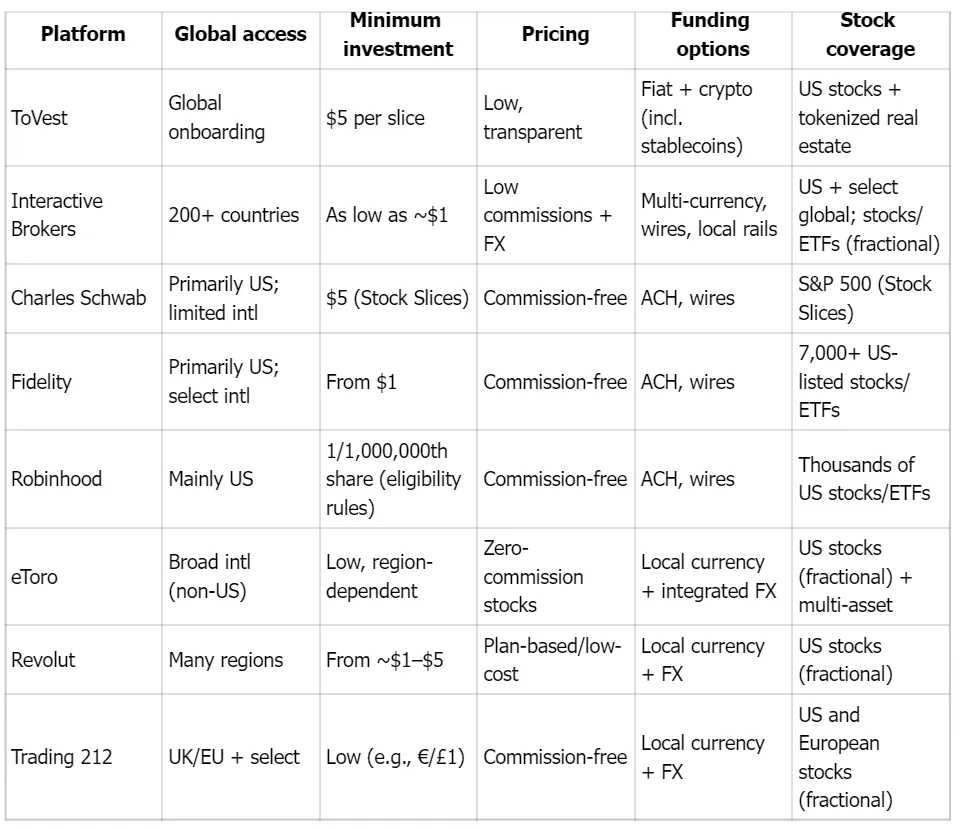
Note: “Fractional shares” are partial units of a stock, allowing purchases below one whole share and bringing minimums down to the $1–$5 range at leading brokers and apps (see Bankrate’s overview of fractional share investing).
ToVest
ToVest is a blockchain-based marketplace for fractional investing in US stocks and real estate, designed from the ground up for global access. Investors can buy a $5 slice of a stock or property token, fund in multiple fiat currencies or major cryptocurrencies, and trade 24/7 with instant, on-chain settlement and auditable transparency. Custodied assets and smart contract controls protect ownership and streamline corporate actions.
What makes ToVest different is interoperability: you can move capital between crypto and stock exposures without complex off-ramps, while a single account spans equities and tokenized real estate. This broadens diversification, especially for investors outside the US. In short: ToVest removes barriers for international investors by combining global onboarding, low minimums, and a comprehensive asset inventory on a single digital platform. For background on tokenization and investor workflows, see our Academy deep dive on tokenized assets and settlement efficiency.
Interactive Brokers
Interactive Brokers (IBKR) is a mature, globally accessible broker favored by active and professional investors. It offers fractional shares in US stocks and ETFs—and even some international stocks—making it a fit for non‑US residents seeking diversified access, with execution quality and advanced order types that appeal to sophisticated users (BrokerChooser’s guide to fractional brokers notes IBKR’s breadth).
IBKR supports clients across 200+ countries, competitive FX conversion, direct USD funding, and multi-currency balances. There’s no high account minimum for fractional trading, commissions are low, and platform tooling (screeners, algos, APIs) is among the industry’s deepest—useful if you scale beyond a starter account.
Charles Schwab
Charles Schwab’s Stock Slices make S&P 500 stocks accessible from $5 per slice with no trading commissions and automatic dividend reinvestment, packaged in a beginner-friendly interface with strong investor education. Schwab’s US-focused brand and regulatory protections (including SIPC coverage via its custodial framework) make it a trusted name for long-term investors, though non‑US residency can limit onboarding. As Bankrate puts it, Schwab gives investors straightforward ownership in top US companies with an emphasis on support and security.
Fidelity Investments
Fidelity’s Stocks by the Slice covers more than 7,000 US‑listed stocks and ETFs starting at $1, and trades are commission-free. The platform stands out for robust research, planning tools, and tax reporting—an edge for buy-and-hold investors and those optimizing after-tax returns. International access may require specific residency or account types, but for eligible users, Fidelity balances low minimums with a strong service model (see Bankrate’s coverage of fractional brokers).
Robinhood
Robinhood popularized mobile-first, commission-free trading with intuitive UX and ultra-low minimums: you can buy as little as 1/1,000,000th of a share (for eligible stocks, typically over $1 share price and $25M market cap). Onboarding is simple, and coverage spans thousands of stocks and ETFs. Global access remains limited for non‑US residents, and funding options center on ACH and wires. For starters building a habit with small, regular buys, the app’s simplicity is appealing.
eToro
eToro caters to global (non‑US) investors with fractional access to US stocks, built-in FX conversion, and social features like CopyTrading, where you can mirror strategies of experienced investors. Stockbrokers.com’s guide to fractional brokers highlights eToro’s fractional stock exposure and cross-border UX, which lets users invest in local currencies while accessing US markets. Minimums vary by region, and the platform spans multi-asset exposure (stocks, ETFs, crypto in certain jurisdictions).
Revolut
Revolut blends banking and investing in a single app, letting non‑US residents fund in local currencies, convert seamlessly to USD, and buy US stocks in small increments (often from $1–$5). It’s popular with mobile-first users who value fast onboarding, integrated FX, and a clean interface. Trading limits, pricing, and availability differ by plan and region, but for many international users, Revolut’s “banking + investing” bundle is a practical on-ramp to US equities.
Trading 212
Trading 212 is a leading commission-free broker for the UK/EU and select regions, offering fractional US and European stocks with low minimums and a beginner-friendly app. It’s known for intuitive UX and broad reach among global retail users seeking simple, economical access to US equities. Availability and funding rails vary by residency, but for many European investors, it’s a straightforward way to dollar-cost average into US names.
Stake and Public
Stake focuses on giving global users easy USD access to US markets, with a streamlined onboarding flow, fractional trading, and tools tailored to international retail investors. Public emphasizes education, community features, and fractional trading; availability is region-specific outside the US. Both cater to investors who value content, simplicity, and a social layer—good complements to the larger broker options above.
Criteria for Choosing a Fractional Shares Platform
Key factors to compare:
- Costs: Commissions, FX conversion/spreads, and any platform or clearing fees.
- Minimums: Smallest trade size and recurring investment thresholds.
- Execution and order types: Price improvement, routing, and advanced orders.
- Custody model: Direct brokerage custody vs. partner custodian vs. on-chain records.
- Tax and reporting: Country support, forms, dividend handling, capital gains reports.
- Funding and currencies: ACH/wires/cards, multi-currency wallets, and crypto rails.
- Access: Residency eligibility, KYC requirements, and investable universe (US-only vs. global).
Quick picks (by use case)
- Lowest minimums: Fidelity ($1), Robinhood (micro-fractions), Schwab ($5).
- Broadest global access: Interactive Brokers; ToVest for fiat+crypto rails.
- Best for beginners: Schwab, Fidelity, Trading 212, Revolut.
- Strongest tax/reporting tools: Fidelity, Schwab, Interactive Brokers.
- Crypto integration and 24/7 settlement: ToVest.
Comparative, feature-first tables help you weigh low-cost access against execution quality and tooling—a structured approach reduces bias and blind spots when choosing (see this analysis of feature-first comparisons).
Minimum Investment and Fees for Fractional US Stocks
Minimums (typical)
- ToVest: $5 per stock or real estate slice.
- Interactive Brokers: As low as ~$1 (varies by instrument).
- Charles Schwab: $5 for Stock Slices.
- Fidelity: From $1 for 7,000+ US-listed stocks/ETFs.
- Robinhood: As little as 1/1,000,000th of a share (eligibility rules apply).
- eToro: Low minimums; region-dependent.
- Revolut: Often $1–$5 (plan/region-dependent).
- Trading 212: Low; commonly €/£1.
Fees to expect
- Most major brokers offer commission-free fractional trading; however, you may see small clearing fees or FX spreads for international users, and some platforms apply modest activity or plan fees (BrokerChooser’s roundup notes examples like small per‑trade clearing charges at certain brokers).
- Commission-free trading means no explicit per-trade fee, but platforms may monetize via spreads, payment for order flow, or subscriptions.
Global Access and Currency Options
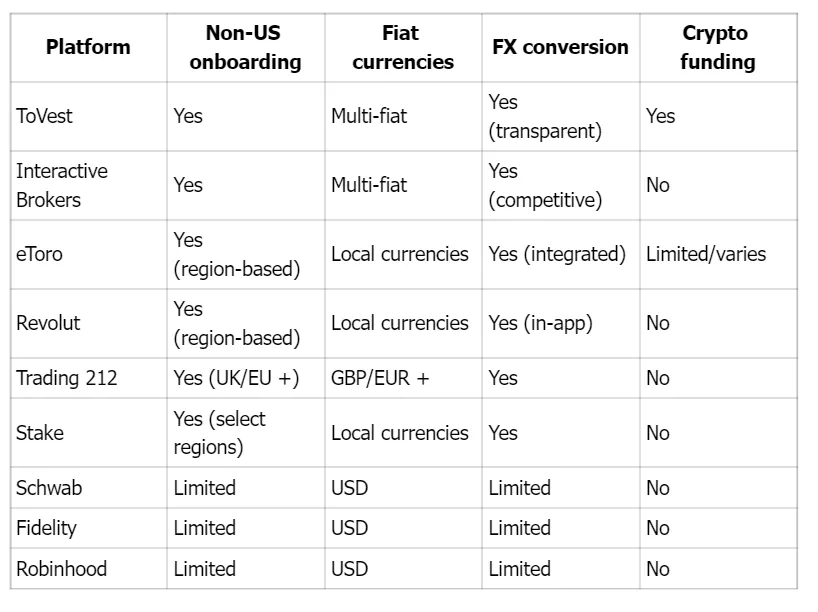
Who onboards non‑US residents?
- Broad international: ToVest, Interactive Brokers, eToro, Revolut, Trading 212, Stake.
- Primarily US/residency limits: Charles Schwab, Fidelity, Robinhood (availability varies by region and account type).
Funding and currencies
- Multi-currency support: Interactive Brokers, eToro, Revolut, Trading 212, Stake, ToVest.
- USD-only or limited rails: Often the case at US-first brokers; check your residency and funding options.
- Crypto funding: ToVest supports major cryptocurrencies and stablecoins alongside fiat.
What “multi-currency support” means: a platform lets you deposit and hold multiple currencies, convert at competitive rates, and settle US trades in USD without friction.
Global onboarding and payment rails
Custody, Settlement, and Regulatory Protections
- Custody: Where and how assets are held (broker-dealer books, partner custodians, or tokenized records).
- Settlement: How trades finalize and deliver; speed affects reinvestment and availability of funds.
- Regulatory protections: Investor safeguards (e.g., SIPC in the US) and oversight standards that govern brokers and custodians.
How platforms compare
- ToVest: Uses blockchain smart contracts to record ownership and enable instant, auditable settlement, with a custodial framework for underlying assets. On-chain transparency reduces reconciliation risk and accelerates the re-use of capital.
- Traditional brokers (e.g., Schwab, Fidelity): Custody under US regulations with SIPC insurance safeguards and mature tax/reporting pipelines; settlement follows market cycles (e.g., T+1) and corporate actions are handled in-house (see Bankrate’s summaries of protections and service depth among leading brokers).
- Fintech apps: Often rely on partner custodians and simplify UX; in exchange, they may limit advanced order types or research. Full-service platforms tend to provide more analytics and support but may add platform or service fees as part of the trade-off (see research on feature depth across platforms).
Additional Features and Tools for Investors
Feature map (selected)
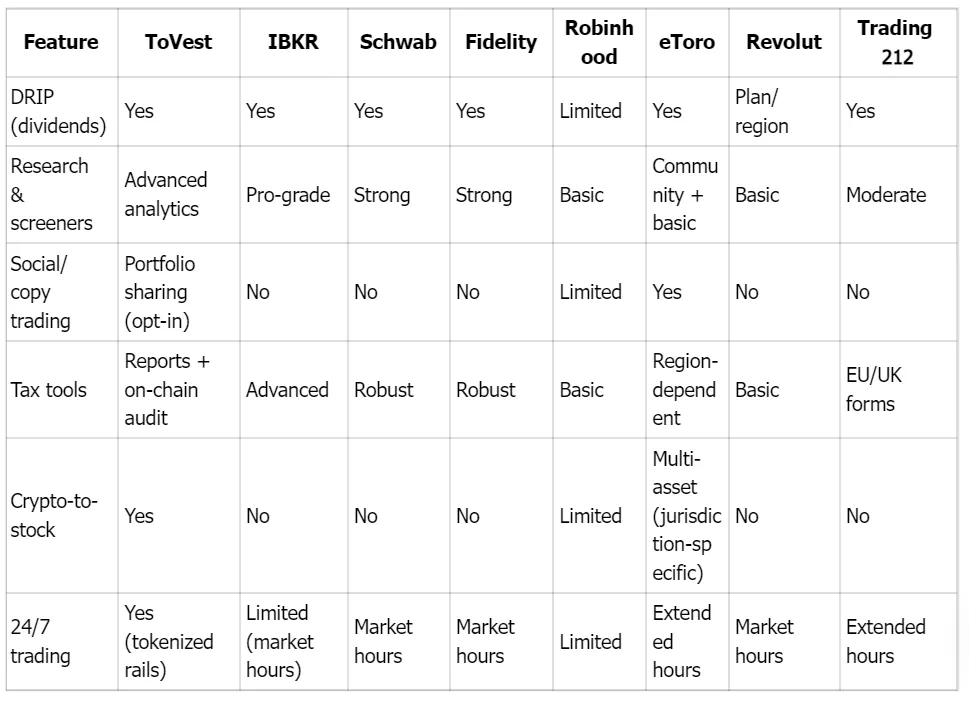
Why this matters: Features like DRIP, research, social learning, and automation help investors stay disciplined. ToVest’s blockchain transparency and 24/7 settlement particularly benefit dollar-cost-averagers and globally mobile users who want always-on access and interoperable funding.
Frequently Asked Questions
What Are Fractional Shares and How Do They Work?
Fractional shares are portions of a stock, allowing you to buy part of a share with small amounts, making expensive stocks accessible to any budget.
How Do I Find the Best App for Buying Fractional Shares of US Stocks?
Compare minimums, fees (including FX), global onboarding, funding options, research tools, and asset coverage—choose the one that fits your location and strategy.
What Is the Minimum Investment Needed for Fractional US Stocks?
Many platforms let you start with $1–$5 per trade; others set low region-dependent minimums.
Can Global Investors Access US Fractional Stocks Easily?
Yes—platforms like ToVest, Interactive Brokers, eToro, Revolut, and Trading 212 onboard non‑US residents and support multi-currency funding, though rules vary by country.
Are There Fees or Commissions on Fractional Share Trades?
Most platforms are commission-free for fractional trades, but you may encounter small clearing fees or conversion spreads depending on how you fund your account.

