USDT Investment Options to Watch in 2025 for Instant Transactions
15 ธันวาคม 2568
Strategic Overview
USDT is a stablecoin designed to maintain a constant value, making it a practical store of value and a fast medium for crypto-native payments and investments. Its near-instant transferability and deep liquidity make it ideal for moving capital between platforms and strategies without waiting on bank rails. In 2025, investors are prioritizing stability, speed, flexibility, and yield—particularly as stablecoin activity has surged, with annual transaction volumes topping an estimated $27 trillion, driven largely by USDT and other tokenized cash instruments, according to McKinsey’s research on next‑gen payments. From tokenized real assets on ToVest to yield products on other platforms including Bybit, Binance, Aave, Gate.io, and MEXC, this guide pinpoints where USDT can work hardest—instantly.
Platform snapshot for instant USDT moves:
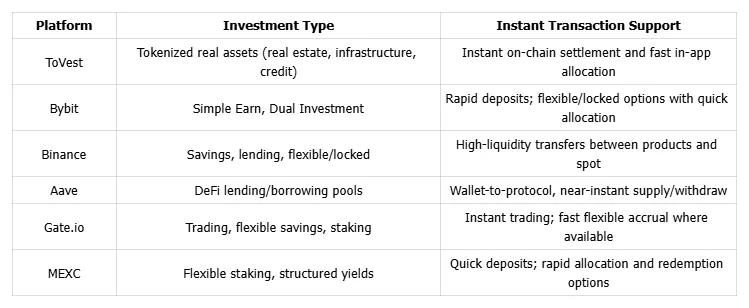
ToVest Tokenized Real Asset Investments with USDT
ToVest enables investors to allocate USDT directly into tokenized real-world assets, such as income-focused real estate and private credit. Tokenization is the process of converting a physical or financial asset into a blockchain-based digital token representing ownership or participation, enabling instant digital settlement, transparent record-keeping, and fractional access.
What sets ToVest apart:
- Instant digital settlement and low-latency execution for allocations and rebalancing.
- Diversified exposure to real-world assets with low, transparent fees.
- Strong security protocols and audited processes designed for institutional-grade custody and compliance.
- Stablecoin rails that store and transfer value without traditional banking settlement, streamlining on/off ramps and internal moves.
Asset categories available on ToVest:
- Income-generating real estate
- Infrastructure-linked opportunities
- Private credit and trade finance programs
- Select commodity or revenue-sharing assets
How to invest on ToVest with USDT:
- Create your account and complete verification.
- Deposit or bridge USDT to your ToVest wallet.
- Browse tokenized offerings, review terms and disclosures, and assess risk.
- Allocate USDT; settlement occurs digitally with on-chain records.
- Track distributions and performance; reallocate or withdraw as strategy evolves.
For deeper context, see ToVest Academy on tokenized assets and our latest market report for data-driven insights.
Bybit USDT Yield and Investment Products
Bybit is a leading venue for USDT-based yields, offering flexible and locked Simple Earn products that have recently ranged from roughly 4% to 7.59% APY, based on Datawallet’s compilation of best Tether yield opportunities. For advanced users, Dual Investment structures can quote headline yields up to 406.64% by accepting price settlement conditions at maturity, allowing near-instant allocation but variable outcomes depending on market moves.
Transparency and liquidity are notable strengths: Datawallet highlights Bybit’s public proof-of-reserves showing tens of billions in customer assets, including around 36.8 billion USDT held across custody sources.
Bybit product comparison (illustrative ranges):
ProductExpected APYLock-UpWithdrawal TermsInstant AccessSimple Earn
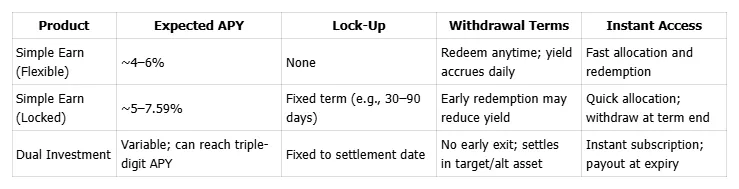
Note: Yields vary by market conditions and inventory. Understand term commitments and settlement mechanics before subscribing.
Binance USDT Savings and Lending Options
Binance offers multiple USDT programs with quick allocation and internal fund mobility:
- Savings accounts: on-platform wallets that earn interest on idle balances.
- Lending markets: peer-to-platform or peer-to-peer loans where you supply USDT to earn interest.
Why investors use Binance for instant USDT moves:
- Depth and variety across flexible/locked products, plus high trading volume for fast deposits and conversions.
- Competitive rates on flexible and promotional products.
- Swift transfers between spot, savings, and other earning programs to capture opportunities without downtime.
Fast flow to start earning on Binance:
- Deposit USDT.
- Choose Flexible Savings for daily accrual or Locked for higher potential APY.
- Allocate with a tap; monitor and rebalance between products as markets change.
Aave Decentralized USDT Lending and Borrowing
DeFi—short for Decentralized Finance—lets users transact directly with on-chain liquidity pools, rather than intermediaries. On Aave, you supply USDT to a pool and instantly start earning interest; you can also borrow against collateral, with rates that adjust algorithmically. Many networks enable wallet-only access, offering greater privacy and self-custody.
Pros vs. cons for instant USDT liquidity:
- Pros: self-custody, no centralized KYC on-chain, near-instant supply/withdraw, transparent reserves.
- Cons: smart contract risk, variable interest rates, network fees, and potential liquidity crunches during volatility.
Quick start on Aave:
- Connect a Web3 wallet.
- Select USDT and your preferred network.
- Deposit USDT into the lending pool.
- Earn variable interest; monitor utilization and APY.
- Withdraw anytime, subject to pool liquidity.
For practical ranges, Milk Road’s guide to lending USDT notes many DeFi pools have historically offered about 3–12% APY, though rates fluctuate with demand and risk.
Gate.io USDT Trading and Interest Opportunities
Gate.io blends deep USDT trading pairs with flexible earnings:
- Instant deposits and conversions for fast strategy execution.
- Flexible savings or staking products with daily accrual where supported.
- Auto-invest features to dollar-cost average into selected assets.
- Intuitive order flows for rapid spot and derivatives trading.
This mix helps both new and advanced users keep USDT productive while retaining near-immediate access.
MEXC Innovative USDT Investment Features
MEXC emphasizes security and speed for USDT deployment:
- Custody practices that include multi-signature controls and significant cold storage.
- Fast onboarding and deposits so users can allocate to flexible staking, structured yield notes, or spot trades with minimal delay.
- Rapid exchange services to move between USDT, stablecoin pairs, and target assets for tactical positioning.
For investors prioritizing quick execution and diversified tools, MEXC offers a streamlined path from deposit to deployment.
Centralized vs Decentralized USDT Investment Platforms
CeFi (centralized finance) platforms like Bybit and Binance provide familiar user experiences, fiat on/off ramps, and curated products. DeFi protocols like Aave offer self-custody, privacy, and programmable liquidity via smart contracts.
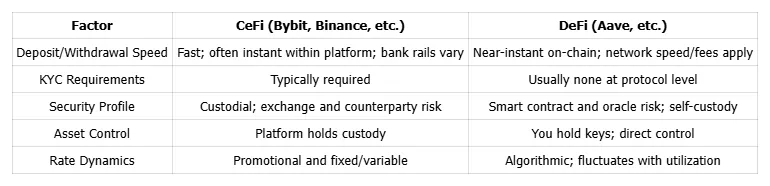
Choose based on your need for instant access, custody preference, and risk tolerance.
Key Yield Strategies for USDT in 2025
Core strategies that balance yield with instant (or near-instant) access:
- Flexible staking: deposit USDT with no lock-up and earn daily interest; easy to exit.
- Liquidity pools: provide USDT to decentralized pools to earn fees or incentives; rates vary with trading activity and utilization.
- Dual investment: accept settlement conditions for boosted APY; returns can be high but are market-contingent and typically locked to expiry.
- High-volume CeFi savings: flexible and promotional products on major exchanges for convenience and quick reallocation.
At-a-glance strategy table:
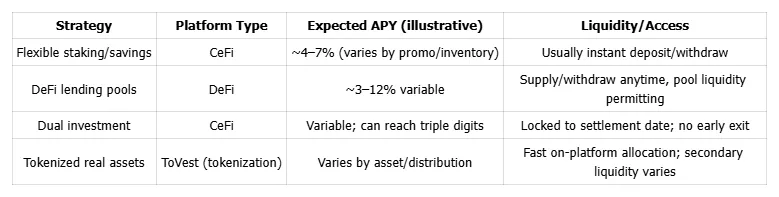
Always review product terms, smart contract audits, and custody arrangements before committing capital.
Market Trends Influencing USDT Investments
Stablecoin adoption is accelerating: McKinsey estimates tokenized cash volumes exceeded $27 trillion annually by 2025, showcasing real-world utility for instant settlement and programmable finance. Cost efficiency is a major driver—blockchain payment rails can range around 0.5–1% in fees, well below typical card fees of 2–3%, and projections suggest stablecoins could account for 20% of cross-border payments by 2030, potentially saving businesses $10 billion. For investors, that translates to faster access, more transparent flows, and the ability to hedge fiat exposure while keeping portfolios diversified and liquid.
Frequently asked questions about USDT investments
What are the best USDT investment options for instant transactions?
Flexible staking platforms and liquidity pools—such as ToVest’s tokenized offerings—let you allocate USDT quickly and retain fast withdrawal options.
How can I earn yields on USDT with instant liquidity?
Stake USDT in flexible savings or supply it to decentralized lending pools where rewards accrue daily and funds can be withdrawn on demand.
What are the risks of investing in USDT for quick returns?
Yields can change rapidly, and decentralized options introduce smart contract risk; in centralized finance, consider counterparty and custody risk—diversify and review terms carefully.
How do I start investing using USDT on popular platforms?
Deposit USDT, choose a product like flexible savings, lending, or tokenized assets on ToVest, and allocate; the onboarding and allocation flow typically takes minutes.
How does USDT compare to other stablecoins for fast-yield investments?
USDT’s deep liquidity often supports competitive yields and quick fills, while alternatives may offer different transparency models or ecosystems; both generally support instant transactions.