Boost Portfolio Stability with Stablecoins – Low Risk, High Liquidity
17 ธันวาคม 2568
Stablecoins are digital assets designed to maintain a stable value—most are pegged to a fiat currency such as the US dollar and backed by collateral. For investors asking whether stablecoins can diversify a portfolio and which platforms accept USDT or USDC, the answer is yes on both counts: stablecoins add a low-volatility, highly liquid sleeve to an allocation, and they’re widely supported across major exchanges, fintech apps, and tokenization platforms like ToVest. As adoption accelerates and stablecoins bridge traditional and digital finance, they offer faster settlements, efficient hedging, and a straightforward way to access tokenized real-world assets—areas where ToVest excels with institutional-grade transparency and security, helping you reinforce stability without sacrificing liquidity, speed, or access.
Understanding Stablecoins and Their Role in Portfolio Stability
Stablecoins blend crypto benefits with stability via fiat, crypto, or algorithmic pegs but face challenges, making design and reserve quality central to their reliability, as outlined by JPMorgan Private Bank’s overview of stablecoins (see JPMorgan Private Bank on stablecoins). Stablecoins are crypto tokens on decentralized ledgers promising fixed fiat value, mostly issued by single entities, which helps explain their pegging mechanics and redemption models in practice (Bank for International Settlements, Chapter III – Demystifying Stablecoins).
Common structures and how they maintain pegs:
- Fiat-collateralized: Backed by cash and short-duration Treasuries; peg held via issuance and redemption with the issuer (e.g., USDT, USDC).
- Crypto-collateralized: Overcollateralized with crypto assets and maintained by on-chain mechanisms and autonomous liquidations (e.g., DAI).
- Algorithmic: Rely on algorithmic supply adjustments without full reserves; these can be fragile during stress (e.g., historical examples like TerraUSD).
Representative examples and mechanics:
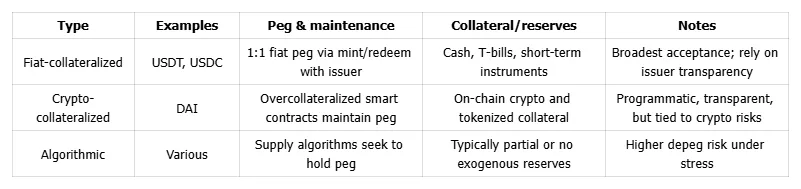
This blend of traditional finance (fiat pegs, reserves, redemption) with blockchain rails (programmability, 24/7 settlement) underpins why stablecoins are used as stable settlement assets while retaining crypto-native speed and composability.
Sources: JPMorgan Private Bank on stablecoins; Bank for International Settlements, Chapter III – Demystifying Stablecoins.
Benefits of Using Stablecoins for Investment Diversification
Stablecoins act as low-risk, high-liquidity alternatives to volatile cryptocurrencies, especially useful during market turbulence, and are increasingly used for hedging, settlements, and treasury operations in digital markets (Ainvest analysis of institutional adoption). They serve as a cash-like buffer that preserves value while keeping capital at the ready for redeployment.
How stablecoins compare with other portfolio building blocks:
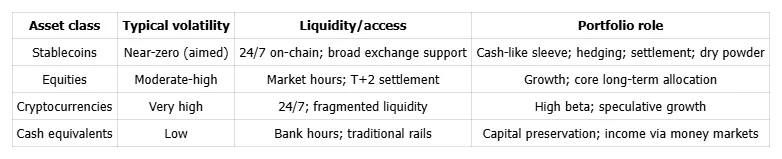
Investors can “park” capital in stablecoins during uncertainty to preserve purchasing power and maintain liquidity for fast re-entry. Institutional interest is rising, with research citing that stablecoins are a catalyst for mainstream crypto participation—many firms report readiness to use them and note their dominance in on-chain transactions (Ainvest analysis of institutional adoption).
How Stablecoins Mitigate Risk in Volatile Markets
In contrast to assets like Bitcoin that can swing 5–10% in a single day, stablecoins target minimal price fluctuation, allowing investors to reduce exposure during high-volatility windows (see Diamond Pigs explainer on stablecoins and crypto volatility). In decentralized finance, they act as stable settlement assets and collateral, dampening volatility transmission through trading and lending systems (European Systemic Risk Board report on cryptoassets and financial stability).
Real-world use cases:
- Hedge during crypto sell-offs: Move from volatile tokens into USDC/USDT to lock in value while staying crypto-native for rapid redeployment.
- Inflation resilience: In countries facing high inflation, stablecoins can help maintain purchasing power and enable dollar access; Argentina has seen triple-digit inflation in recent years, driving demand for dollar-pegged options (JPMorgan Private Bank on stablecoins).
- Treasury and payments: Protocol treasuries and market makers use stablecoins to settle quickly across venues, reducing basis and counterparty risk.
Key risks to manage:
- Depegging risk (market stress, reserve concerns)
- Algorithmic design failures (e.g., reflexive runs)
- Mass redemptions and liquidity mismatches
Practical guidance: diversify across issuers and models, prioritize transparent reserves and redemption processes, and avoid undercollateralized or opaque structures.
High Liquidity Advantages of Stablecoins in Trading and Settlements
Liquidity is the ease and speed with which an asset can be converted to cash or another asset without significantly affecting its price. Tether (USDT) commands a large share of the market—roughly two-thirds—and is widely supported across blockchains and platforms, contributing to deep trading pairs and settlement utility (JPMorgan Private Bank on stablecoins).
How stablecoins streamline trading and cross-border activity:
- Use as base pairs to enter/exit positions instantly across spot, futures, and options markets.
- Move funds between venues on-chain within minutes, avoiding banking delays.
- Facilitate cross-border transfers, often reducing fees and intermediary steps.
- Support on-chain settlement in DeFi, money markets, and tokenized assets.
For cross-border payments, industry data suggests stablecoins can reduce transaction costs by up to 70% and compress settlement times from days to minutes (Yellow Card analysis of stablecoins and traditional finance). For investors, that translates into easier market entry and exit, faster rebalancing, and more efficient deployment of cash across strategies.
Choosing the Right Stablecoins for Your Portfolio
Start by matching design to risk tolerance:
- Fiat-collateralized coins (e.g., USDT, USDC) offer predictable pegs and broad liquidity; institutions tend to favor these versions for their stability profile (Ainvest analysis of institutional adoption).
- Crypto-collateralized options (e.g., DAI) provide on-chain transparency and programmability but can be sensitive to crypto market drawdowns.
- Algorithmic models can fail under stress; approach with caution unless backed by robust, exogenous collateral.
Why regulated stablecoins and transparency matter: leading market research stresses that fully-reserved, transparent designs—combined with credible oversight—improve trust and adoption (JPMorgan Private Bank on stablecoins).
Quick comparison of popular choices:
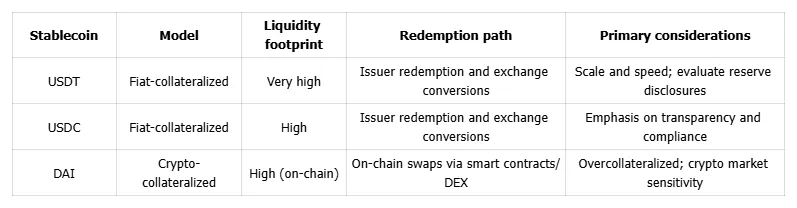
Practical tips:
- Prioritize regulated stablecoins, clear reserve policies, and independent attestations.
- Monitor peg behavior during stress.
- Diversify across issuers and chains to minimize idiosyncratic risk.
Investment Platforms Accepting Stablecoins like USDT and USDC
Where you can put stablecoins to work:
- Centralized crypto exchanges: Trade, stake, or lend with USDT/USDC; robust order books and fiat on/off-ramps.
- Tokenization platforms (ToVest): Convert stablecoins into tokenized real-world assets (RWAs) such as real estate or short-duration credit, with instant settlement and institutional-grade reporting.
- DeFi protocols: Provide liquidity, access money markets, or collateralize positions.
- Peer-to-peer and fintech apps: Send, receive, and store stablecoins with integrated payments.
What to look for: trusted custody, strong security practices, clear redemption/on-ramp processes, and integration with broader financial markets.
Feature snapshot:
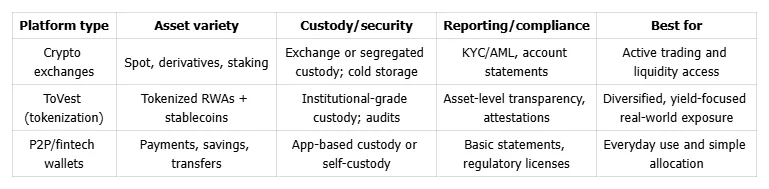
Integrating Stablecoins with Tokenized Real-World Assets on ToVest
ToVest makes it straightforward to convert stable liquidity into diversified, tangible exposure.
Step-by-step:
- Deposit USDT or USDC into your ToVest account.
- Browse tokenized real-world assets (e.g., income-generating real estate or short-term credit pools).
- Review asset disclosures, cash flows, and risk metrics.
- Execute trades in real-time; allocations settle on-chain with institutional-grade custody.
- Track performance, distributions, and audit trails from a unified dashboard.
- Rebalance or redeem to stablecoins at any time to maintain flexibility.
Why investors choose ToVest:
- Real-time trading, advanced security, and robust partner networks.
- Seamless stablecoin settlement across multiple chains.
- Transparent, institutional reporting that supports both retail and professional workflows.
- Research and market insights to inform allocation decisions (see ToVest research and reports).
Regulatory Considerations and Safety Measures for Stablecoin Investments
The future of stablecoins is shaped by regulatory developments; fully-reserved, transparent issuers are expected to inspire greater trust and broader institutional use (JPMorgan Private Bank on stablecoins). At the same time, the market has seen the risks of run dynamics and design fragility—TerraUSD’s 2022 collapse showed how quickly algorithmic pegs can unravel and spill over into broader markets (JPMorgan Research on TerraUSD).
Key risk themes: stablecoin regulations, reserve transparency, investor protection.
Safety checklist:
- Regulated issuer with clear legal structure and jurisdictions.
- Independent reserve attestations and high-quality collateral.
- Robust, tested redemption mechanisms and liquidity management.
- Documented risk disclosures, including chain and counterparty exposures.
- Multi-chain and multi-custody redundancy where possible.
ToVest aligns with industry-leading protocols for compliance, custody, and auditability to safeguard user capital while enabling efficient stablecoin-based settlement.
Emerging Trends and Innovations in Stablecoin Design and Use
Design is shifting toward store-of-value characteristics and resilience, appealing to investors in inflation-prone markets and to institutions seeking predictable settlement assets (JPMorgan Private Bank on stablecoins). Notable innovations include:
- Real-world asset collateralization and on-chain money-market integrations.
- Multi-chain operability and native interoperability.
- Programmable payments for treasury, payroll, and B2B settlement.
- Enhanced transparency tooling and proof-of-reserve frameworks.
Adoption continues to broaden across remittances, payroll, and dollar access in emerging markets, with industry estimates indicating that by 2025 nearly half of global financial institutions will pilot or use stablecoins in some capacity (Yellow Card analysis). For a deeper dive into design directions, see Centrifuge’s perspective on the future of stablecoin design.
Frequently Asked Questions
What are stablecoins and how do they maintain their value?
Stablecoins are cryptocurrencies designed to hold a stable value, often pegged 1:1 to fiat currencies like the US dollar, using reserves or algorithms to minimize price fluctuations.
Can stablecoins help reduce overall portfolio volatility?
Yes—by shifting into stablecoins during stress, investors lower exposure to price swings while retaining liquidity for fast redeployment.
What should investors consider before adding stablecoins to their portfolio?
Evaluate reserve transparency, regulatory oversight, redemption mechanics, and the coin’s historical peg stability.
Which platforms support trading and storing USDT and USDC safely?
Major crypto exchanges, tokenization platforms like ToVest, DeFi protocols, and regulated fintech apps support secure USDT/USDC use with varying custody options.
How do regulations impact the stability and adoption of stablecoins?
Clear rules and audits enhance transparency and trust, supporting peg integrity and accelerating mainstream adoption.