Step‑by‑Step Checklist: Secure US Stock Token Purchases for Expats
23 ธันวาคม 2568
Buying US stock tokens as an expat can be safe and straightforward—if you follow a compliance-first playbook. These tokens are blockchain-based representations of US equities, and in most jurisdictions, they’re treated like securities, so you’ll need to verify licensing, investor eligibility, and custody before you click buy. This guide addresses the main questions international investors ask—how to choose the best US stock token platform for international investors, whether you can use crypto for US stock tokens, and how to keep your holdings secure—then provides a practical checklist for immediate use. ToVest’s perspective is clear: combine institutional-grade controls with modern token rails so you gain transparent access, verifiable ownership, and real-time settlement—without compromising compliance.
Understand Legal and Regulatory Requirements for Expats
US stock tokens typically fall under securities laws, with oversight by the SEC in the US and evolving regimes globally; in the EU, the MiCA framework is shaping a pan-EU path for tokenized assets, custody, and market integrity, which cross-border investors should track alongside local rules. A core principle is that both the issuer’s and the investor’s jurisdictions matter, and offerings to foreign investors can trigger home-country rules—so legal permissibility must be confirmed on both sides before investing. Special Purpose Vehicle (SPV) structures are common in compliant tokenization: an SPV holds the underlying shares and issues tokens that carry enforceable rights to those assets.
Quick legal checklist for expats:
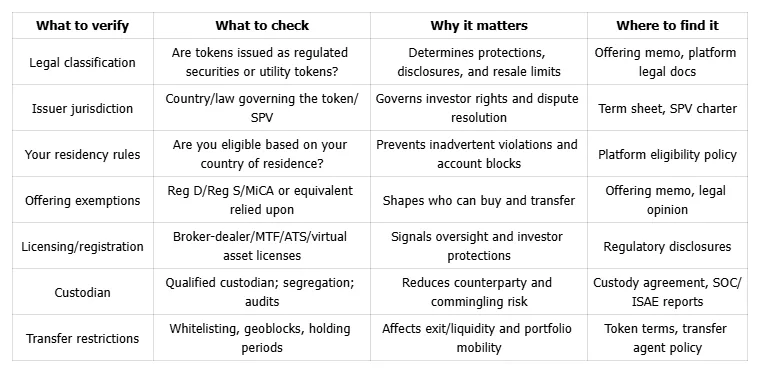
For deeper background on cross-border triggers and SPV-based tokenization, see the Legal Guide to RWA Tokenization by Buzko Legal and the SPV-driven workflow explained by RWA.io.
- Buzko Legal: Legal Guide to RWA Tokenization: https://www.buzko.legal/content-eng/legal-guide-to-real-world-assets-rwa-tokenization
- RWA.io: How to Tokenize Real‑World Assets (SPV approach): https://www.rwa.io/post/how-to-tokenize-real-world-assets-step-by-step
Choose a Compliant US Stock Token Platform
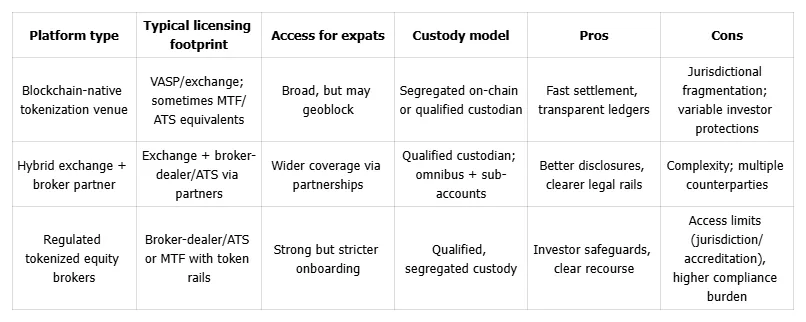
The safest path is to select a compliant platform with a clear regulatory framework, proper licensing, credible KYC/AML controls, and regular third-party audits. When evaluating the best US stock token platforms for expats, consider:
- Licensing status in recognized jurisdictions (e.g., broker-dealer/ATS, MTF, VASP/Exchange).
- KYC/AML procedures, sanctions screening, and ongoing monitoring.
- Smart contract audits, incident response capabilities, and oracle designs.
- Third-party or segregated custody with verifiable attestations.
- Clear legal terms, risk factors, and investor eligibility by country.
- Market access (spot, secondary venues), 24/7 support, and fee transparency.
Comparison of platform models:
A practical issuer-side due diligence checklist that mirrors what you should look for as an investor is outlined in Investax’s Asset Tokenization Checklist, which stresses audits, compliance documentation, and robust KYC/AML: https://investax.io/blog/asset-tokenization-checklist-for-issuers
Verify Token Ownership and Legal Backing
Don’t buy mere digital collectibles. Your tokens should confer legally enforceable rights to the underlying shares via direct tokenized equity or through an SPV that holds the stock and issues claim-bearing tokens. This means the chain of title—from token to SPV to custodian-held shares—must be clear and provable. The core risk to avoid is purchasing tokens that are not legally backed by assets or enforceable contracts.
Tokenized equity simply refers to digital tokens that represent legal ownership or rights to equity in a company; the definition and mechanics are summarized by Investopedia: https://www.investopedia.com/terms/t/tokenized-equity.asp
Legal-linkage document checklist:
- Offering memorandum or private placement memo detailing rights and risks.
- SPV charter, shareholder agreement, and governing law.
- Custodian agreement naming the SPV and asset segregation terms.
- Transfer agent/whitelisting policy and investor eligibility by jurisdiction.
- Corporate actions policy (dividends, splits, votes) and how tokens are updated.
- Redemption/exit mechanics and dispute resolution venue.
- Attestations or audit reports proving share holdings match token supply.
For why this linkage matters and the pitfalls of “unbacked” tokens, see Ancilar’s On-Chain Tokenization guide: https://medium.com/@ancilartech/unlocking-real-world-assets-your-guide-to-on-chain-tokenization-ec4adba83e6b
Complete KYC, AML, and Accreditation Procedures
Reputable platforms will require identity verification, residency checks, sanctions screening, and—depending on the exemption—accredited investor validation before you can invest. Expect to provide government ID, proof of address, source-of-funds declarations, tax residency information, and, where applicable, documents confirming accredited status.
In the US, accredited investor thresholds generally include income above $200,000 ($300,000 with spouse) or net worth over $1 million excluding a primary residence; the SEC outlines the full criteria here: https://www.sec.gov/education/capitalraising/building-blocks/accredited-investor
Typical KYC/AML documentation list:
- Passport or national ID, plus a selfie or liveness check.
- Proof of address (utility bill/bank statement).
- Tax identification number and residency certification.
- Source-of-funds/source-of-wealth disclosures.
- For accreditation (if required): income statements, brokerage letters, or CPA attestations.
Platforms typically restrict access until KYC/AML is cleared and will only issue tokens to verified, whitelisted wallets, in line with issuer policies described in many asset tokenization frameworks, such as those cataloged by Investax: https://investax.io/blog/asset-tokenization-checklist-for-issuers
Select Secure Custody Solutions and Wallets
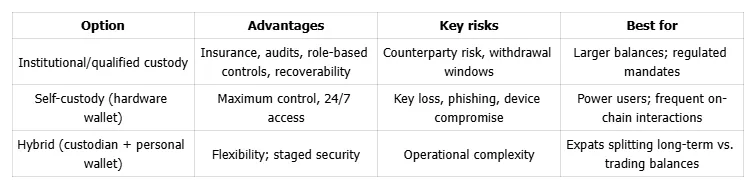
Custody is where expats either succeed or face real-world risk. Segregated custody means your assets are held separately from the platform’s reserves and are verifiable—ideally both on-chain and via independent attestations. For institutional-grade setups, look for qualified custodians, crime insurance where available, and external audits; for self-custody, use hardware wallets, enable 2FA, and secure your seed phrase in geographically separate locations.
ToVest emphasizes that custody, segregation, and auditability form the backbone of investor protection: https://www.xbto.com/resources/tokenization-platforms-explained-technology-custody-compliance
Custody options compared:
Review Smart Contract and Oracle Security
Smart contract audits are critical to prevent exploits and logic errors in token contracts, transfer restrictions, and corporate action modules. Ask for independent audit reports, code repositories, and whether there’s an active bug bounty. Oracles—systems that feed off-chain data like stock prices or corporate events to smart contracts—must be reliable, redundant, and tamper-resistant to avoid mispricing and stale data.
- Issuer and platform audit expectations are described in Investax’s tokenization checklist (audits, monitoring, incident response): https://investax.io/blog/asset-tokenization-checklist-for-issuers
- A practical overview of oracle design and platform readiness is outlined in this Coinmonks engineering checklist: https://medium.com/coinmonks/how-to-create-a-complete-checklist-for-asset-tokenization-platform-development-637036b227b8
Smart-contract due-diligence questions to ask:
- Who audited the contracts, when, and are fixes verified?
- Is the code open source? Is there a bug bounty?
- How are upgrades controlled (multisig, timelocks)? Is there a pause switch?
- Which oracle providers are used? What are the failover and manipulation defenses?
- How are corporate actions (splits/dividends) reflected on-chain?
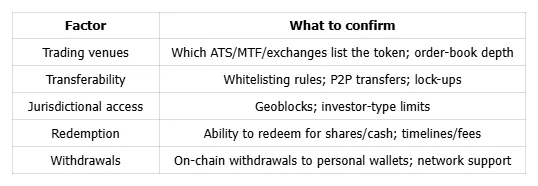
Confirm Liquidity and Secondary Market Access
Liquidity depends on the presence of regulated secondary venues, wallet whitelisting policies, and transfer rules. Some platforms restrict trading to whitelisted investors or specific jurisdictions, which can impact your ability to exit. Check whether tokens can be transferred between platforms, redeemed for underlying shares, or withdrawn to self-custody. Note that tokenized US equities can enable price responsiveness outside traditional market hours if platforms support 24/7 markets.
- ASIFMA’s roadmap details how transfer restrictions and venue design affect secondary liquidity: https://www.asifma.org/wp-content/uploads/2019/11/tokenised-securities-a-roadmap-for-market-participants-final.pdf
- For how tokenization can enable around-the-clock responsiveness and operational rails, see XBTO’s overview: https://www.xbto.com/resources/tokenization-platforms-explained-technology-custody-compliance
Liquidity checklist:
Manage Tax, Reporting, and Cross-Border Compliance
Tokens are commonly treated as securities or property, and in the US, sales, swaps, and even crypto-to-token conversions are taxable events. Keep meticulous records and align classifications across countries to avoid double taxation. Use treaty relief where available and reconcile all trades, income (dividends/staking), and fees.
- The IRS clarifies that digital asset transactions are taxable, with capital gains generally reported on Form 8949 and Schedule D; start here: https://www.irs.gov/businesses/small-businesses-self-employed/digital-assets
- Form 8949 instructions and filing resources are available via the IRS website: https://www.irs.gov/forms-pubs/about-form-8949
Tax checklist for expats:
- Track every transaction (date, cost basis, proceeds, fees, FX rates).
- Record dividends/airdrops/staking and classify per local law.
- File US Form 8949 and Schedule D if you are US-taxable; consider FATCA/FBAR and local equivalents as applicable.
- Apply treaty benefits to avoid double taxation; document foreign tax credits.
- Reconcile crypto-to-token swaps as dispositions where required.
Execute a Test Purchase and Monitor Your Holdings
Execute a limited test purchase to validate the full workflow before scaling up. Start by selecting a compliant platform and specific token, complete KYC/AML, and fund your account (fiat or crypto). Execute a small trade, then confirm on-chain ownership and off-chain documents (offering memo, custody attestations) and ensure your token is on the correct whitelist. Finally, monitor positions for corporate actions, smart-contract upgrades, and regulatory changes that could affect transferability or tax treatment.
Suggested first-trade flow:
- Choose platform and asset
- Complete KYC/AML
- Execute small transaction
- Confirm on-chain ownership and dashboard balances
- Review offering, custody, and transfer policies
- Scale allocation with position limits and alerts
Frequently Asked Questions
What US tax rules apply to expat purchases of US stock tokens?
US expats must report gains and income from token transactions per IRS digital asset rules, typically using Form 8949 and Schedule D for capital gains.
Can I use cryptocurrency to purchase US stock tokens safely?
Yes—on compliant platforms that accept crypto deposits—but converting crypto to tokens is usually a taxable event and must be recorded for reporting.
How do expats avoid double taxation on US stock token gains?
Use relevant tax treaties, apply consistent asset classification across jurisdictions, and keep complete records to claim foreign tax credits where eligible.
What features should I look for to ensure secure token custody?
Prioritize segregated custody that includes audits and insurance, or utilize hardware-wallet self-custody with strong 2FA and secure seed management.
Are there trading restrictions for expats on US stock token platforms?
Yes—some platforms geoblock by residency or require whitelisted wallets, so confirm eligibility and transfer rules before onboarding.