The Complete Legal Handbook for Trading US Stock Tokens in 2025
24 ธันวาคม 2568
US stock tokens bring the familiar world of equities into the efficiency of blockchain: faster settlement, fractional ownership, and 24/7 market access. If you’re wondering how to get started, the safest route is simple—open an account with a regulated platform like ToVest, complete identity checks, fund a wallet or custodial account, and buy only tokens that are fully disclosed and legally offered. Legal trading generally occurs on registered security token venues (e.g., ATS in the US), with regulated exchanges and brokers increasingly piloting tokenized equity access. This handbook explains how stock tokens work, the current legal framework, and step-by-step guidance to invest safely—along with the platform, custody, and compliance features that matter most.
Understanding US Stock Tokens
US stock tokens are digital assets issued on blockchain networks that represent fractional ownership or rights tied to underlying US equities or ETFs. They are often structured as security tokens and provide exposure to the performance of real stocks, with settlement and transfer occurring on-chain.
Stock tokens enable fractional investing, global access, and programmability. They integrate with blockchain infrastructure so transfers, investor caps, and even payouts can be automated via smart contracts—features explored across industry primers like the Gemini explanation of tokenized stocks and CoinGecko’s guide to tokenized stocks. Real‑world pilots are expanding: for example, Robinhood partnered with Bitpanda to bring tokenized US shares to European users, reflecting a broader shift toward compliant access in multiple jurisdictions, as noted by BlockBeats. The market remains early: mid‑2025 estimates peg stock‑token capitalization around $424 million, underscoring a nascent but growing niche, according to Legal Nodes’ 2025 stock tokenization guide.
Comparison snapshot:
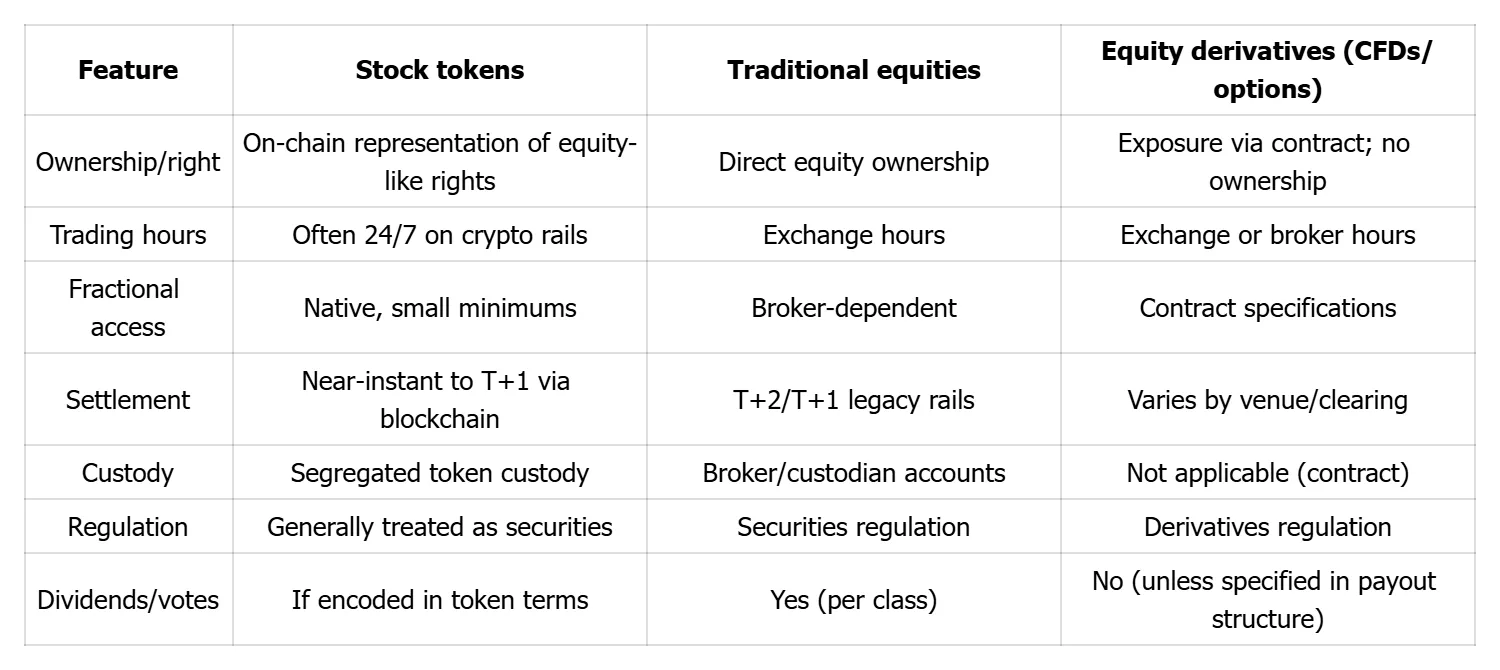
Helpful background: see the Gemini explanation of tokenized stocks, CoinGecko guide to tokenized stocks, and Wall Street Journal coverage of Kraken’s stock tokens.
Legal Classification and Regulatory Framework
The US relies on the Howey Test to determine whether an asset is a security, looking at investment of money, common enterprise, expectation of profits, and reliance on others’ efforts. For stock tokens that confer equity‑like rights or profit expectations, regulators largely treat them as securities, triggering SEC jurisdiction and standard requirements for issuance, disclosures, custody, and secondary trading. Practical compliance parallels those for traditional equities—registration or exemption, broker/dealer or ATS permissions, and investor protections—outlined in InnReg guidance on tokenized securities.
Quick classification and oversight touchpoints:
- Does the token represent equity‑like rights or profit sharing? Likely a security (SEC).
- Is it a derivative on a commodity or index? Potential CFTC oversight.
- Are there taxable events (trades, dividends, staking)? IRS reporting applies.
- Is secondary trading offered to US persons? Check ATS registration or exchange licensure.
- Are tokens transferable across borders? Consider Reg S, local securities rules, and sanctions screening.
For a deeper primer, see the Zoniqx overview of the Howey Test and InnReg guidance on tokenized securities.
Setting Up for Legal US Stock Token Trading
A compliant launch follows a structured path:
- Scope and legal analysis: confirm security status, offering exemptions, and secondary trading permissions.
- Entity and jurisdiction planning: align corporate structure, investor base, and cross‑border strategy.
- Offering documentation: draft disclosures that mirror traditional securities requirements.
- Compliance stack: AML/KYC, sanctions screening, tax reporting, investor eligibility.
- Technology build: audited smart contracts enforcing transfer rules, eligibility, and cap‑table logic.
- Custody architecture: segregated, bankruptcy‑remote custodians with clear insurance.
- Venue integrations: list only on permitted security token exchanges or registered ATS.
- Controls and monitoring: incident response, on‑/off‑chain reconciliations, and audit scheduling.
A practical playbook for the above can be found in the TokenMinds playbook for asset tokenization and Blockchain App Factory’s compliance overview.
Choosing the Right Entity and Jurisdiction
Delaware LLCs—often Series LLCs—remain popular for tokenization because of predictable case law and asset‑segregation features, per Buzko Legal’s RWA tokenization guide. Match your structure to your investor base: Reg D can target US accredited investors, while Reg S facilitates offshore participation. To manage cross‑border risks, consider feeder funds or ring‑fencing US from non‑US flows, limit transferability where required, and encode restrictions directly in smart contracts.
Drafting Compliant Offering and Disclosure Documents
Offering documents should state token economics, rights (dividends, redemptions, governance), risk factors, tax implications, technology architecture, and custody arrangements—mirroring the disclosure rigor of traditional securities. As InnReg notes, tokenized securities must meet analogous disclosure and registration requirements. Best practices include independent financial audits, smart‑contract audits, proof‑of‑reserves attestations to evidence backing, and clear dispute‑resolution and governing law provisions, as summarized in Blockchain App Factory’s compliance overview.
Building a Robust Compliance Infrastructure
Core components include:
- AML/KYC and sanctions/OFAC screening tied to investor eligibility
- VASP or MSB registration where applicable, plus FATCA/CRS and IRS tax reporting
- Smart contracts enforcing transfer restrictions, whitelists, and cap‑table accuracy; automating dividends where specified
- Continuous monitoring for rule changes and automated compliance updates
See Blockchain App Factory’s compliance overview and InnReg guidance on tokenized securities for implementation blueprints.
How to Get Started with US Stock Token Investing
Getting started is straightforward:
- Choose a regulated, security‑token‑enabled platform like ToVest, which provides clear licensing, audits, and custody disclosures.
- Complete KYC and link a payment method or deposit crypto/fiat.
- Decide on custodial vs. self‑custody; if self‑custody, secure your wallet and backups.
- Review available stock tokens, focusing on offering docs, rights, and proof‑of‑reserves.
First purchase checklist:
- Open an account on a secure platform and finish identity verification.
- Fund your account via bank transfer, card, or supported stablecoin.
- Select a stock token, review its disclosures and smart‑contract audit.
- Place a market or limit order; confirm settlement and custody location.
- Enable 2FA and set alerts; store transaction records for taxes.
Before investing, verify platform licenses, published audits, and proof‑of‑reserves, as advised in Blockchain App Factory’s compliance overview.
Safest Methods to Buy US Stock Tokens
- Use regulated venues with bankruptcy‑remote custody, clear insurance policies, and transparent segregation of client assets—standards highlighted in the TokenMetrics review of 2025 platforms.
- Prefer on‑platform primary or secondary trading over OTC/peer‑to‑peer deals, which may lack disclosures and recourse.
- Check for independent smart‑contract audits and current proof‑of‑reserves; these attest backing and reduce technical risk, per Blockchain App Factory’s compliance overview.
Investor safety checklist:
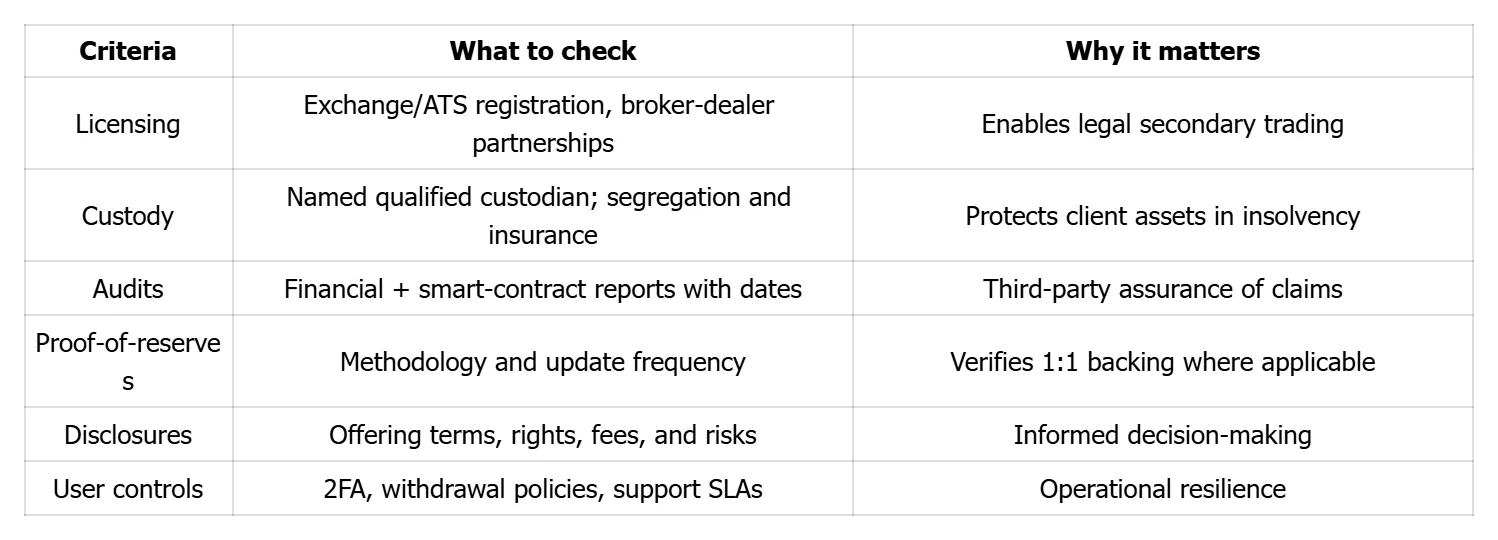
- Licensing: exchange, broker‑dealer, or ATS registration where required
- Custody: segregated, bankruptcy‑remote; named custodian and insurance summary
- Disclosures: offering docs, rights, fees, and risks clearly published
- Audits: financial and smart‑contract audits with recent dates
- Reserves: independent proof‑of‑reserves and reconciliation cadence
- Controls: 2FA, withdrawal allowlists, incident response policy
Legal Platforms for Trading US Stock Tokens
Secondary trading of security tokens is permitted only on regulated security token exchanges—such as registered ATS in the US or licensed exchanges abroad—supported by end‑to‑end AML/KYC and investor eligibility checks, as outlined in Blockchain App Factory’s compliance overview. Real‑world examples and pilots include Kraken’s product initiatives, described on the Kraken xStocks page and in Wall Street Journal coverage of Kraken’s stock tokens, and broader industry education from Coinbase and Gemini.
Platform vetting criteria:
Custody, Settlement, and Secondary Market Trading
Regulated tokenized securities use segregated, bankruptcy‑remote custody with published insurance and chain‑of‑custody details—key protections spotlighted in the TokenMetrics review of 2025 platforms. Smart contracts govern token creation, transfer restrictions, whitelists, dividends, and cap‑table integrity; with proper design, they enable near‑instant settlement compared to legacy rails, as discussed in InnReg guidance on tokenized securities and the TokenMinds playbook for asset tokenization.
Simplified flow:
- Issuer mints tokens to a controlled treasury address
- → 2) Investors pass KYC/eligibility and receive whitelisted access
- → 3) Primary sale settles on‑chain to segregated custody
- → 4) Listing on a regulated ATS for secondary trading
- → 5) Transfers enforced by smart‑contract rules; periodic on/off‑chain reconciliation
- → 6) Dividends or corporate actions executed per token terms
Investor Protections and Risk Mitigation Strategies
Investor protections combine legal disclosures, technical controls, and operational safeguards to reduce fraud, mismanagement, and loss. Leading platforms like ToVest publish independent audits, maintain transparent cap‑tables, encode transfer rules in audited smart contracts, and offer lost‑key reissuance tied to identity verification. As industry analyses note, smart‑contract and independent audits strengthen trust, and proof‑of‑reserves supports backing claims, per Blockchain App Factory’s compliance overview and Legal Nodes’ 2025 stock tokenization guide.
Key risk mitigants:
- Regulated venue (ATS or licensed exchange) with full AML/KYC
- Segregated, bankruptcy‑remote custody and insurance disclosures
- Independent financial and code audits; on‑/off‑chain reconciliation
- Proof‑of‑reserves; public methodology and cadence
- Clear offering documents and dispute‑resolution clauses
- Access controls: 2FA, allowlists, withdrawal checks
- Incident response and communication SLAs
Ongoing Governance, Reporting, and Legal Compliance
Post‑launch, issuers and platforms must maintain regular investor disclosures, financial audits, and reconciliations, updating offering terms as regulations evolve. Automate compliance where possible—sanctions lists, investor eligibility, and reporting—and schedule recurring proof‑of‑reserves and smart‑contract updates. Continuous legal review is essential as the SEC and global regulators refine tokenization policy; keep investor portals current with filings, audits, and notices, as recommended in the TokenMinds playbook for asset tokenization.
Future Trends in US Stock Token Regulation and Trading
Tokenization is expanding beyond equities: the broader real‑world asset market reached tens of billions in 2024–2025, with a $24 billion figure frequently cited in industry roundups like the Zoniqx RWA market roundup. Expect clarifying legislation (such as proposals akin to CLARITY Act concepts), standardized disclosures, and broader ATS connectivity for compliant secondary trading. As large brokers and exchanges pilot tokenized access—like ToVest, Kraken, and Gemini—mainstream adoption should accelerate, with faster settlement, richer data, and user‑friendly tools aligned to institutional standards.
Frequently Asked Questions
Are US stock tokens treated like traditional securities?
Yes. In most cases they’re treated as securities under current US rules, so SEC oversight, registration or exemptions, and disclosures apply.
What investor protections are in place when trading US stock tokens?
Leading platforms like ToVest offer independent audits, proof‑of‑reserves, segregated custody with insurance details, and clear dispute‑resolution procedures.
How do taxation rules apply to trading US stock tokens?
Gains are generally taxed as capital gains, while dividends are income; maintain records and consult IRS guidance and a tax professional.
Can token holders exercise voting rights or receive dividends?
Voting is uncommon, but some tokens distribute dividends if specified in the offering; always review the token’s terms.
What should investors look for in a legal trading platform for US stock tokens?
Check for regulatory registration, bankruptcy‑remote custody, recent audits, proof‑of‑reserves, and full AML/KYC with transparent disclosures.