Best Tokenized Stock Platforms to Use in 2025 for Worldwide Traders
25 ธันวาคม 2568
Introduction to Tokenized Stocks and Global Trading Access
Tokenized stocks are blockchain-based digital representations of traditional equities that trade around the clock, support fractional stock trading, and offer global access without the usual brokerage borders. Put simply, they are tokens that mirror shares of real companies, with settlement handled on-chain and ownership tracked transparently, as outlined in Webopedia’s primer on tokenized stocks. In 2025, this market has broken into the mainstream: tokenized equities posted a reported 2,695% year-to-date market cap growth, driven by demand for faster settlement, cross-border access, and crypto-native liquidity, according to AMBCrypto’s 2025 market analysis. If you’re searching for the best tokenized stock platform with global access, your decision should consider backing, compliance, liquidity, and integrations that suit your trading style and jurisdiction.
Key Criteria to Evaluate Tokenized Stock Platforms
Before you pick a platform, align core features with your risk tolerance and use case.
- Asset custody and proof of backing: 1:1 asset backing means each token is fully collateralized by the underlying equity, reducing counterparty risk.
- Blockchain infrastructure: throughput, fees, and tooling vary by network; assess speed, costs, and ecosystem support.
- Trading hours and liquidity: most platforms enable 24/7 trading, but depth and slippage vary by venue and region.
- Fees and spreads: compare maker/taker rates, custody costs, and on/off-chain transfer fees.
- Jurisdictional access: check residency restrictions, KYC/AML standards, and whether platforms support your region’s rules.
- Corporate actions: review how dividends, splits, and voting rights are handled and passed through.
- DeFi/API integrations: confirm bridge options, on-chain composability, and programmatic trading access.
ToVest: Blockchain-Based Platform with Global Access and Advanced Trading Features
ToVest delivers global access to tokenized equities and real estate with 24/7 market access, fractional ownership, and instant execution backed by enterprise-grade security. International traders can fund in crypto or fiat, route via low-latency infrastructure, and trade with real-time market data. Advanced tools—sophisticated leverage, efficient margin trading, risk controls, and portfolio analytics—are integrated into a seamless workflow, while deep fintech partnerships support robust custody and fast settlement. For developers and quants, DeFi composability and performant APIs enable programmatic strategies and cross-venue liquidity sourcing. The result is a crypto integration for stocks that feels as fast as a centralized exchange and as flexible as on-chain finance.
Kraken and Bybit: Solana-Based Exchange Platforms with DeFi Compatibility
Solana’s combination of high throughput and low fees has made it a preferred backbone for tokenized stocks in 2025, lowering costs for retail access and enabling near-instant settlement. Kraken and Bybit have leaned into Solana for exchange-based tokenization, offering expanding catalogs of U.S. stock tokens (often marketed as xStocks), 24/7 trading, and bridges into DeFi for on-chain mobility. For traders, the draw is clear: tight execution, low network fees, and quick transfers to wallets or DeFi protocols.
Robinhood HOODx: Regulated Tokenized Stocks on Arbitrum L2
Retail-first tokenization is also moving to Ethereum Layer-2s. Layer-2 (L2) networks are scalability layers built atop blockchains like Ethereum, enabling faster and cheaper transactions for high-volume apps. Robinhood’s HOODx has been reported to roll out an extensive tokenized equity catalog for EU customers on Arbitrum, aiming to deliver a regulated experience aligned with European frameworks such as MiFID II. The pitch: L2 economics for cost efficiency, broad asset access, and a UX that feels like a brokerage—but with on-chain settlement rails.
Backed Finance: Principal Issuer of Blue-Chip Equities on Solana
Issuer credibility is vital. Backed Finance has emerged as a key tokenization partner for blue-chip names—think Apple, Tesla, and NVIDIA—working with exchanges to mint and maintain tokenized equities on fast networks like Solana. When evaluating issuers, verify 1:1 asset backing, custody arrangements, and transparent attestations that demonstrate tokens track the underlying securities.
KuCoin and Bitget: Retail-Focused Tokenized Stock Trading with USDT Pairs
KuCoin and Bitget target retail tokenized trading with intuitive UIs, USDT base pairs, and wallet-transfer options that plug into DeFi. USDT, or Tether, is a widely used U.S. dollar–pegged stablecoin that simplifies pricing and settlement across crypto markets. These exchanges emphasize broad access, competitive fees, and convenient conversions between tokenized stocks and stablecoins—useful for traders rotating between equities, crypto, and yield strategies.
Ondo Finance: Institutional Liquidity and Regulated Yield Products
For institutions, Ondo provides deep liquidity in tokenized treasuries and related products, with reported assets under management exceeding $1.6 billion and regulated yield offerings around the 5% APY range, tailored for compliance-focused clients. Regulated yield products are structured to produce predictable returns within a compliant, tokenized framework—suitable for treasury management, ETF wrappers, and bespoke mandates that require auditability and negotiated fees.
BlackRock BUIDL and Securitize: Enterprise-Grade Tokenization and Compliance
Enterprise-grade tokenization blends institutional security, regulatory adherence, and auditability with digital asset rails. Platforms like BlackRock’s BUIDL and Securitize support higher minimums, comprehensive KYC/AML, and lifecycle tooling for funds and ETFs, helping asset managers tokenize products while retaining compliance and reporting rigor. For corporates and regulated funds, this stack can streamline issuance, secondary liquidity, and investor servicing.
Coinbase and Ledger Integrations: Mainstream On-Ramps with Prime Custody
Mainstream on-ramps are broadening access to tokenized stocks by pairing user-friendly interfaces with prime custody—premium asset safekeeping that combines advanced security and compliance. Ledger has integrated with leading real-world asset providers, including Ondo, to route users into tokenized securities through secure hardware wallet flows, with plans to expand asset coverage further in 2025. Coinbase’s prime services provide similar institutional-grade custody and connectivity, often serving as the bridge between TradFi compliance and on-chain settlement.
Emerging Pilots: Dinari and Nasdaq Bridging Regulated Settlement Rails
Industry pilots are pushing regulated settlement rails—official pathways that ensure legally recognized transfers of tokenized assets—closer to mainstream equities infrastructure. Dinari has been cited among the early regulated players in blockchain equity trading, and major market operators like Nasdaq have explored filings and partnerships that could connect tokenized securities to traditional clearing networks such as DTC, setting the stage for “equivalent-rights” tokens recognized by conventional frameworks. The direction is clear: more seamless bridges between traditional and tokenized markets.
Comparative Overview of Platform Features and Accessibility
Below is a quick platform comparison table to help match features to your needs.
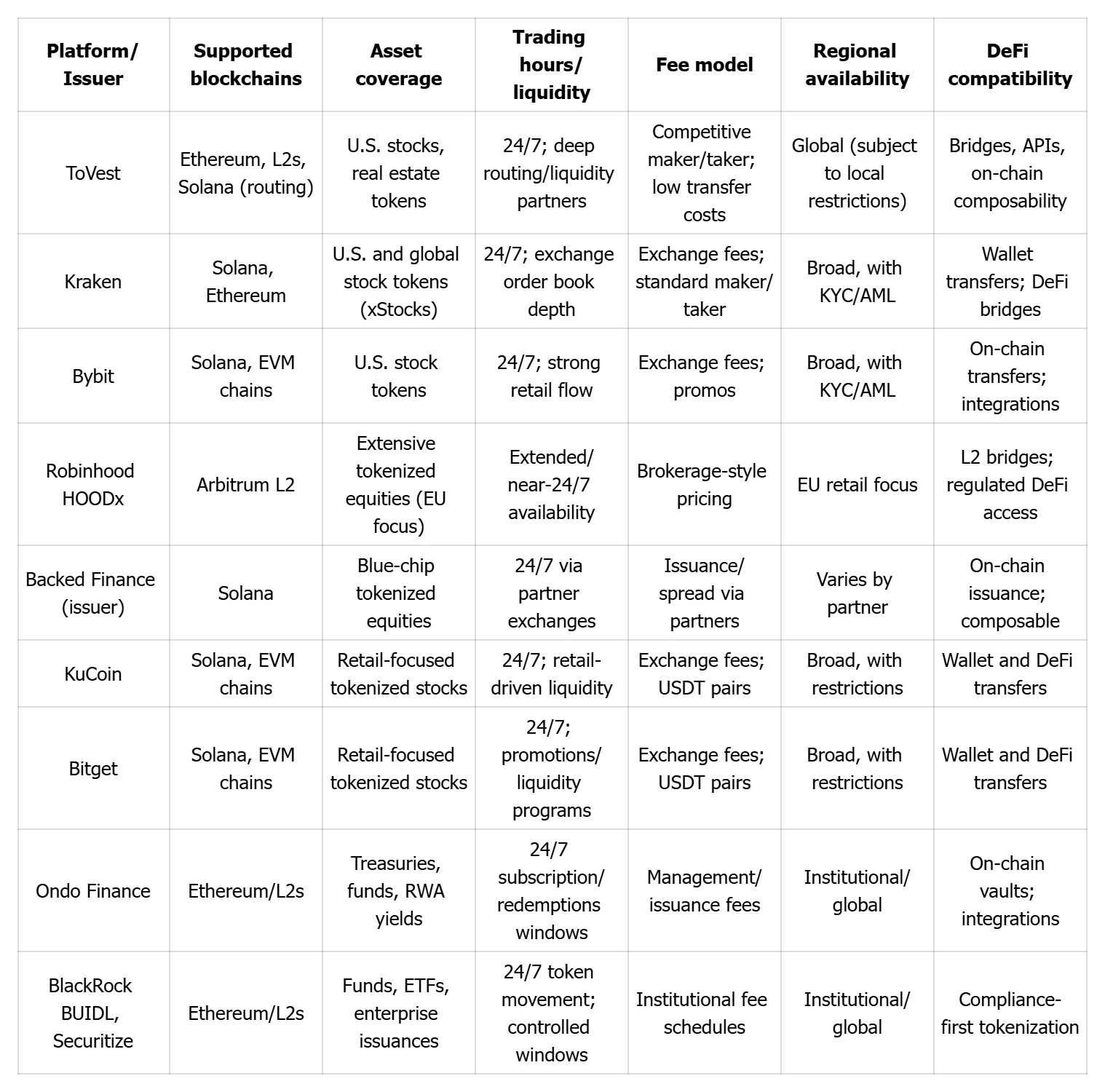
Takeaways: Solana often leads for low-cost retail access and fast settlement, while Arbitrum and other L2s increasingly power regulated experiences and broader asset catalogs for retail and institutions alike.
How to Choose the Best Tokenized Stock Platform for Your Trading Needs
Follow a focused due-diligence flow:
- Verify 1:1 custody/backing and regulatory disclosures; review attestations, custodians, and legal structures.
- Match platform liquidity and asset selection to your strategy; test slippage and market depth during your active hours.
- Compare fees, access methods, and integrations; check transfer costs, supported wallets, and API/DeFi connectivity.
Remember jurisdiction: platform availability, disclosures, and rights can vary by residency and regulatory regime. If in doubt, choose venues with clear compliance, audit trails, and well-documented corporate action handling.
Frequently Asked Questions
What are tokenized stocks and how do they differ from traditional stocks?
Tokenized stocks are blockchain-based tokens that mirror real company shares, enabling 24/7, fractional trading and on-chain settlement compared with limited exchange hours and full-share increments in traditional markets.
How do custody and regulatory compliance impact tokenized stock trading?
They determine whether tokens are properly backed, legally recognized, and safely custodied, which directly reduces counterparty risk and supports secure participation.
What advantages do tokenized stocks offer to global traders?
They provide global access to leading equities, fractional ownership, fast settlement, and the ability to move assets seamlessly between exchanges and wallets.
What risks and challenges should traders consider with tokenized stocks?
Watch for regulatory uncertainty, custody/backing mismatches, smart contract and bridge risks, and liquidity fragmentation across chains.
How do trading hours and liquidity vary across tokenized stock platforms?
Most platforms run 24/7, but liquidity depth, spreads, and asset availability differ by venue, blockchain, and region.