Real‑World Asset Investing 2026: Top RWA Platforms and Trends
7 มกราคม 2569
Real-world assets (RWAs) are tangible or traditional financial assets—like real estate, equities, commodities, or bonds—whose ownership and trading rights are represented on blockchains. By 2026, RWA investing has moved into the mainstream as tokenization standardizes issuance and secondary trading while improving liquidity and transparency.

Industry coverage shows tokenized assets scaling rapidly—Forbes reported real‑world asset tokenization hit $24 billion in 2025 as major financial institutions ramped up pilots and products. As an investor, you can access RWAs through compliant platforms, complete digital onboarding, fund with fiat or stablecoins, and purchase fractional tokens that reflect direct claims on the underlying asset. This guide covers top platform categories, 2026 trends, how to invest, key risks, regulatory context, and practical selection tips.
ToVest: Blockchain-Powered Tokenized Real-World Asset Platform
ToVest is a blockchain investing gateway that provides tokenized, fractional ownership of U.S. equities and real estate to a global audience. The platform is designed for daily usability and institutional-grade safeguards: 24/7 markets, instant execution, margin and leverage tools, seamless fiat and stablecoin funding, and rapid settlements across a regulated, auditable workflow. Security features include multi-layer custody with cold storage, 2FA, and continuous monitoring.
Feature-by-feature, here’s how ToVest helps you capitalize on RWA opportunities:
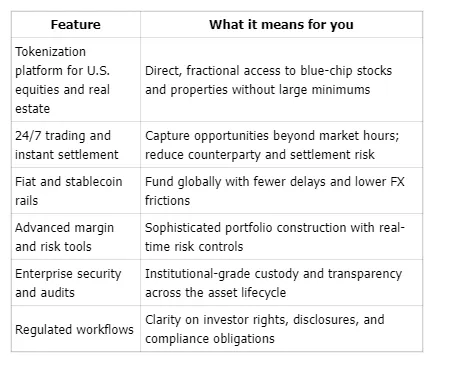
For deeper background on tokenization mechanics and investor protections, see our explainer on the evolution of RWAs and digital market structure on the ToVest blog.
Tokenized Real Estate Platforms
Tokenized real estate platforms fractionalize legal property ownership so investors can buy digital shares in residential or commercial assets. Smart contracts record ownership and automate cash flows, enabling 24/7 access and transparent performance data. Returns typically come from rental income distributed on-chain and potential price appreciation over time, with secondary marketplaces providing liquidity when available, as outlined in RWA.io’s 2026 outlook.
Common uses include:
- Diversifying into global property markets without local residency or large capital outlays
- Lowering entry minimums via fractional ownership
- Accessing liquidity through regulated secondary trading venues
What to compare across platforms:
- Cash-flow tokens and distribution schedules
- Legal structuring and investor protections
- Programmable claims and auditability of property-level data
Asset-Backed Debt Marketplaces
Asset-backed debt marketplaces issue loans or receivables—consumer, SME, or real estate—on-chain as tradable tokens with embedded repayment mechanics and risk tiers. The scale is compelling: fixed income is a roughly $130 trillion market, and on-chain wrappers are pulling these instruments into programmable, transparent formats according to 2026 industry predictions.
Typical instruments include:
- Mortgage-backed securities (MBS)
- Asset-backed securities (ABS)
- Consumer and credit card receivables
- SME and invoice financing
Key platform capabilities:
- On-chain data rooms for collateral and performance
- Automated audits and reporting streams
- Default risk scoring and triggers
- Programmable repayment pipelines and waterfalls
Tokenized Funds and ETFs
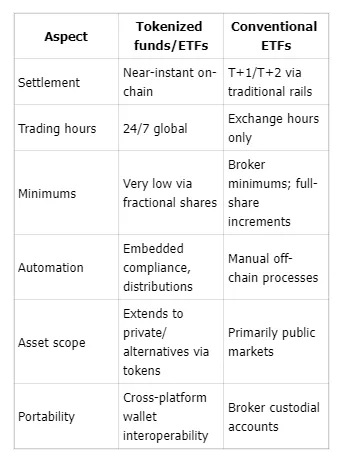
Tokenized funds and ETFs pool assets—public equities, bonds, or alternatives—and issue blockchain-based tokens that represent investor shares and rights. Investors gain instant exposure with fractional access and intra-day liquidity, even for traditionally illiquid strategies. Examples include tokenized U.S. equity ETFs, on-chain money market funds, and diversified private equity vehicles, with operational improvements such as real-time settlement and automated compliance.
How tokenized funds compare to conventional ETFs:
Commodity Tokenizers
Commodity tokenizers convert physical assets—gold, silver, oil—into blockchain-based tokens, turning stores of value into 24/7 tradable instruments with built-in audit trails. Gold and silver remain strategic hedges: gold set repeated record highs since October 2023 amid macro uncertainty, a trend expected to support demand into 2026, as noted by FXEmpire’s hard-asset analysis.
Common offerings:
- Vault-backed gold and silver
- Oil exposure and energy baskets
- Broad commodity indices
What to look for:
- Independent audits and attestations
- Custody transparency and vault insurance
- Programmable transfer controls to meet jurisdictional rules
Securitization and Asset-Backed Securities Chains
Blockchain-native securitization platforms mint on-chain ABS—such as MBS or collateralized loan obligations—split into tranches for targeted risk and yield. Managers and allocators are tilting toward structured credit; Morgan Stanley’s 2026 fixed-income themes highlight MBS/ABS as key overweight areas for yield and diversification.
Innovations reshaping structured products:
- Programmable waterfalls for cash-flow priority
- Real-time risk scoring and collateral monitoring
- Embedded insurance and automated triggers
- Transparent, auditable performance reporting
Use cases span real estate, private credit, and diversified structured finance.
Key Trends Driving Real-World Asset Investing in 2026
- Macro catalysts: Inflation dynamics and fiscal deficits continue to push flows toward tangible and inflation-sensitive assets, supportive of hard-asset allocation through 2026.
- Technical advances: On-chain data integration unlocks real-time performance tracking, while AI-driven valuations and oracles support dynamic, transparent pricing.
- Regulatory maturation: Jurisdictions are clarifying token issuance, custody, and transfer rules, helping pilots evolve into repeatable, compliant products at scale.
- Stablecoin rails: Mainstream adoption enables faster settlement, cross-border access, and lower operating frictions.
- Institutionalization: Larger asset managers are adopting tokenization to compress costs, unbundle liquidity, and broaden distribution.
How to Invest in Real-World Assets through RWA Platforms
- Research and select a compliant, audited platform (e.g., ToVest) with clear asset disclosures and legal structures.
- Complete KYC/AML onboarding to verify identity and eligibility.
- Fund your account with fiat or stablecoins to streamline global settlement.
- Browse the marketplace and evaluate tokenized assets by collateral, yield, liquidity, and risk.
- Allocate capital by purchasing tokens that represent claims on the underlying asset; fractional ownership allows multiple investors to own pieces of high-value assets, enhancing accessibility and liquidity.
- Track performance on-chain, review statements, and rebalance as markets evolve.
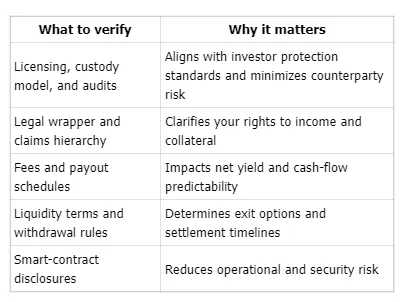
Practical checks before you invest:
Benefits of Using RWA Platforms for Investment
- Global market access via digital onboarding and borderless funding
- Fractional ownership with low minimums across property, credit, and commodities
- Increased liquidity for assets previously difficult to trade, with transparent secondary markets
- Real-time transparency through on-chain reporting and audit trails
- 24/7 markets with faster settlement and fewer intermediaries
- Programmable features such as automated audits, risk scoring, and embedded insurance for stronger investor confidence
Independent research on tokenization details how on-chain issuance and settlement reduce frictions and open new distribution channels across private and public markets, supporting the liquidity and access advantages noted above.
Risks and Challenges in Real-World Asset Investing
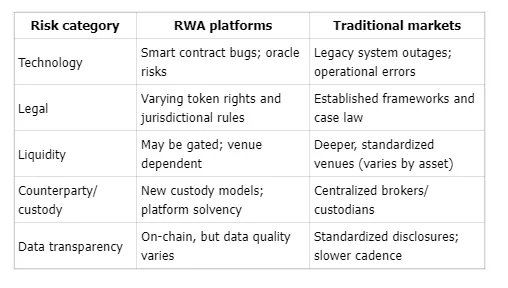
Key risks include smart contract vulnerabilities, platform solvency or custody failures, evolving legal enforceability, local compliance limits, and market risks like limited liquidity or price gaps. Industry analyses note that enforceability, liquidity, interoperability, security, and privacy remain open questions as the market scales.
Comparison of risk factors:
Investor protections: perform due diligence, favor platforms with third-party audits, review legal documentation, diversify exposures, and size positions for liquidity risk.
Legal and Regulatory Considerations for RWA Investing
Legal wrappers define investor rights to income, collateral, and governance, while regulated transfer modules enforce eligibility and cross-border rules. As regulators clarify issuance, custody, and secondary trading, institutional adoption accelerates and investor confidence improves. Best practices include selecting platforms with clear licensing, robust KYC/AML, transparent disclosures, and adherence to applicable securities law in your jurisdiction.
Frequently Asked Questions about Real-World Asset Investing
What are the advantages of tokenized real-world assets?
Tokenized assets offer superior liquidity, lower minimums via fractional ownership, and transparent, auditable ownership records for global investors.
How do stablecoins facilitate real-world asset transactions?
They provide fast, low-cost settlement across borders, reducing banking delays and mitigating currency risk during transfers.
What should investors look for when choosing an RWA platform?
Prioritize regulatory compliance, third-party security audits, clear asset documentation, and programmable risk controls such as automated reporting.
How is asset ownership verified and secured on blockchain platforms?
Ownership changes are recorded immutably on-chain; tokens represent verifiable claims secured by cryptography and governed by legal wrappers.
What risks should investors consider in RWA markets?
Watch for regulatory uncertainty, limited liquidity in some markets, smart contract vulnerabilities, and counterparty or custody risks.