7 Key Advantages of Buying On‑Chain Stocks for Global Investors
14 มกราคม 2569
On-chain stocks are blockchain-based tokens representing equity in publicly traded companies, providing programmable access, real-time settlement, and direct ownership on a distributed ledger. Once niche, tokenized securities are moving mainstream as on-chain revenue reached a $20 billion economic sector in 2025, signaling a structural shift in capital markets, according to the 2025 Onchain Revenue Report from 1kx Network (see the 1kx analysis). Ethereum alone hosted an estimated $11.5 billion in tokenized assets in 2025, while real‑world assets surpassed $25 billion, per a comprehensive 2025 year‑end review by 99Bitcoins/TradingView (see the 2025 crypto market year‑end review). For global investors, this translates into lower barriers, faster access, and broader diversification.

Seven key advantages at a glance:
- Greater liquidity and fractional ownership
- Faster settlement and 24/7 market access
- New yield and revenue models through DeFi integration
- Lower operational costs enabled by Layer‑2 scaling
- Access to tokenized real‑world assets and diversification
- Improved transparency, auditability, and programmable corporate actions
- Accelerated institutional product innovation and distribution
ToVest Platform Advantages for Global Investors
ToVest is designed for non‑U.S. investors seeking compliant, low‑cost exposure to U.S. equities and real‑world assets. The platform supports fractional ownership, allowing you to start with small amounts, streams real‑time market data, and applies institutional‑grade security across custody and infrastructure. Flexible stablecoin funding (USDT/USDC) simplifies onboarding, and advanced tools—such as margin and portfolio analytics—help optimize positions.
Compliance is foundational: robust KYC/AML, clear investor eligibility rules, and transparent disclosures keep access open while meeting regulatory standards. For global users, ToVest directly addresses common hurdles:
- Lower minimums, 24/7 access, and instant settlement
- A diversified catalog spanning stocks, bonds, real estate, and index-like baskets
- Integrated custody with programmable controls and automated recordkeeping
Tokenization is the process of representing real‑world assets (stocks, bonds, real estate) as blockchain tokens. This enables divisible ownership, automated compliance rules, and seamless transferability across wallets and venues.
Greater Liquidity and Fractional Ownership
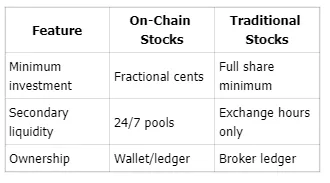
Fractional ownership allows investors to purchase and hold small, divisible portions of an asset, such as a stock or real estate, rather than buying a full share or property outright. Tokenized shares and exchange‑traded products enable micropurchases and fractional positions, improving access to high‑price securities; on‑chain liquidity pools amplify this effect, as highlighted in the 1kx report. Layer‑2 networks processed over 1.9 million transactions per day in 2025, supporting deeper liquidity and tighter spreads throughout the week, according to the 2025 year‑end review.
Comparison: on-chain stocks vs traditional stocks
Faster Settlement and 24/7 Market Access
On-chain settlement allows near-instant transfer of ownership, collapsing typical multi-day stock trades into seconds. With stablecoins accounting for an estimated 70% of Layer‑2 payments during 2025, around‑the‑clock funding is powering continuous trading and redemptions on tokenized equities, as reported in the same year‑end review.
Buying on ToVest in three steps:
- Select the asset you want to buy
- Fund with supported stablecoins (USDT/USDC)
- Receive instant settlement to your ToVest custodial wallet
For non‑U.S. investors, this model mitigates currency restrictions, eliminates timezone barriers, and improves flexibility for rebalancing and hedging.
New Yield and Revenue Models through DeFi Integration
DeFi (Decentralized Finance) models enable protocol‑driven yields, such as fee sharing, staking, or automated dividends distributed directly to token holders. DeFi led on-chain earnings in 2025, and stablecoin issuers Circle and Tether generated roughly $4.5 billion in yield, according to the 1kx revenue report—underscoring how programmable cash flows are maturing.
Common on‑chain yield structures:
- Protocol fee pools tied to trading or lending revenues
- Automated, on‑chain dividend distribution to token holders
- Revenue‑sharing tokens that route income via smart contracts
Compared with traditional dividends, on‑chain distributions can be faster, more transparent, and automatically prorated to fractional positions.
Lower Operational Costs Enabled by Layer‑2 Scaling
Layer‑2 scaling refers to networks built atop primary blockchains to process more transactions at lower cost, reducing fees and congestion. In 2025, maturing blockchain technology helped cut average transaction costs, supported 126% YoY growth in applications, and lifted Layer‑2 total value locked above $39.3 billion by November, per the 2025 year‑end review.
Cost advantages for investors and issuers:
- Near‑zero trading and transfer fees on efficient Layer‑2s
- Automated compliance and corporate actions reduce back‑office overhead
- Lower portfolio rebalancing expenses—a boost to long‑term operational efficiency
Access to Tokenized Real‑World Assets and Diversification
Tokenized real‑world assets (RWAs) are digital representations of physical or financial assets on the blockchain, enabling fractional, instant, and borderless access. Tokenized government bonds surpassed $1.5 billion in early 2025, and the broader RWA segment exceeded $25 billion that year, according to the same year‑end review.
Examples accessible via ToVest:
- Tokenized U.S. Treasuries and investment‑grade corporate bonds
- Fractionalized commercial and residential real estate
- ETF‑style baskets and structured products for sector or thematic exposure
By bringing fixed income, real estate, and alternatives onto a single rails system, investors can add uncorrelated exposures, improve liquidity profiles, and source higher‑quality collateral for financing.
Improved Transparency, Auditability, and Programmable Corporate Actions
Programmable corporate actions are automated events—like dividend payments, buybacks, and shareholder votes—executed by smart contracts directly on the blockchain. On‑chain records create an unfalsifiable, real‑time ownership history and enable automated, transparent distributions. As enterprise tokenization providers note, blockchains establish immutable ownership records that can be independently verified, strengthening auditability end‑to‑end (see Zeeve’s overview of tokenization’s transparency benefits).
Features investors can expect:
- On‑chain voting with verifiable tallies
- Real‑time audit trails for positions and transfers
- Automated dividend issuance proportional to fractional holdings
Accelerated Institutional Product Innovation and Distribution
Licensed on‑chain ETPs and tokenized funds attracted substantial institutional AUM in 2025, broadening regulated entry points and improving sector liquidity, according to the 2025 year‑end review. Notable milestones include BlackRock’s tokenized BUIDL fund passing approximately $2.3 billion and the SPXA S&P 500 token raising over $500 million from institutions—signposts that on‑chain distribution is working.
ToVest supports this evolution with institutional‑grade custody integrations, compliance toolkits, and product‑structuring support for funds and family offices seeking programmatic cash flows and transparent reporting.
Key regulatory considerations:
- Securities law oversight for tokenized securities (e.g., SEC or equivalent regulators)
- Evolving qualified custody standards for digital assets
- Best‑practice risk controls: KYC/AML, disclosures, and resilient smart‑contract audits
Frequently Asked Questions
What are the main advantages of buying stocks on-chain as a global investor?
On-chain stocks provide global investors with 24/7 access, faster settlement, fractional ownership, greater liquidity, lower costs, transparent recordkeeping, and new yield opportunities.
How do I invest in on-chain stocks with stablecoins?
Deposit supported stablecoins like USDT or USDC, select your desired asset on ToVest, and execute a trade that settles instantly to your ToVest custodial wallet.
Is there a minimum investment to buy tokenized stocks?
Yes. Tokenized stocks on ToVest can be purchased fractionally, allowing you to start with very small amounts without needing to buy a whole share.
How does ToVest ensure compliance and investor security?
ToVest combines robust KYC/AML, licensed custody partners, and transparent disclosures to meet regulatory standards and safeguard client assets.
Are tokenized stocks the same as cryptocurrencies?
No. Tokenized stocks represent equity in real companies and are typically backed by custodians, while cryptocurrencies are native digital assets independent of any company.
Can I diversify into other real-world assets through ToVest?
Yes. ToVest provides access to tokenized real estate, bonds, and other RWAs, enabling you to build an instant, diversified portfolio alongside equities.