Best Crypto‑Enabled Stock Exchanges to Use in 2026 Today
January 22, 2026
A new class of hybrid stock exchanges is making it practical to buy stocks with crypto in 2026. These platforms blend traditional brokerage features with crypto rails, allowing investors to move between assets and funding methods with less friction. Below, we compare the best options by fees, regulation, custody, and features—so you can select the right place to buy stocks using crypto, stablecoins, or fiat today. As a compliance-first, blockchain-enabled fintech, ToVest highlights how tokenized equities and interoperable fiat/stablecoin rails are redefining access to U.S. stocks globally.

Overview of Crypto-Enabled Stock Exchanges
A crypto-enabled stock exchange is a trading platform that lets you buy, sell, and hold both traditional stocks and cryptocurrencies in one account, often with seamless fiat and crypto funding, tokenized equities, and blockchain-powered settlement for faster, more transparent asset transfers.
Consumer interest keeps rising as stock and crypto trading converge, with mainstream brokerages integrating digital assets and exchanges broadening onramps—trends reflected in leading industry roundups and user adoption data across 2024–2026, including NerdWallet’s best exchanges analysis. See an overview in NerdWallet’s best crypto exchanges and apps.
ToVest sits at this intersection as a blockchain-integrated, compliance-first platform for tokenized U.S. equities and real-world assets, offering fiat and stablecoin interoperability, institutional-grade custody, and ultra-low-latency settlement. These hybrid stock exchanges and crypto stock platforms are expanding access via fractional shares, tokenized equities, and cross-asset funding.
Key Criteria for Choosing Crypto-Enabled Stock Platforms
Use these factors to compare the best exchanges for crypto and stocks:
- Regulatory status and jurisdictions: Prefer regulated stock-crypto brokers and platforms that disclose licenses, MSB registration, and AML/KYC controls.
- Fee structure: Compare maker/taker fees vs. spread-based pricing, and watch for network, deposit, and withdrawal fees.
- Fiat on/off ramps: Fiat on/off ramps enable easy conversion between traditional currency (like USD) and crypto for funding and withdrawals; speed, limits, and fees vary widely by method.
- Crypto deposit exchanges: Confirm whether you can deposit crypto or stablecoins to fund stock purchases directly (or if conversion is required).
- Custody arrangements: Who holds assets, what insurance applies, and whether custodians are independent, audited, and segregate client assets.
- Product scope: Stocks, ETFs, bonds, major cryptos, staking, tokenized assets, and fractional shares.
- Trading tools: Pro charts, APIs, automation, copy trading, and 24/7 support for crypto markets.
- Tax reporting and statements: Especially important for active traders and cross-asset reporting.
- Global access: Supported countries, currencies, languages, and regional product variations.
Interactive Brokers Crypto
Interactive Brokers Crypto extends a blue-chip brokerage experience to digital assets, appealing to investors who want stocks, bonds, and crypto under one roof with established controls and reporting. Its regulated infrastructure, multi-asset research tools, and robust order routing make it a strong hybrid investment platform for those who value oversight and global market access. Account minimums are effectively low for most users, product coverage is broad, and crypto trading fees are capped at about 1% of trade value. Compared with crypto-native exchanges, IBKR typically offers superior market access and reporting but features fewer altcoins, fewer on-chain features, and limited crypto deposit options for account funding—better for investors than for crypto-first power traders.
Fidelity Crypto
Fidelity Crypto adds digital assets to a household-name brokerage that scores highly on trust and retirement planning. Features include integrated stock and ETF trading alongside major cryptocurrencies, a solid 4.2/5 editorial rating in leading roundups, and a spread-based crypto fee model around 1%. It’s a natural fit for retirement accounts and long-term investors who prioritize statements, beneficiary settings, and goal-based planning. While it lacks the deep coin lists and advanced tooling of specialist exchanges, Fidelity’s safe hybrid broker approach suits buy-and-hold investors comfortable with a streamlined crypto lineup and strong investor protections.
Robinhood
Robinhood is a retail-first app with commission-free stock and ETF trades and a growing list of basic crypto assets (35+). While order flow and spreads still impact total cost, its zero-commission brand, simple interface, and educational content make it one of the most approachable retail crypto stock platforms. Limitations include fewer advanced order types and more constrained crypto withdrawals and wallet tools than crypto-native venues. For beginners focused on simplicity and small balances, it’s a practical on-ramp; active crypto traders may prefer lower-fee, pro-grade alternatives.
eToro
eToro is a multi-asset platform known for social and copy trading, letting users mirror strategies and build diversified stock-and-crypto portfolios. Onboarding is straightforward and fees are transparent, with flat crypto trading costs that are easy to understand for newcomers. Its social crypto investment platform fosters idea sharing, and thematic portfolios blend equities with digital assets. Trade-offs include regional restrictions and fewer advanced order types than professional trading terminals. For community-driven investors who want to learn by observing others, eToro’s copy-trading exchanges stand out.
Uphold
Uphold is a simple, global-facing hybrid broker offering a wide range of cryptocurrencies and access to U.S. stocks with low entry requirements. Retail fees commonly range from about 2% to 5.5%, trading off price for ease and breadth of assets. For investors outside the U.S. or those seeking to buy stocks with crypto through a single, unified wallet, Uphold’s crypto and fiat pathways are appealing. It’s a straightforward option for tokenized stock access and cross-asset conversions, though high-frequency traders will likely prefer lower-fee venues.
Coinbase
Coinbase is a leading crypto exchange renowned for user-friendly design, deep liquidity, and fast fiat on/off ramps in supported regions. It lists 250+ coins and commonly uses maker/taker fees around 0.40%/0.60% at lower tiers, with clear disclosures and reliable infrastructure. Coinbase does not natively offer direct stock trading; investors seeking crypto-to-stock pathways can transfer funds to a broker or use third-party integrations that convert crypto to fiat first. For best-in-class custody, APIs, and trading reliability, Coinbase remains a top choice among crypto trading platforms.
See fee comparisons in Koinly’s best crypto exchange USA guide.
Kraken
Kraken is widely respected for security, support, and pro-grade tools, with competitive maker/taker fees that can be as low as 0.25%/0.40% and low minimum deposits (around $10). It’s regularly cited near the top of editorial rankings; Investopedia named it “Best for Low Fees,” and NerdWallet rates it among the top platforms for 2024–2026. Beyond low-fee crypto platforms, Kraken offers strong account protections, bank-grade controls, and support for staking and earn features where permitted. It’s well-suited to both active traders and long-term holders who value reliable execution and robust compliance.
Learn more from Investopedia’s best crypto exchanges.
Comparing Fees and Trading Costs
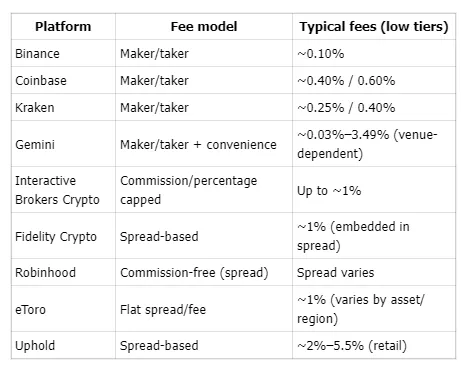
A spread is the difference between the current buy and sell price of an asset. Some exchanges charge a spread instead of explicit maker/taker fees. Spreads can be less transparent than posted fees and may widen during volatility, but they sometimes enable “zero-commission” marketing and simpler price quotes for casual buyers.
Typical fee structures (illustrative ranges; check current schedules):
- Active traders often save with transparent maker/taker models on pro exchanges.
- Casual buyers prioritizing convenience may prefer simple spread pricing—though the effective cost can be higher.
For detailed low-fee comparisons, see Koinly’s fee analysis of major U.S. exchanges.
Regulation, Security, and Custody Models
Custody refers to how a platform holds and secures client assets, including whether funds are insured, how wallets are managed on-chain, and what institutional-grade controls protect against hacks or fraud. Strong custody models use segregation, independent audits, and multi-signature or MPC key management.
Traditional brokers like Interactive Brokers and Fidelity operate under established securities regulation with explicit disclosures, SIPC coverage for securities, and robust AML/KYC. Crypto-native exchanges emphasize licensure and asset protections tailored to digital assets; for example, Gemini is frequently noted for FDIC protection on fiat balances and substantial crypto-specific insurance in editorial reviews. Kraken and others provide bank partnerships for fiat and strong security programs across hot/cold storage.
ToVest differentiates with a compliance-first framework: MSB registration, rigorous AML/KYC, institutional-grade custody partners, and blockchain-integrated settlement—bringing tokenized equities into a regulated, investor-friendly environment.
Fiat On and Off Ramps and Crypto Deposit Options
A fiat on-ramp is any service that lets users exchange traditional money (USD, EUR, etc.) for crypto or tokenized assets on a platform, enabling simple account funding. Off-ramps allow you to convert back to bank accounts or cards.
Overview of funding pathways (availability varies by region and account type):
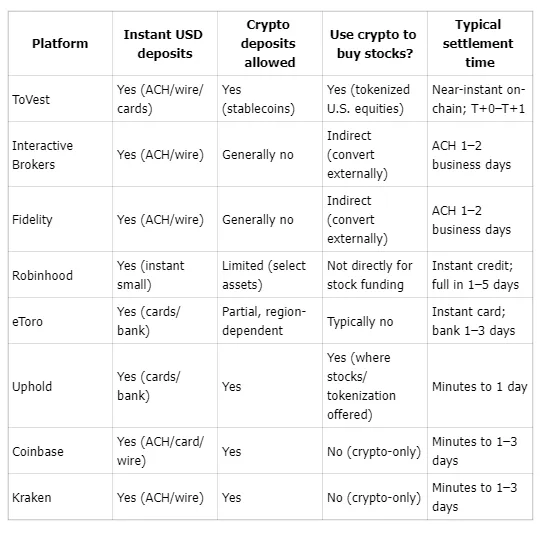
Note: Crypto deposit for stocks is still limited on most regulated brokers; hybrid platforms and tokenized equity venues provide the most direct fiat-crypto pathways.
Platform Features for Investors and Traders
Core features to compare across investor-friendly crypto exchanges and hybrid brokers:
- Trading and analytics
- 24/7 crypto markets, extended hours for stocks
- Real-time market data, screeners, and pro charting
- APIs and webhooks for automation and quant strategies
- Funding and access
- Fiat on/off ramps (bank, card, stablecoins)
- Debit cards and spending features
- Cross-asset conversion (crypto ↔ stocks/tokenized)
- Yield and programmability
- Staking: locking assets to help secure networks in exchange for rewards (where permitted)
- Programmable assets and tokenized equities for fractional, on-chain ownership
- Social and education
- Copy trading and community insights
- In-app education and tax reports
What stands out:
- eToro: Social and copy trading for community-driven investing.
- Kraken/Coinbase: Deep liquidity, APIs, and reliable execution for advanced users.
- Robinhood: Beginner-friendly, low-friction onboarding.
- ToVest: Tokenized equities with fiat and stablecoin interoperability, ultra-low latency settlement, real-time data, and institutional-grade custody under a compliance-first model.
See a broader feature overview in QuickNode’s exchange guide.
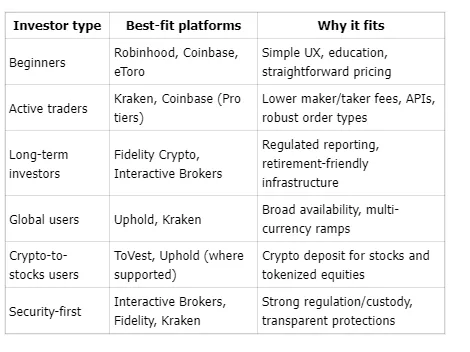
Which Platform Is Right for Different Investor Profiles?
Definitions: Active traders buy and sell frequently to capture volatility. Long-term investors buy and hold for compounding and future growth.
Frequently Asked Questions about Crypto-Enabled Stock Exchanges
What are the best crypto-enabled stock exchanges or hybrid brokers for 2026?
Top hybrid brokers include Fidelity Crypto and Interactive Brokers Crypto, while leading crypto-native choices with strong fiat ramps and asset breadth include Kraken, Coinbase, and others.
Which platforms have the lowest fees?
Binance, Bybit, and others often post 0.08%–0.10% maker/taker fees, while Kraken, Gemini, and broker-integrated crypto (Fidelity/Interactive Brokers) typically run up to about 1% depending on venue and volume.
Are these platforms secure and regulated?
Many—including Kraken, Gemini, and Coinbase—operate under U.S. and international compliance frameworks with strong security programs; oversight and protections vary by region and product.
What cryptocurrencies are supported?
Most platforms support Bitcoin and Ethereum plus hundreds of additional coins; hybrid brokers usually focus on major assets for compliance and simplicity.
Which are best for beginners vs. advanced traders?
Coinbase and Gemini are beginner-friendly; Kraken Pro and others offer lower fees and advanced tools for high-volume traders.
Any promotions or account minimums?
Many platforms have $0 minimums; some periodically offer bonuses for new users who meet trading thresholds.
How do they compare to pure DEXs?
Centralized and hybrid exchanges offer fiat ramps and stock/crypto integrations; DEXs enable non-custodial crypto trading but generally lack direct stock access and easy fiat support.