Tokenized US Stocks vs Traditional ETFs: Which Boosts Diversification More?
16 มกราคม 2569
Diversification is about spreading risk efficiently, not just buying more assets. Traditional ETFs remain the most reliable engine for broad, low-cost diversification thanks to deep liquidity, robust regulation, and institutional scale. Tokenized US stocks, however, unlock diversification for more people: fractional ownership, 24/7 trading, and near-instant settlement make it easier to fine-tune allocations and rebalance across time zones. In practice, ETFs still deliver more breadth and legal certainty at scale, while tokenized stocks can enhance diversification for global investors with smaller capital or digital-first strategies. The strongest approach for many investors is a blend: use ETFs for core exposure, and tokenized assets for precision and around-the-clock portfolio management.

Understanding Tokenized US Stocks
Tokenized US stocks are blockchain-based tokens that represent ownership or economic exposure to a real US stock, enabling 24/7 trading, fractional allocation, and instant settlement for investors worldwide, with many structures backed 1:1 by underlying shares held in custody, as summarized in this overview of tokenized stocks vs ETFs by industry analysts. Their appeal is straightforward: global accessibility, fractional ownership, and blockchain-powered trading that can plug into DeFi as collateral and settlement rails. While still small, the space is growing: Gate Research estimates tokenized equities at roughly $500 million in market value as of late 2025.
Core features at a glance:
- 24/7 access across jurisdictions and time zones
- Fractional ownership for low minimums and higher allocation precision
- Near-instant, blockchain-native settlement and transparent on-chain records
- Potential DeFi integration (collateral, lending) and programmable compliance
Feature snapshot:
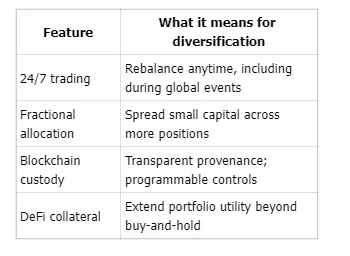
For a practical breakdown of how tokenized rails change costs, minimums, and settlement, see OSL’s breakdown of tokenized vs traditional stocks.
Defining Traditional ETFs
A traditional ETF (Exchange-Traded Fund) is a regulated investment fund that holds a diversified basket of securities and is traded on stock exchanges during regular market hours, offering investors broad, low-cost market exposure. ETFs pair established investor protections with clear tax treatment and large-scale market infrastructure. The industry’s sheer size—about $19.25 trillion in assets under management—underscores why ETFs are a default tool for diversification: predictable structures, institutional liquidity, and broad, rules-based exposures.
Key Features Impacting Diversification
Several structural factors shape how tokenized US stocks and traditional ETFs contribute to diversification:
- Trading hours: when and how you can rebalance
- Allocation precision: ability to buy fractions vs full shares
- Liquidity: depth, spreads, and execution quality
- Regulatory clarity: legal frameworks, tax, and disclosures
- Investor protections: custody, voting/dividends, and dispute resolution
In short, tokenization maximizes access and precision; ETFs maximize breadth, regulation, and execution quality.
Quick comparison:
- Tokenized: 24/7 access, high precision, evolving liquidity/regulation
- ETFs: exchange hours, strong liquidity, mature regulation and protections
Trading Hours and Price Discovery
Price discovery is the process by which markets establish asset prices based on supply and demand. Tokenized assets can trade around the clock, allowing investors to rebalance during off-hours or across time zones; traditional ETFs trade strictly during exchange sessions, which concentrates liquidity and governance but limits timing flexibility. With 24/7 markets, flexibility rises—but so can off-hour volatility and spreads, as noted by TD Securities on tokenizing ETFs. The trade-off: continuous access and responsiveness versus the price integrity and depth found during standard ETF trading windows.
Fractional Ownership and Allocation Precision
Fractional ownership means you can buy less than one full share. Tokenized US stocks are built for fractionalization, lowering entry barriers and letting investors match target weights precisely even with modest capital. That precision supports more positions and smoother rebalancing.
Illustrative allocation with $200:
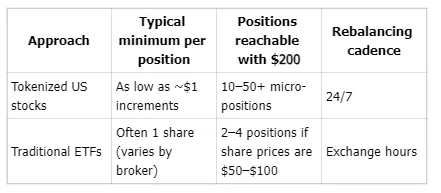
Result: tokenization broadens inclusion and enables custom diversification without large tickets.
Liquidity and Execution Quality
Liquidity is how easily you can buy or sell at the current price. Traditional ETFs enjoy deep, institutional liquidity with tight spreads and efficient creation/redemption mechanisms, delivering consistent execution for diversified exposure. Tokenized assets are earlier-stage: order books may be thinner, spreads wider, and prices can temporarily diverge from underlying markets—especially outside U.S. trading hours—according to justETF’s primer on tokenised ETFs. For large or urgent trades, ETFs typically provide superior execution quality today.
Regulatory Clarity and Investor Protections
Regulatory clarity means well-defined rules for issuance, trading, tax, and disclosures; investor protections include custody standards, voting rights, and remedies. Traditional ETFs benefit from mature legal frameworks, established custody chains, and robust investor rights shaped over decades. Tokenized instruments, by contrast, can face uneven or evolving rules across jurisdictions, and certain structures may raise questions about tax treatment, dividend handling, or voting rights—risks highlighted in DailyForex’s overview of tokenization and regulation. These differences matter when you rely on products to diversify core wealth.
Comparison of Diversification Benefits
Both structures can diversify, but in different ways. ETFs optimize breadth, scale, and legal certainty—ideal for core market exposure. Tokenized US stocks expand accessibility and capital efficiency: fractional allocation, 24/7 rebalancing, and faster settlement can meaningfully improve real-world diversification for global, smaller-ticket, and always-on strategies. Market depth and legal protections still favor traditional ETFs at scale. And while tokenized equities are growing, their market size—about $500 million—remains a tiny fraction (~0.0004%) of global equities, per Gate Research.
Side-by-side summary:
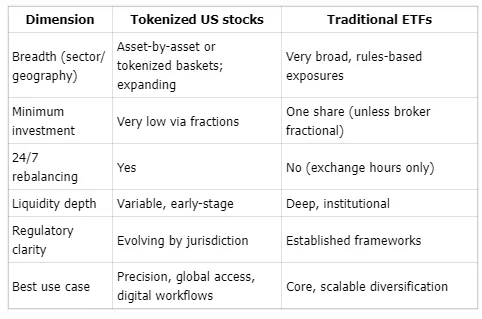
Pros and Cons of Tokenized US Stocks and Traditional ETFs
Pros and cons at a glance:
- Tokenized US stocks
- Pros: 24/7 access, fractional allocation, DeFi utility, near-instant settlement, as covered in this overview comparing tokenized stocks and ETFs.
- Cons: Evolving regulation/tax clarity, potential counterparty/custody considerations, thinner liquidity and possible price divergence, as flagged by justETF and DailyForex.
- Traditional ETFs
- Pros: Massive scale, clear regulation, predictable NAV/tax treatment, and deep liquidity.
- Cons: Limited trading hours; minimums can be higher if fractional brokerage access is unavailable.
Implication: For most investors, ETFs anchor diversification. Tokenized assets complement by adding precision, speed, and access where traditional options fall short.
Practical Insights for Investors Seeking Diversification
- Use ETFs for core, low-cost market exposure; add tokenized US stocks or tokenized ETFs for tactical tilts, small-ticket positions, and 24/7 rebalancing.
- Global access: Acquire U.S. exposures with stablecoins and settle near-instantly—useful when banking rails are slow or time zones misalign.
- Precision at small scale: Build micro-diversified baskets or thematic tilts with $50–$500 using fractional tokens.
- Event-driven rebalancing: Adjust exposure during non-U.S. hours when macro news breaks—feasible with tokenized markets.
- On ToVest, investors benefit from fractional ownership, 24/7 trading, and institution-grade custody to blend tokenized assets with ETFs for an optimized, modern portfolio. Explore practical workflows in the ToVest Academy guide to tokenized assets.
Frequently asked questions
Can I diversify my portfolio by buying tokenized US stocks online?
Yes. Fractional tokens let you spread smaller amounts across many names, enabling flexible, global diversification with 24/7 execution.
How does fractional ownership improve portfolio diversification?
It lowers minimums so you can hold more positions and match target weights precisely, reducing concentration risk.
What are the risks of investing in tokenized stocks compared to ETFs?
Tokenized assets face evolving regulation and thinner liquidity, while traditional ETFs offer established protections, deep markets, and predictable structures.
Can tokenized stocks be used for 24/7 portfolio rebalancing?
Yes. Tokenized markets operate around the clock, so you can adjust exposures outside traditional exchange hours.
Are tax implications different for tokenized stocks versus traditional ETFs?
They can be, depending on your jurisdiction and product structure; consult a local tax advisor before investing.