US Large‑Cap vs International ETFs: Which Offers Greater Safety?
16 มกราคม 2569
For most global investors, safety means more than short-term price stability. It blends liquidity, transparency, diversification, and resilience to shocks. On those dimensions, U.S. large‑cap ETFs typically offer greater safety than international ETFs thanks to deeper market liquidity, stronger regulatory protections, and lower geopolitical and currency risks. That said, limiting exposure to one country can concentrate risk; a balanced allocation that adds high‑quality international funds can improve portfolio durability across cycles. If you’re entering U.S. markets from abroad—especially via platforms that enable fractional or tokenized access like ToVest—anchoring in U.S. large‑caps and layering a measured international sleeve is a pragmatic, secure global stock investing approach.

Understanding Safety in ETF Investing
Safety in ETF investing refers to the ability of a fund to preserve capital, remain liquid during stress, and minimize extreme drawdowns while offering transparency and resilience against diverse market shocks. In practice, ETF safety is shaped by:
- Volatility and drawdowns (how large and frequent price swings are).
- Liquidity and market depth (ease of trading without price impact).
- Regulatory safeguards and disclosure quality.
- Diversification, concentration, and factor tilts.
- Geopolitical, economic, and currency risk.
For cross‑border investors using platforms like ToVest to access U.S. markets with fractional, regulated exposure, risk mitigation often starts with a safer core—broad U.S. large‑cap ETFs—before adding selective international ETFs for diversification.
Liquidity and Market Depth Comparison
Liquidity is how easily an ETF can be bought or sold without materially moving its price. Higher liquidity supports tighter bid‑ask spreads, lower trading costs, and better investor protection—especially in stressed markets. U.S. large‑cap ETFs trade on the world’s deepest exchanges with robust market‑maker support and long trading hours, while many international ETFs face lower volumes, narrower local hours, and greater execution frictions. Industry data show the U.S. ETF complex dwarfs global ex‑U.S. peers in assets and flows, a structural advantage for ETF liquidity and safety.
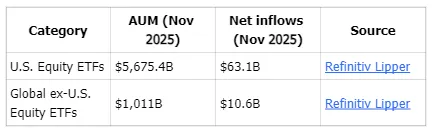
Lower structural liquidity abroad can translate into wider spreads, more frequent trading halts, and higher slippage—key reasons U.S. large‑caps are generally the safer core for ETF investing and secure global stock investing.
Regulatory Protections and Transparency
Regulatory protections in finance are legal frameworks that safeguard investors from fraud, promote market integrity, and enforce transparency from issuers. U.S. large‑cap ETFs benefit from stringent SEC oversight, standardized financial reporting, and strong shareholder rights, providing clearer disclosure and better legal recourse. International markets vary widely—rules, enforcement, and access to data can be inconsistent, raising regulatory risk for foreign investors. As a primer, iShares notes that U.S. investments offer robust oversight and transparency, whereas foreign markets often present heterogeneous disclosure standards and added frictions for investors outside the jurisdiction.
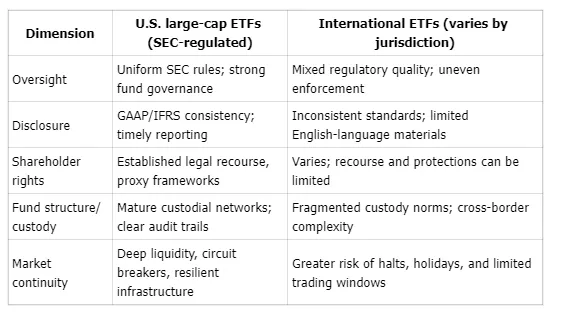
For global investors, this transparency gap is a core ETF safety consideration.
Geopolitical and Economic Risk Factors
Geopolitical risk is the likelihood that political events—elections, wars, sanctions, capital controls, or trade disputes—disrupt market performance or access to capital. U.S. markets are generally more insulated from turbulence than many international regions, with lower exposure to corruption, policy shocks, or capital restrictions; investors also avoid an extra layer of currency risk when holding U.S. dollar assets iShares international investing overview. Meanwhile, navigating international markets often entails added hurdles, from foreign exchange and tax complexity to local trading conventions NerdWallet guide to international investing.
Common international risk examples:
- Foreign exchange and capital controls risk.
- Political instability and regulatory reversals.
- Trade and sanction exposure concentrated by country or sector.
- Limited liquidity and narrower trading hours.
These factors can amplify volatility and impair exit liquidity in stress—two central dimensions of ETF safety.
Volatility, Drawdowns, and Diversification Benefits
Volatility is the magnitude of price swings over a period; drawdown is the peak‑to‑trough decline during a downturn. Research indicates that international developed equities have historically shown lower volatility and correlation relative to U.S. small‑caps, and in S&P 500 down quarters since 2010, U.S. small‑caps lost nearly twice as much as developed international peers—underscoring the diversification role of non‑U.S. exposure versus domestic small‑cap risk iShares international investing overview.
Key takeaways for ETF safety:
- U.S. large‑caps typically exhibit lower volatility and milder drawdowns than U.S. small‑caps.
- Adding developed international exposure can blunt U.S.‑specific shocks, improving portfolio volatility reduction and drawdown resilience—provided investors accept FX and country risks.
Evidence from developed ex‑U.S. funds:
- In a comparative review of VEA, IEFA, and SCHF, VEA showed the deepest historical max drawdown among the trio but delivered the best Sharpe and Sortino ratios over the assessed period, pointing to superior risk‑adjusted performance despite headline drawdown VEA vs. IEFA vs. SCHF analysis.
Concentration and Factor Exposure Differences
Concentration risk is the danger that portfolio results hinge on a small set of stocks or sectors; leadership reversals can inflict outsized losses. U.S. large‑cap indices have grown increasingly top‑heavy, with returns dominated by mega‑cap growth names—a double‑edged sword for ETF safety if leadership rotates iShares international investing overview. International developed markets tend to lean more toward value factors (higher dividend and earnings yields) and exhibit broader sector and country leadership.
At a glance:
- U.S. large‑cap ETFs: higher growth tilt; heightened mega‑cap concentration; potent when growth leads, riskier if leadership narrows or reverses.
- International developed ETFs: more value tilt; wider sector/regional spread; potential shock absorption when value outperforms.
For risk mitigation, balancing growth and value exposures across regions can reduce concentration risk and improve ETF safety.
Currency Exposure and Macro Sensitivity
Currency risk is the potential for returns to be altered by movements in exchange rates between the investor’s home currency and the market’s local currency. International ETFs expose investors to a “double impact”: local equity performance plus FX movements. Dollar strength is a headwind for unhedged foreign holdings; dollar weakness is a tailwind iShares international investing overview. Over certain cycles, currency can dominate: from 2002–2007, currency moves accounted for roughly 49% of MSCI ACWI ex‑U.S. outperformance versus the U.S., according to Pacer’s analysis Pacer Perspective.
Macro variables—global rate differentials, commodity cycles, and political events—can compound currency volatility, making FX risk a central consideration in ETF safety for global portfolios.
Cost Structures and Expense Ratios
An expense ratio is the percentage of an ETF’s assets used to cover annual operating costs; lower fees increase net returns and support risk‑adjusted safety over time. Many S&P 500 ETFs charge as low as 0.03%, well below typical international funds expense ratio discussion. Among broad developed ex‑U.S. options, fees are competitive but higher than the cheapest U.S. large‑cap core: VEA at 0.05%, IEFA at 0.09%, and SCHF at 0.06% in recent disclosures VEA vs. IEFA vs. SCHF analysis.
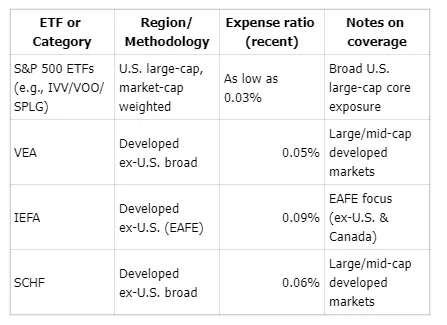
Beyond headline fees, index methodology (sector caps, country weights), rebalancing rules, and securities lending can influence realized volatility, drawdown behavior, and risk metrics like Sharpe and Sortino—key components of ETF safety.
Blended Portfolio Approaches for Enhanced Safety
Blended portfolios combine allocations to both U.S. and international equities, harnessing imperfect correlations to strengthen resilience and improve return‑to‑risk. Research and practitioner experience suggest a core in U.S. large‑caps with a meaningful international sleeve can enhance diversification—provided investors size FX and country risks appropriately and favor transparent, low‑cost funds iShares international investing overview.
Practical guidance:
- Target ranges: 20–35% international within equity exposure often balances global diversification with U.S. stability for ETF allocation for safety.
- Style balance: Pairing U.S. growth with international value has historically improved outcomes; MSCI analysis highlights periods where international value outshone U.S. growth, supporting a complementary blend MSCI value vs. growth.
ToVest enables global investors to implement such blended equity portfolios with fractional, regulated access to U.S. markets and seamless cross‑border execution—bridging traditional and tokenized capital markets with real‑time risk tools. For a step‑by‑step framework, see our portfolio construction guide on ToVest Academy (https://tovest.com/en-US/blog/academy/574589).
Frequently Asked Questions
Do international ETFs reduce portfolio volatility?
Yes—adding developed international exposure can lower overall volatility through diversification, though it introduces FX and country risks that must be managed prudently.
What makes U.S. large-cap ETFs a safer core holding?
They offer superior liquidity, stronger regulatory protections, and lower geopolitical and currency risks than most international funds, creating a durable foundation for global portfolios.
How does currency risk affect international ETF returns?
FX movements can amplify or detract from local market returns; a stronger U.S. dollar is a headwind for unhedged foreign holdings, while dollar weakness is a tailwind.
What is the ideal allocation between U.S. and international ETFs for safety?
A 20–35% international sleeve alongside a U.S. large‑cap core typically enhances resilience without overexposing the portfolio to any single country.
Are there additional risks unique to international equity investing?
Yes—variable disclosure standards, political instability, capital controls, and lower liquidity are more common abroad and should be factored into risk management.