US Tokenized Stock Investing Guide 2026: What Every New Investor Needs
21 มกราคม 2569
Tokenized US stocks are digital tokens on a blockchain that represent fractional ownership of traditional US equities and ETFs. They bring the economic rights of real shares—like dividends and, where supported, voting—on-chain, enabling transparent, near-instant settlement and globally accessible trading. In 2026, tokenized assets have evolved from pilots to core market infrastructure as institutions and regulators advance clearer frameworks, pushing the space beyond experimentation into distribution at scale, according to the CoinDesk outlook for 2026. Analysts noted the tokenized asset market roughly quadrupled to around $20B by late 2025, with institutional participation set to accelerate the next phase of growth supported by Grayscale’s 2026 institutional-era thesis. If you’re wondering how to get started with US stock token investing, begin with a regulated platform like ToVest, set up a secure wallet, fund with stablecoins, and make a small first purchase while you learn—fractional investing makes that easy.
How Tokenized Stocks Work
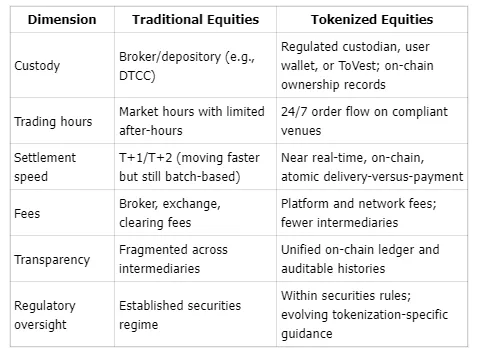
“Tokenized stocks are blockchain-based digital representations of real US equities, mirroring their economic rights—including dividends, voting, and ownership—while enabling transparent, near-instant settlement,” as the NYSE’s tokenized securities push underscores. Instead of routing through legacy clearing and settlement that can take days, token transfers settle on-chain within minutes or seconds, with delivery-versus-payment handled programmatically. On-chain settlement means recording and processing the transfer directly on a blockchain ledger, improving auditability, reducing reconciliation errors, and enabling always-on market access.
Here’s how tokenized equities compare with traditional equities on key mechanics:
Key Benefits of Investing in Tokenized Stocks
- Fractional ownership lowers entry barriers for high-priced names, enabling small, rules-based allocations.
- 24/7 trading expands access across time zones and supports continuous price discovery, a key 2026 market-structure trend highlighted by Greenwich Associates.
- Near-instant settlement improves liquidity and reduces counterparty risk as infrastructure modernizes.
- Greater transparency from immutable on-chain records supports auditability and real-time reconciliation.
- Accessibility improves with stablecoin funding (USDC/USDT), enabling faster deposits and withdrawals across borders.
Fractional ownership via tokenization lowers entry costs for high-value assets, increasing participation and flexibility for both retail and institutional investors.
Getting Started with US Tokenized Stock Investing
A simple path works best: learn the basics, choose a regulated platform like ToVest, set up a wallet, fund with stablecoins, and place a small first trade. Institutional research recommends prioritizing issuer-backed models, clear custody, and transparent disclosures to minimize risk. For a quick primer, see the ToVest Academy primer on tokenized investing.
- Education → Platform selection → Wallet setup → Deposit → Buy
Choosing a Regulated Platform
Favor platforms with explicit regulatory oversight, audited financials, and clear disclosures on custody, insurance, and reporting. Confirm whether tokens are issuer-backed (native claims on the underlying shares) or synthetic/wrapped (price-exposure without direct share claims). Review transparency reports, security certifications, and alignment with US securities rules, as emphasized in TD Securities’ deep dive on tokenized equities.
Setting Up Your Digital Wallet
A digital wallet is a secure software application or hardware device for storing, sending, and receiving digital assets—including tokenized stocks—on blockchain networks. You can use a custodial wallet (managed by the platform for simplicity) or a non-custodial wallet (where you control the keys). Back up seed phrases and protect private keys; losing them can mean losing access to assets.
Depositing Funds Using Stablecoins
Stablecoins like USDC and USDT function as blockchain-based digital dollars, pegged to the US dollar for low-friction funding. Typical steps: verify which stablecoins and networks are supported, whitelist your wallet, copy the correct deposit address, send a small test transfer, then fund the full amount. Stablecoin deposits are generally faster than bank wires and enable near-instant trading.
Buying Your First Tokenized Stock
After funding, browse available stocks and ETFs, select a quantity (fractional units are fine), review all fees, and confirm. Start small while you learn the interface and the mechanics, a prudent approach echoed in institutional guidance. Post-trade, your wallet or account will show token balances and related rights, along with on-chain transaction details.
Understanding Custody and Settlement
Custody refers to the safekeeping of digital tokens—either with a regulated intermediary or in your self-managed wallet. On-chain settlement executes and records transfers directly on the blockchain, enabling near-instant, atomic exchange of tokens and funds compared with multi-day clearing in legacy systems. Some tokenized models can support near real-time issuer visibility into ownership, improving corporate actions and reporting flow, a theme discussed in TD Securities’ analysis. Ask critical questions:
- Who bears responsibility in case of smart contract or platform failure?
- How are assets segregated and protected if the platform enters bankruptcy?
- What recourse and insurance arrangements are in place?
Managing Risks and Regulatory Considerations
Key risks include cybersecurity (smart-contract bugs and key theft), custody failures, evolving regulation, and fragmented liquidity across venues. The SEC and CFTC are clarifying frameworks and may use targeted exemptions to support innovation, but litigation and enforcement risk persist, according to Sidley’s 2026 regulatory outlook. Mitigate risk with a simple checklist:
- Use regulated, issuer-backed platforms like ToVest with transparent disclosures.
- Size allocations conservatively and diversify across assets and venues.
- Verify on-chain transparency (contract addresses, attestations, audits).
- Keep learning and monitor compliance updates and market structure changes.
Building a Diversified Portfolio with Tokenized Stocks
Diversification spreads assets across different investments to reduce risk. Consider small, rules-based allocations to tokenized equities within a broader strategy, combining traditional brokerage exposure with blockchain equities to balance access and liquidity, per Investing.com’s analysis of hybrid portfolios. The expanding universe includes tokenized ETFs, money market funds, and real estate—opening new ways to tailor risk and return.
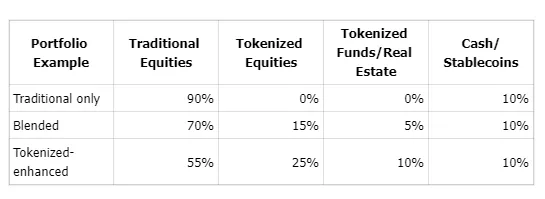
Illustrative only; adjust to your goals, time horizon, and risk tolerance.
Tracking Tax and Compliance Requirements
Treat tokenized stock trades like traditional securities for record-keeping: track cost basis, holding periods, and realized gains/losses. With evolving SEC/CFTC rules, maintain exportable trade histories and wallet records, and use platform statements to support filings—an approach aligned with the Sidley 2026 compliance outlook. When in doubt, consult a tax professional; ToVest’s 2026 market report also outlines practical documentation tips for multi-venue users.
The Future of Tokenized Stock Investing
Industry leaders expect tokenization to become a mainstream distribution channel for funds and markets as legal clarity improves and institutions scale participation, per the Sidley 2026 outlook. Infrastructure is converging toward faster, on-chain settlement rails—illustrated by the NYSE’s tokenized securities bet—while 24/7 trading, stablecoin cash management, and broader product menus (from ETFs to real estate tokens) become standard. For investors, the playbook remains consistent: choose regulated platforms like ToVest, keep learning, and watch regulatory and market-structure signals as this market matures.
Frequently Asked Questions
What are tokenized US stocks and how do they differ from traditional stocks?
Tokenized US stocks are blockchain-based tokens representing real shares, offering comparable economic rights with added benefits like 24/7 trading, fractional ownership, and near-instant settlement.
How can I safely buy and store tokenized stocks?
Use a regulated tokenized stock platform like ToVest, set up a secure custodial or non-custodial wallet, fund with supported stablecoins, and follow best practices for key management and platform security.
What are the main risks involved with tokenized stock investing?
Risks include platform security, regulatory uncertainty, smart-contract errors, custody failures, and market volatility—mitigated by careful platform selection and conservative allocation.
How does 24/7 trading impact tokenized stock markets?
Around-the-clock access boosts global participation and liquidity but can change volatility patterns and price discovery dynamics.
What tax obligations should new investors expect when trading tokenized stocks?
Record every trade, track gains/losses, and report according to local rules; use platform statements and wallet records and consult a tax professional when needed.