Buy Tokenized Real Estate in 2026: A Quick Start Guide
3 กุมภาพันธ์ 2569
Tokenized real estate allows you to buy fractional interests in property using digital tokens, offering lower minimums and faster settlement than traditional deals. If you’re wondering how to buy tokenized real estate in 2026, the short answer is: choose a regulated platform, complete KYC, review legal documents, verify custody and fees, understand liquidity limits, and start small while monitoring results. This quick-start guide expands those steps into a practical playbook—what tokenization is, what to check before you invest, and how to evaluate platforms and offerings. Throughout, we reflect ToVest’s perspective: regulated market access, strong compliance, and operational rigor designed to make tokenized assets—including tokenized stocks and real estate—simple and secure for global investors.

Understanding Tokenized Real Estate
Tokenized real estate converts property ownership or related rights into digital tokens recorded on a blockchain. Think of a token as a digital deed or share certificate—it represents rights, while the property itself stays off-chain, as described in the RWA platforms guide for 2026 (RWA.io). In short, the blockchain acts as your ledger; the building remains in the real world.
Real-world asset tokenization turns off-chain ownership rights into on-chain tokens connected to legal frameworks, as explained in a business guide to RWA tokenization (ChicMic Studios). In U.S. deals specifically, the token acts as a wrapper—investor rights are enforceable through the legal documents, not the ledger alone, according to a US real estate tokenization overview (Tokenizer Estate).
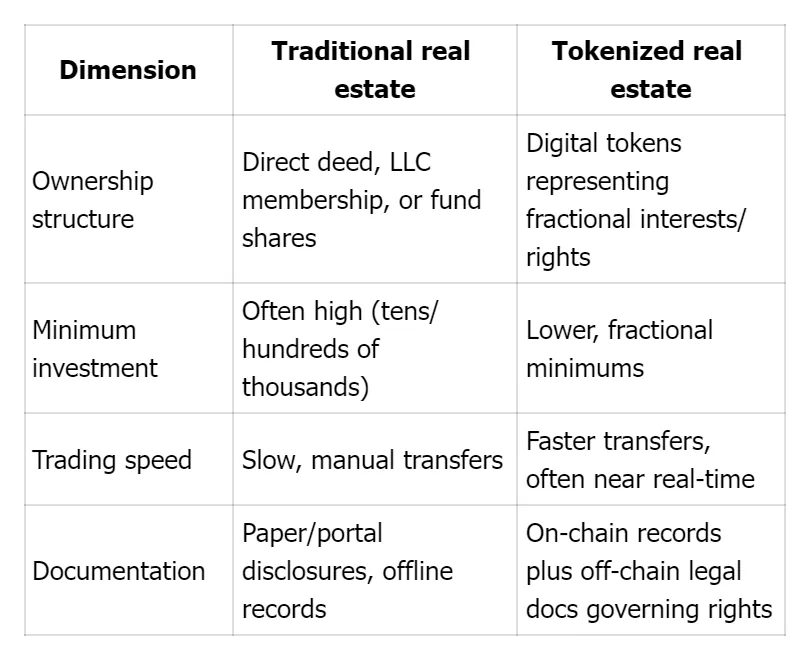
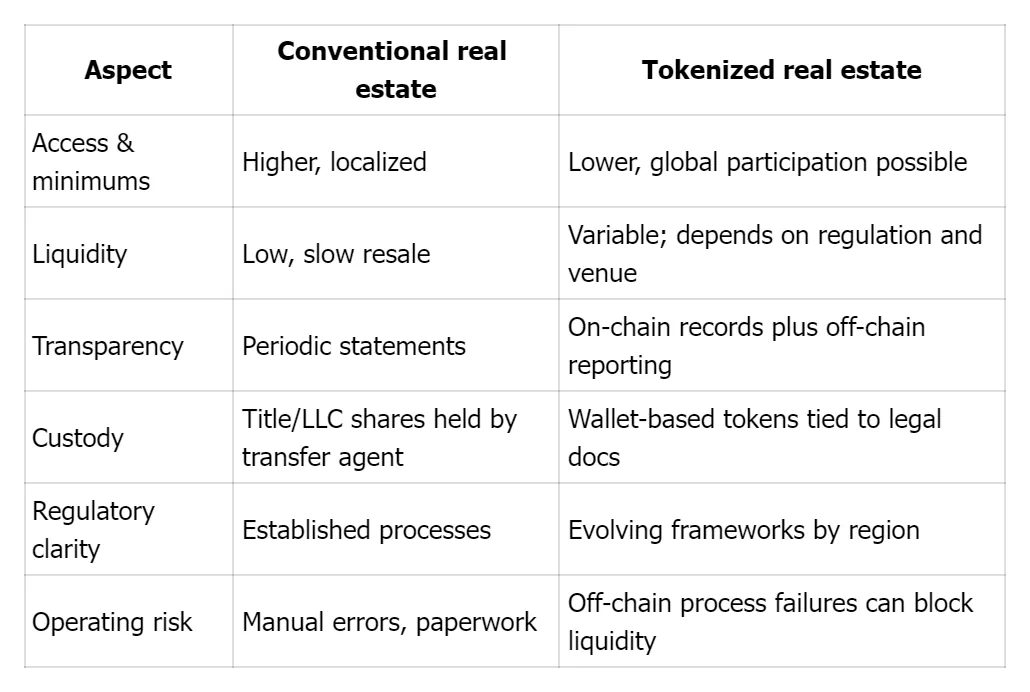
Traditional vs. tokenized real estate at a glance:
Preparing to Invest in Tokenized Real Estate
Before you buy, run preflight checks. Confirm the legal claim you’re acquiring, your cashflow rights, any resale or transfer limitations, and the platform’s operational capabilities. Pay particular attention to investor eligibility, platform licensing, and the presence of Know-Your-Customer (KYC) and Anti-Money Laundering (AML) controls. Tokenization works best when treated as a securities-plus-operations product: legal terms, compliance, and servicing must align—not just token minting.
Quick readiness checklist:
- Identify the legal structure and what the token represents (equity, debt, revenue share).
- Confirm investor eligibility and geographic restrictions.
- Verify KYC/AML, audit trails, and data retention.
- Review custody of tokenized assets and how on-chain records reconcile to off-chain registers.
- Understand fees, distribution cadence, and resale rules.
- Check the platform’s operational track record and support response times.
Step 1: Review the Legal Offering Documents
Your rights reside in the legal documents. Offering circulars, operating agreements, subscription docs, and transfer policies should clarify:
- What you legally own (fractional equity, profit participation, specific voting rights).
- Cashflow terms (rental income, interest, distributions, waterfalls).
- Transfer, resale, and exchange rules, including any holding periods and approvals.
- Exit scenarios, buyback rights, and dissolution procedures.
If it isn’t clearly stated off-chain, assume it isn’t guaranteed. Tokens reflect these rights; they don’t replace them.
Step 2: Verify Platform Licensing and Investor Eligibility
Choose regulated platforms and issuers. Confirm registrations or exemptions relevant to your region (e.g., SEC regimes in the U.S., MiCA in the EU) and ensure the platform implements KYC/AML gating and maintains audit trails. The regulatory path (e.g., Reg D, Reg A, Reg CF) dictates who can invest, when tokens can be resold, and where they can trade.
Expect to provide and receive:
- Identity verification (KYC), source-of-funds checks, and sanctions screening.
- Disclosures on conflicts, fees, and risk factors.
- Offering documents tied to the exemption being used (e.g., Reg D PPM, Reg A circular).
- Clear statements on transfer restrictions, lockups, and secondary access.
Step 3: Confirm Custody and Insolvency Protections
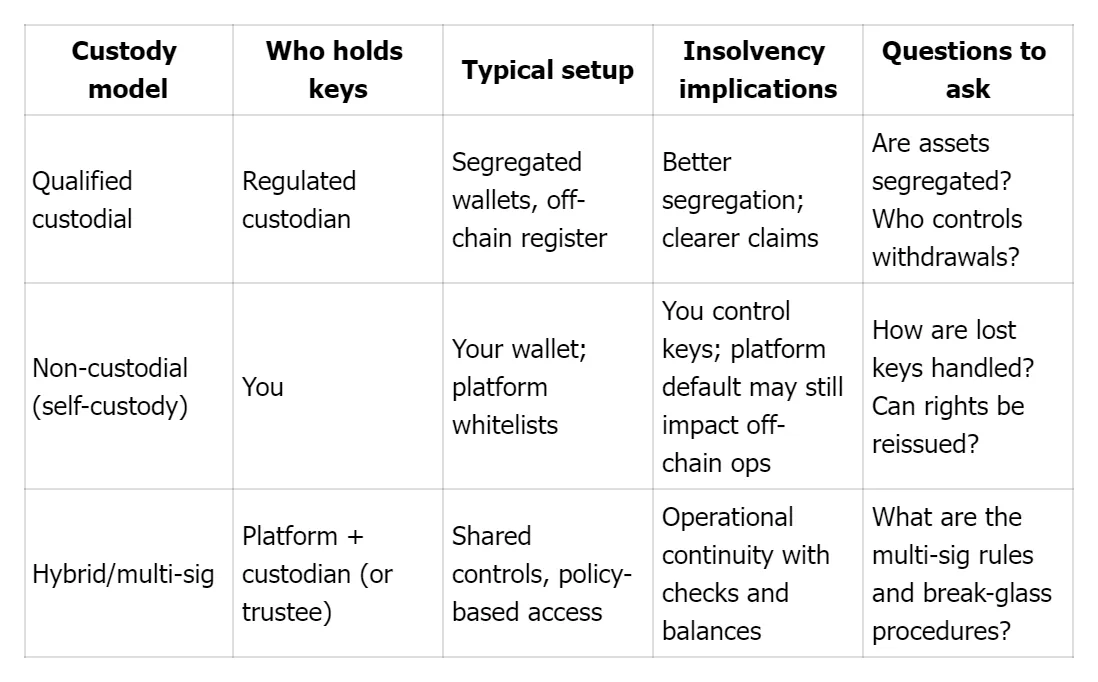
Custody—the safekeeping of your tokens and the linkage to the underlying legal asset—is crucial. Custody and safekeeping are central challenges, and traditional custodians are building wallet and smart contract capabilities, as noted in What is RWA tokenization (Investax). Custody risk is real: private keys can be lost, wallets compromised, and exception processes must be in place. Assess how custody works and what happens if a platform fails.
Step 4: Evaluate Token Economics and Fees
Scrutinize minimums, fees, and distributions. Many offerings target $500–$10,000 entry points for fractional real estate, according to Brevitas’ overview of tokenized real estate (Brevitas). Smart contracts can automate rental income or dividend payouts, improving transparency and timeliness, as covered in a tokenization applications brief (XBTO).
Illustrative economics (always check the specific offering):
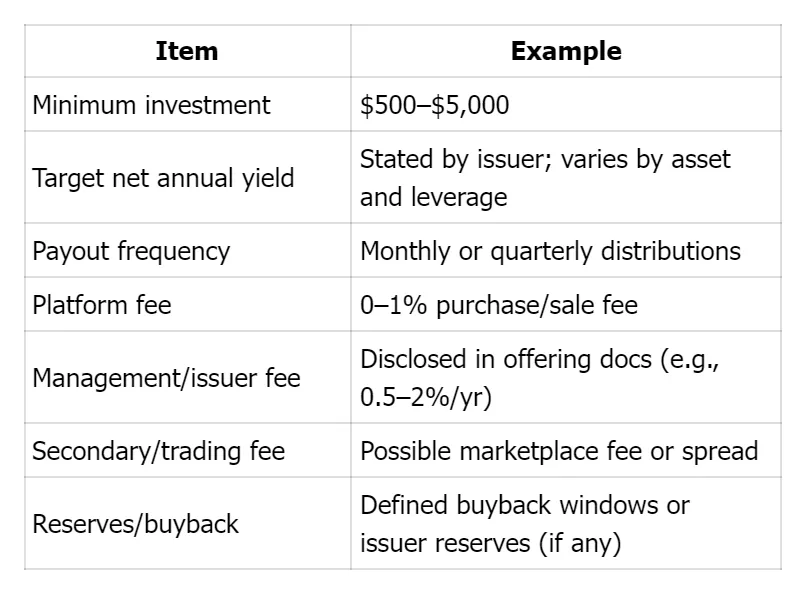
Understand explicit fees and downstream costs such as buyback provisions, transfer fees, and marketplace commissions.
Step 5: Assess Secondary Market Access and Liquidity
Secondary markets are regulated venues or mechanisms where tokens can be resold peer-to-peer or on approved exchanges. Liquidity often fails because off-chain processes break—compliance checks, settlement, and records—rather than smart contracts themselves. Know your exit options:
- Direct platform resales or bulletin boards.
- Approved secondary exchanges/ATS venues.
- Negotiated peer transfers subject to whitelisting and transfer restrictions.
Regulatory constraints matter. For example, Regulation Crowdfunding typically imposes a one-year resale restriction and requires an SEC-registered intermediary. Other exemptions have their own holding periods, buyer eligibility rules, and venue requirements.
Step 6: Understand Exception Handling and Operational Processes
Beyond code, operations decide outcomes. Plan for exceptions: legal order freezes, lost-key reissues, cap table reconciliations, mis-posted distributions, or reporting discrepancies. Robust platforms embed exception and compliance reporting into their workflows—not just smart contracts.
What to ask about exception handling:
- Key loss and recovery: Is there a notarized reissuance path? Multi-sig overrides?
- Freeze/suspension: How are court orders handled? Who can pause transfers?
- Reconciliation: How often are on-chain and off-chain records audited?
- Distributions: What happens if a payout fails? Are make-goods documented?
- Dispute resolution: Defined timelines, escalation contacts, independent audits?
Step 7: Start Small and Monitor Performance
Begin with the minimum and scale only after the platform proves timely distributions, accurate reconciliations, and responsive support. Track:
- Income history versus projections.
- Audit trails and cap table reports.
- Any exception events and their resolution times.
- Communication quality from both issuer and platform.
If results remain consistent across several cycles, consider increasing your allocation.
Benefits and Risks of Tokenized Real Estate
Benefits:
- Global investor access and fractional minimums.
- Near real-time settlement and 24/7 availability.
- Automated distributions and transparent ledgers.
- Programmatic compliance and audit trails.
Risks:
- Legal and regulatory uncertainty across jurisdictions.
- Potential custody/key loss and wallet compromise.
- Secondary market illiquidity and holding periods.
- Operational breakdowns in off-chain processes.
Side-by-side view:
Note: Many of these concepts also apply to tokenized stocks, which follow similar custody, compliance, and secondary-market principles.
Choosing a Regulated and Secure Platform
Prioritize platforms that bundle legal, compliance, custody, and ongoing servicing—not just token minting. Marketplaces that only issue tokens without end-to-end operations create unnecessary risk. Look for:
- Regulated custody arrangements, segregation of assets, and verifiable insolvency protections.
- Full KYC/AML, eligibility gating by jurisdiction, and immutable audit trails.
- Clear transfer policies, exception playbooks, and tested incident response.
- Transparent fee schedules and distribution mechanics with live reporting.
- Demonstrated performance in regulated jurisdictions.
ToVest emphasizes regulatory adherence, instant or near-instant settlement, and robust operational controls to make tokenized real estate—and broader tokenized assets—accessible to global investors. For more about our approach and insights, see ToVest insights.
Frequently Asked Questions
What is tokenized real estate?
Tokenized real estate divides property ownership rights into digital tokens on a blockchain, allowing investors to buy fractional shares and track holdings online.
How do I buy tokenized real estate?
Join a compliant platform, complete KYC, review the offering documents, and purchase tokens representing property interests—often with much lower minimums than traditional deals.
What are the main benefits?
Tokenized real estate offers lower entry barriers, global access, faster settlement, automated income distributions via smart contracts, and improved transparency.
What types of tokenized real estate exist?
Asset types include single-property equity, property-backed loans, and diversified portfolios targeting income or appreciation across regions and asset classes.
Is tokenized real estate regulated in the US?
Yes; offerings generally fall under U.S. securities laws, with investor protections enforced through legal documents and platform compliance.
How is the market performing?
The market is expanding as more platforms, assets, and institutions participate, with improving infrastructure and investor adoption year over year.
What should I consider before investing?
Review legal terms, verify platform licensing and investor eligibility, assess custody and operational risks, and be aware that secondary liquidity may be constrained.