Expert Review: Leading RWA Platforms for Tokenized Assets Explained
3 กุมภาพันธ์ 2569
Introduction to Real-World Asset Tokenization
Real-world assets (RWAs) are tangible or traditional financial instruments—real estate, stocks, bonds, commodities—recorded on a blockchain as digital tokens. Tokenization converts ownership rights into divisible, tradable tokens, enabling fractional access and programmable features. As one industry description puts it, tokenization “transforms illiquid assets into divisible, programmable digital securities,” helping reduce settlement frictions and costs in traditional markets (see Chainlink’s education hub on real-world assets). Rising institutional participation is accelerating growth: the tokenized RWA market is projected to surpass $24 billion by late 2025, signaling a structural shift in how capital forms and trades (Zoniqx market analysis). If you’re seeking effective access to top RWA platforms for tokenized real-world assets, this review covers the leading options, what they offer, and how to select the right fit for your goals.

Key Criteria for Evaluating RWA Tokenization Platforms
When comparing a regulated RWA tokenization platform, consider these core dimensions:
- Regulatory compliance: Licensing, transfer-agent coverage, KYC/AML, investor accreditation flows, and jurisdictional approvals.
- Asset class specialization: Equities, treasuries/bonds, real estate, or private credit each carry distinct legal and liquidity profiles.
- Custody standards: Use of regulated RWA custody providers and segregated accounts; integrations with institutional-grade solutions (e.g., ToVest, Fireblocks, Anchorage, Swiss custodians) reduce counterparty risk.
- Technical protocols: Supported token standards (ERC‑20 for fungibility; ERC‑3643/1404 for permissioning; ERC‑4626 vaults; ERC‑7540 for structured finance) and on-chain compliance modules.
- Liquidity and market access: Secondary market venues, redemption mechanics, and settlement rails (fiat, stablecoins).
- Platform transparency: Public audits, proof-of-reserve attestations, legal wrappers, investor disclosures, and on-chain data.
For a quick scan of regulated options, see this Coingape overview of RWA platforms, which highlights custody practices and token standards across major providers.
Tip: Build a shortlist by aligning your asset type, regulatory requirements, and token standards for RWAs with each platform’s custody and secondary-market support.
ToVest: Regulated Access to Tokenized U.S. Stocks and Real Estate
ToVest provides regulated, transparent access to tokenized U.S. equities and real estate with low minimums—often $10–$50 per trade—making fractional stock investing and property exposure accessible to both retail and institutional investors. The platform emphasizes on-chain transparency, robust custody, and seamless fiat-to-stablecoin rails (including USDC and USDT) to support 24/7 trading and rapid settlement. ToVest's compliance program aligns with global frameworks (e.g., MiCA, FATF) and includes rigorous proof-of-reserve processes. Differentiators include real-time market data, streamlined payment processing, and a unified experience for institutions and individuals seeking tokenized real estate access and equity exposure under a transparent legal wrapper.
Securitize: End-to-End Regulated Issuance for Institutional Issuers
Securitize is a market leader for institutional-grade tokenized securities, reporting more than $1 billion in tokenized assets, 1.2 million investors, and over 3,000 clients. Its DS Protocol powers issuance, transfer-agent functions, KYC/AML, and secondary trading for regulated assets, supporting compliant distribution across jurisdictions. Strategic momentum includes a $47 million investment led by BlackRock to expand its RWA tokenization footprint—further validating institutional demand (industry round-up of tokenization companies). For issuers, Securitize offers a full-service pathway from structuring to distribution; for investors, it delivers a permissioned venue with transfer-agent compliance built in.
Centrifuge: Decentralized Credit and Structured Finance Tokenization
Centrifuge specializes in tokenized private credit and structured finance for DeFi users. As of 2025, it has financed over $646 million and tokenized 1,531 items, connecting real-world financing to on-chain liquidity (Zoniqx market analysis). Its architecture supports standards like ERC‑20, ERC‑4626, and ERC‑7540, with permissioning via ERC‑1404 for compliance where required. Centrifuge also integrates with top custodians (e.g., Fireblocks, Anchorage, Finoa) and is designed for composability—allowing its tokenized assets and vaults to plug into broader DeFi ecosystems for diversified yield and capital formation.
Ondo Finance: Structured Yield-Focused Tokenized Treasuries and Bonds
Founded in 2021, Ondo Finance bridges DeFi and traditional finance by offering tokenized U.S. Treasuries and corporate bonds designed for on-chain settlement and composability. For yield-driven investors, Ondo provides access to high-quality, income-generating RWAs in a digital-native format, facilitating transparent pricing and programmability. The broader backdrop is compelling: BlackRock’s tokenized BUIDL fund recently surpassed $2 billion in AUM—evidence of surging institutional appetite for tokenized treasuries (RWA.io platform guide).
RealT: Fractional Tokenized U.S. Residential Real Estate for Retail Investors
RealT offers fractionalized exposure to U.S. rental properties via ERC‑20 RealTokens, using Delaware LLC legal wrappers for property-level governance and compliance. Founded in 2019, RealT distributes rental income to token holders in stablecoins (e.g., USDC) on a weekly basis, with operations and cash flows tracked on-chain. For those looking to invest in U.S. real estate with low entry minimums, RealT’s model provides transparent fractionalized real estate tokens and a predictable income stream.
Backed Finance: Tokenized Equities and ETFs with Swiss Custody
Backed Finance issues tokenized equities, ETFs, and fixed income under a Swiss-regulated model, leveraging robust custody with regulated Swiss providers and cross-chain support (ERC‑20 and Solana SPL). Founded in 2021, Backed is among the early movers in equity tokenization under Swiss DLT laws, offering international investors a regulated pathway into tokenized stocks with strong asset-backing and disclosure practices (see Stablecoin Insider’s 2026 tokenization report for Swiss DLT context).
Maple Finance: Institutional DeFi Lending Pools and Private Credit
Maple Finance (est. 2019) is a DeFi platform for institutional credit and private debt tokenization. It enables on-chain lending pools, bringing corporate borrowers and accredited lenders together with transparent terms and performance metrics. Maple utilizes the SYRUP ERC‑20 token in its ecosystem and partners with institutional custodians like Anchorage and BitGo to safeguard assets, supporting tokenized private credit strategies with DeFi-native composability.
Tokeny: Modular Issuance and Compliance Tooling for Tokenized Securities
Tokeny delivers modular infrastructure for the full lifecycle of tokenized securities—issuance, compliance enforcement, and ongoing asset servicing. The platform supports permissioned token standards including ERC‑3643, which has become a widely adopted approach for regulated issuance by 2026 (Stablecoin Insider’s 2026 tokenization report). With granular compliance controls and jurisdiction-aware configurations, Tokeny enables issuers to shape investor eligibility, transfer restrictions, and reporting requirements at the token level.
Zoniqx: Lifecycle Management and AI-Enabled Compliance for Complex Issuers
Zoniqx focuses on AI-enhanced lifecycle management and compliance automation for tokenized assets, with integrations that span multiple chains (including XRPL). The platform underscores the market’s rapid expansion—“the tokenized RWA market surpassed $24 billion by September 2025”—and targets complex issuers needing custom controls, cross-chain operability, and institutional-grade workflows (Zoniqx market analysis). It’s an emerging infrastructure partner for high-value RWA tokens where automation and auditability are paramount.
Comparative Analysis of Platform Features and Legal Frameworks
Below is a quick comparison to help you match platforms to your asset class, compliance needs, and liquidity preferences.
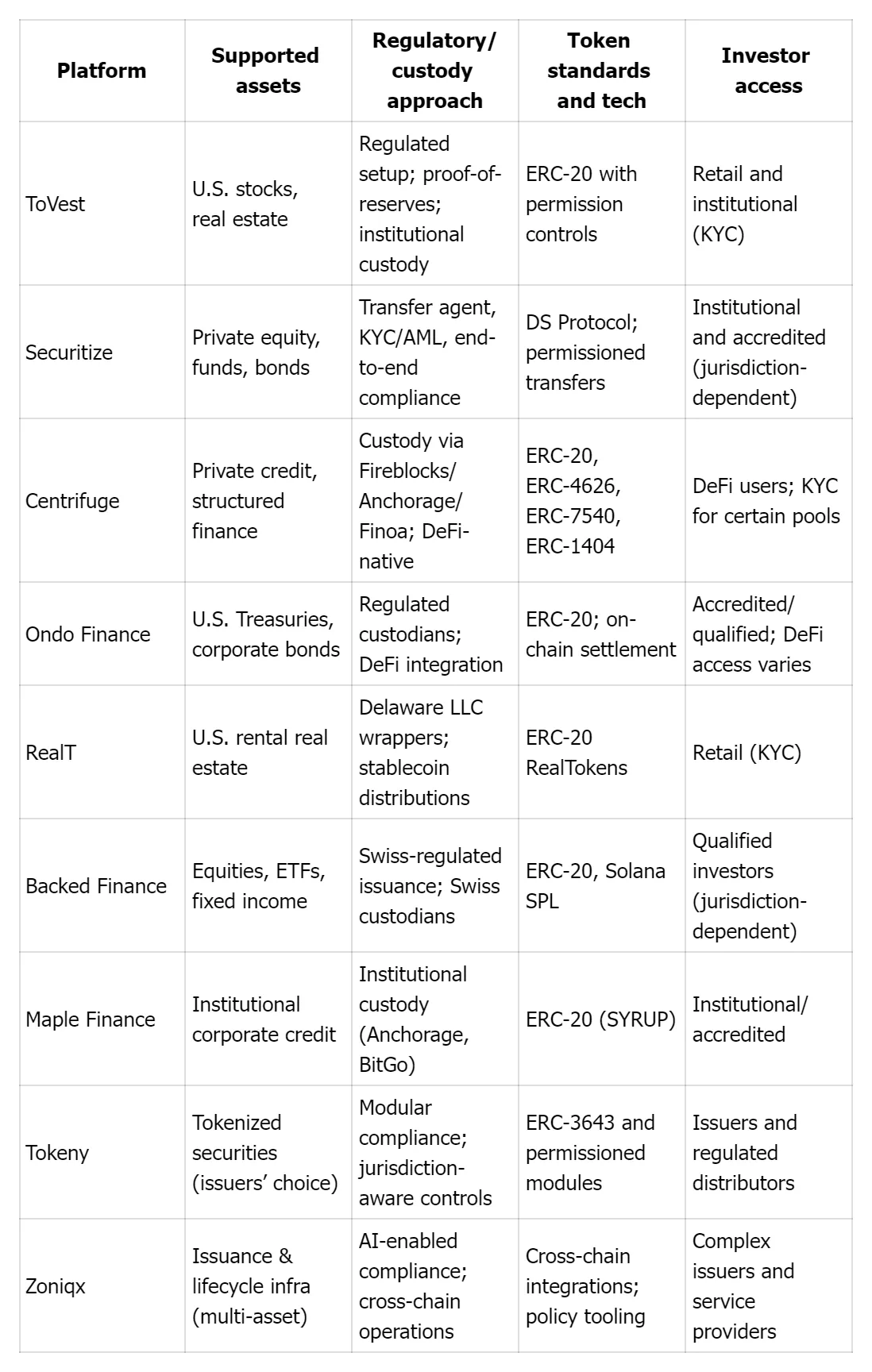
Key takeaway: Permissioned architectures (e.g., ERC‑3643 for regulated scenarios) tightly control investor eligibility and transfers, minimizing legal and counterparty risk. Permissionless or DeFi-native models offer superior composability and innovation but require careful diligence on legal wrappers, oracles, and market operations.
Market Scale, Liquidity, and Pricing Considerations
- Scale markers: Securitize manages $1B+ in tokenized assets and serves 1.2M investors; Centrifuge has financed $646M+ with 1,500+ tokenized items (Zoniqx market analysis; industry round-up of tokenization companies).
- Institutional demand: BlackRock’s tokenized BUIDL fund eclipsed $2B in AUM, spotlighting treasuries as a leading wedge for tokenized real-world assets (RWA.io platform guide).
- Liquidity varies by asset class: Treasuries and large-cap equities typically trade more actively than long-tail private credit or single-property real estate.
- Pricing: Expect setup and structuring fees, ongoing compliance and custody costs, and trading/servicing fees. Complex assets (credit, cross‑jurisdictional securities) often carry higher legal and administration costs.
Operational Risks and Security Measures in RWA Platforms
Operational risks to monitor include legal enforceability of claims, interoperability fragmentation, oracle and proof-of-reserve integrity, and secondary-market liquidity—summarized well by RWA.io. Mitigate these by verifying regulated custodianship, independent audits (including proof-of-reserve), strong legal wrappers, and alignment with regional rules such as MiCA and FATF guidelines. Prefer platforms that publish audits, terms, and legal documentation, and incorporate continuous risk monitoring into your investment process.
How to Choose the Right RWA Tokenization Platform
- Identify your asset class: stocks and ETFs, real estate, treasuries/bonds, or private credit.
- Define liquidity and access needs: institutional vs. retail; permissioned vs. DeFi-native; secondary-market venues and redemption timelines.
- Match regulatory/custody features: confirm regulated custodians, proof-of-reserve attestations, legal wrappers, and applicable token standards (e.g., ERC‑3643 for permissioned securities).
- Re-check disclosures, audits, and compliance policies before investing in tokenized real-world assets, and consider diversifying across issuers or platforms to manage idiosyncratic risks.
Frequently Asked Questions
What are real-world assets and how does tokenization work?
Real-world assets are tangible or financial items—like real estate, stocks, bonds, and commodities—converted into digital tokens on a blockchain. Tokenization enables fractional ownership, programmable compliance, and near-instant settlement.
What benefits does tokenizing real-world assets provide to investors?
Key benefits include fractional access, enhanced liquidity through secondary markets, faster settlement, and transparent on-chain records.
How do custody and regulatory compliance affect platform selection?
Regulated custody and strong compliance enhance investor security, lowering counterparty and legal risks, while ensuring adherence to regional laws and investor eligibility rules.
What are the main risks associated with investing in tokenized assets?
Principal risks include legal enforceability, fragmented standards, proof-of-reserve or oracle failures, and uneven secondary-market liquidity.
How can investors assess liquidity and secondary market support on these platforms?
Review trading volumes, redemption mechanics, and historical trade data; confirm whether assets list on regulated ATSs or reliable decentralized venues with sufficient market depth.