Tokenize vs. Traditional Brokers: Which Offers Cheaper Fractional US Shares?
18 ธันวาคม 2568
Buying slices of U.S. stocks is no longer just for large accounts. You can acquire fractional U.S. shares through two routes: conventional brokers that split shares in their custody systems and tokenized platforms that represent equity exposure as digital tokens on a blockchain. For small-ticket, frequent buyers, tokenization is often cheaper all-in because it compresses settlement, automates back-office workflows, and removes several intermediary layers. That said, the “best” option depends on your priorities—fees, speed, access, and regulatory comfort. Below, we compare costs, settlement, accessibility, and risk so you can decide if a digital asset platform like ToVest or a traditional broker better fits your fractional share investing in U.S. equities.
Understanding Fractional Shares and Tokenization
Fractional shares represent partial ownership of a single stock. Instead of buying one full share of an expensive company, you can invest a dollar amount and receive a fraction of a share in your brokerage account. Major U.S. brokers now offer fractional share investing, often with zero trading commissions, making micro-investing more accessible for retail investors, as tracked by independent roundups such as Bankrate’s overview of fractional-share brokers.
Tokenization is the process of converting real-world assets—stocks, funds, real estate, or other securities—into digital tokens recorded on a blockchain. Each token confers fractional ownership and can be transferred peer-to-peer with programmable rules and automated record-keeping, as defined in Investopedia’s primer on tokenized equity. In practice, tokenized assets are held in digital wallets and traded on blockchain-based platforms; traditional fractional shares live in brokerage accounts on centralized market infrastructure.
Key differences at a glance:
- Where assets live
- Tokenized stocks: blockchain ledger; user-controlled digital wallet
- Conventional fractional shares: centralized broker/custodian account
- How ownership moves
- Tokenized: on-chain transfers finalize ownership automatically
- Conventional: broker adjusts internal records, settles via market plumbing
- Access model
- Tokenized: 24/7 markets are common; programmatic rules possible
- Conventional: exchange hours; broker features vary
- Programmability
- Tokenized: smart contracts can automate distributions and compliance
- Conventional: processes handled via broker back office
Cost Comparison of Tokenized Platforms and Traditional Brokers
“Tokenized platforms generally offer cheaper access to fractional U.S. shares because blockchain technology eliminates intermediaries, streamlines settlement, and reduces customer acquisition costs.” That’s the core fintech thesis behind asset tokenization’s operating leverage, reflected in analyses of tokenization’s business benefits and process automation. The World Economic Forum also notes that tokenization can reduce operational frictions and reconciliation overhead, which influence total cost.
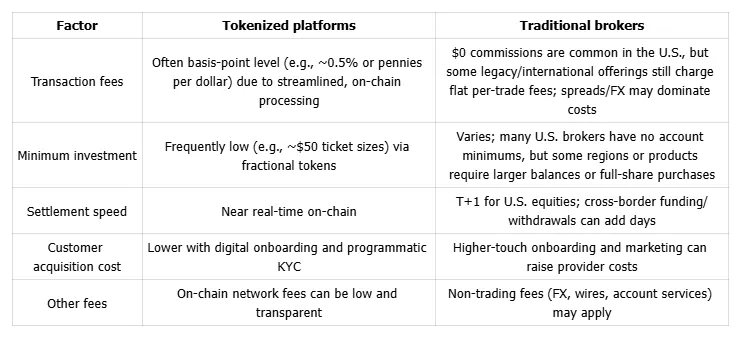
While many U.S. discount brokers now advertise $0 stock commissions, the actual cost for small, frequent orders can include spreads, FX conversion (for non-USD funding), payment rails, and non-trading fees. Legacy and international fee schedules still commonly list flat trade charges, whereas tokenized platforms—like ToVest—typically price at basis-point levels (for example, 1–2 cents per dollar transacted) because settlement and transfer occur on-chain with fewer middlemen, as discussed in industry guides on tokenization economics.
Comparison snapshot (typical ranges; provider-specific):
Notes:
- U.S. brokers’ move to $0 commissions is well documented; however, total cost for small trades often hinges on spread and FX rather than ticket fees, as consumer broker reviews emphasize. Tokenized platforms, such as ToVest, lean on peer-to-peer rails and automated settlement, improving transaction efficiency and fee transparency, as outlined by the World Economic Forum and industry summaries of tokenization benefits.
Sources to explore context:
- Industry view of tokenization’s cost advantages: IdeaUsher’s business benefits of asset tokenization
- Operational efficiency and cost frictions: World Economic Forum’s Asset Tokenization in Financial Markets 2025
- Broker comparisons and fractional-share availability: Bankrate’s fractional-share broker guide
Settlement Speed and Transaction Efficiency
Settlement is the legal and operational process that transfers ownership after a trade. In tokenized markets, settlement can be near-instant—execution and transfer finalize as a single on-chain event with an immutable audit trail, reducing reconciliation tasks and counterparty exposure.
By contrast, U.S. equities now settle on T+1 (trade date plus one business day), per the SEC’s 2024 settlement cycle change. Funding transfers, cross-border movements, or corporate actions can lengthen timelines in traditional pipelines.
Practical comparison:
- Tokenized platform settlement: near real-time finality with on-chain transfer and automated record-keeping (WEF highlights these efficiencies)
- Traditional brokerage settlement: T+1 for U.S. equities, with additional time possible for cash movements and post-trade processing (per SEC T+1 guidance)
Faster finality matters: quicker settlement reduces exposure to market swings between trade and completion, trims back-office costs, and lowers counterparty risk—benefits frequently cited in tokenization analyses by the World Economic Forum.
Accessibility and Minimum Investment Requirements
Tokenized assets are designed for fractional access with low ticket sizes—often around $50—making cost-effective exposure to U.S. equities practical for retail investors. Real-world asset tokenization frameworks emphasize democratized market access through fractional ownership and digital onboarding, as explained by Investax’s overview of RWA tokenization.
Traditional brokers have improved accessibility with fractional shares and no account minimums in the U.S., but frictions remain: some regions still require larger balances, full-share purchases for certain securities, or limited fractional support. Tokenized platforms typically offer:
- 24/7 access and digital onboarding with automated checks
- Small-increment trading beyond market hours
- Streamlined funding via digital rails
GARP’s review of tokenization benefits and risks underscores this expanded market access and usability for retail investors.
Transparency, Security, and Regulatory Considerations
Blockchain transparency refers to the public availability of transaction histories and balances on a distributed ledger, which can increase trust through verifiable, tamper-resistant records. Tokenized platforms, like ToVest, provide real-time, immutable entries that enhance auditability and reduce opportunities for operational fraud compared with opaque, intermediary-heavy chains of custody, as noted by Bitunix’s comparison of tokenized vs. traditional assets and the WEF’s assessment.
Regulation differs. Traditional brokers operate under established SEC and FINRA frameworks with well-defined investor protections. Tokenized shares and other digital instruments fall under evolving rules; regulators are actively discussing pathways for compliant tokenization in capital markets, as highlighted in Morgan Lewis’s summary of the SEC’s tokenization roundtable. Innovation can improve efficiency and access, but legal interpretations and compliance models are still maturing.
Key risks to weigh:
- Cybersecurity and smart contract vulnerabilities
- Loss of private keys or wallet credentials
- Platform or issuer risk (custody, asset backing, or oracles)
- Jurisdictional uncertainty around regulatory compliance and disclosures
GARP’s analysis of tokenization benefits and risks offers a balanced perspective on both transparency gains and new risk surfaces.
Liquidity and Trading Flexibility
Liquidity is how easily an asset can be bought or sold without moving the price. Tokenization can enhance liquidity by enabling 24/7 trading in small increments and by broadening global participation via digital rails, a theme emphasized in overviews contrasting tokenized and traditional assets.
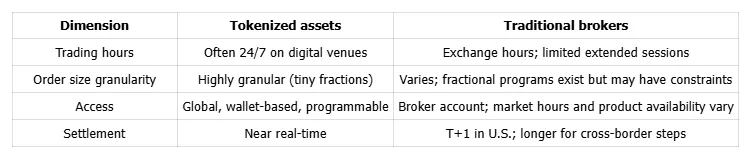
Examples in practice include tokenized exposures to U.S. stocks and real estate that allow frequent rebalancing and small-size entries or exits outside exchange hours, as covered in STO platforms’ primers contrasting traditional vs. tokenized assets.
Key Features of ToVest’s Tokenization Platform
ToVest is built for investors who want low-fee fractional investing and instant settlement without sacrificing data and security.
What stands out:
- Security and compliance foundation: Institutional-grade wallet security, audited smart contracts, and rigorous operational controls designed for investor protection.
- Broad real-world asset coverage: Curated access to fractional U.S. shares and other tokenized assets, with clear metadata and provenance.
- Market intelligence: Advanced analytics, charting, and screening tools integrated into the trading workflow. For deeper research, see ToVest Academy for educational explainers and ToVest Research for data-driven market reports.
- Efficiency by design: 24/7 trading with on-chain finality and transparent fees reduces frictional costs and supports small, frequent orders.
- Ecosystem integrations: Partnerships and technology integrations with established financial and infrastructure providers to support secure issuance, custody, and connectivity.
Bottom line: ToVest merges blockchain transparency and instant settlement with professional-grade data, so retail investors can access fractional U.S. shares cost-effectively.
Choosing the Best Option for Affordable Fractional US Shares
Use this quick checklist to decide:
- Prioritize lowest all-in cost on small orders? Favor tokenized platforms like ToVest with on-chain settlement and transparent, basis-point pricing.
- Need mature regulatory protections and broad incumbents? A traditional broker may fit, especially if you already benefit from $0 commissions and integrated banking.
- Require 24/7 access and instant finality? Tokenized platforms (e.g., ToVest) offer near-real-time settlement and continuous markets.
- Concerned about key management or smart-contract risk? Consider your comfort with digital wallets and platform due diligence.
- Investing in U.S. equities through recurring micro-buys? Tokenization’s transaction efficiency often shines at smaller ticket sizes.
In short, a digital asset platform like ToVest typically delivers lower fees, faster settlement, and greater flexibility for fractional share investing in U.S. equities. Balance those gains against your regulatory preferences and risk tolerance.
Frequently Asked Questions
What are fractional shares and how do they work?
Fractional shares let investors buy a portion of a stock, enabling affordable access to expensive equities without purchasing a full share.
Why do tokenized platforms typically offer lower fees?
They automate transactions on blockchain and reduce intermediaries, which cuts operating costs and allows low-fee, cost-effective investing for small amounts.
How does settlement time impact trading costs?
Faster settlement reduces market and counterparty risk and trims back-office fees, making trades more cost-efficient than slower, multi-day processing.
What minimum investments are required on tokenized platforms versus brokers?
Tokenized platforms like ToVest often support low minimums around $50, while some brokers or regions may require larger balances or full-share purchases despite U.S. discount brokers having no account minimums.
Are tokenized shares regulated like traditional brokerage shares?
They follow evolving rules that differ from traditional brokers, so understand current regulations and protections for your jurisdiction before investing.