How to Turn Bitcoin or USDT Into Real Stock Holdings Safely
2 กุมภาพันธ์ 2569
Converting Bitcoin or USDT into real stock holdings is absolutely possible—and safe—if you follow a regulated pathway. In practice, you can: 1) sell crypto for fiat on a compliant exchange and fund a brokerage account, 2) use a crypto-enabled broker that supports stock purchases, or 3) buy tokenized stocks on-chain. The right choice depends on whether you want traditional shares in a brokerage, indirect exposure via ETFs, or on-chain tokenized equities. Before you move a satoshi, confirm your local rules, document every step for taxes, and secure your wallets. This guide walks you through the safest, most efficient routes with practical steps, risk controls, and platform criteria—so you can transition from BTC/USDT to stock ownership with confidence.
Understand Your Investment Goals and Legal Environment
Clarify what you want to own and how you want it held. Traditional brokerage shares, ETFs, and tokenized equities each come with different protections, liquidity profiles, and tax considerations. Tokenized assets are advancing quickly, but legal recognition varies by country and remains in flux; consult local guidance before buying tokenized shares and understand how they’re treated for investor protection and tax reporting, as noted in Franklin Templeton’s analysis on tokenization and policy evolution.
Tokenized stocks are digital tokens that represent fractional interests in real-world equities and settle on-chain, offering programmability and global access. Institutional research expects tokenization to broaden capital markets access and improve settlement transparency while also highlighting the need for robust regulation and custody standards.
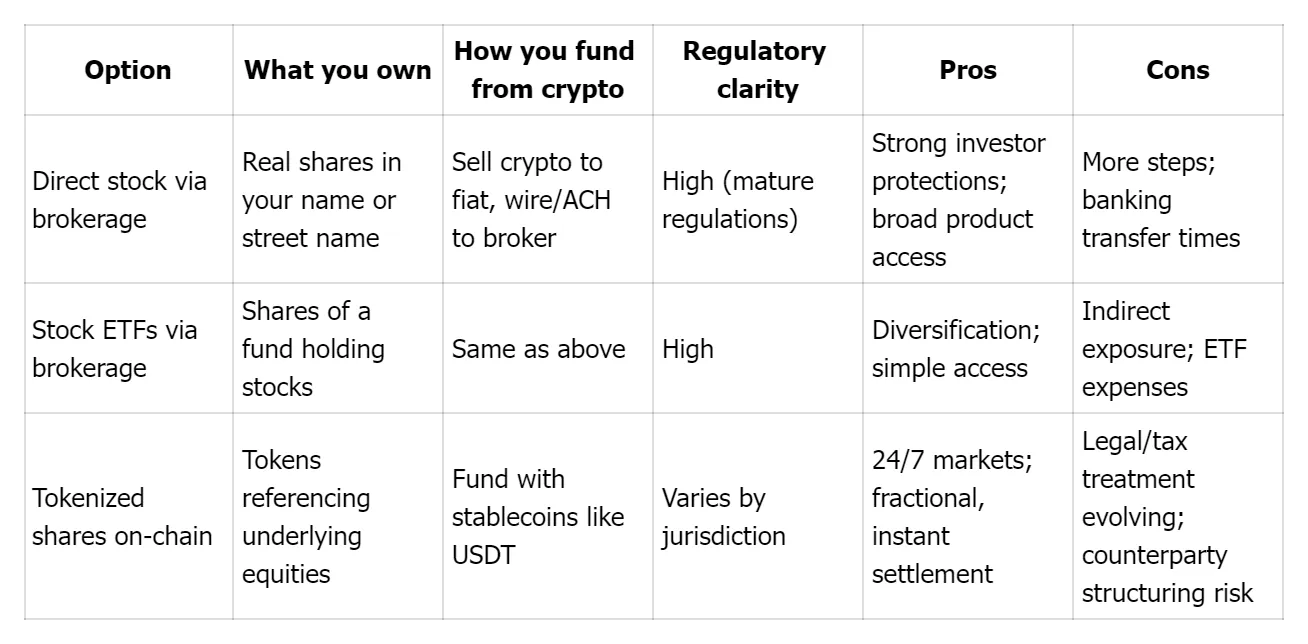
Quick comparison of your main options:
Choose the Right Conversion Pathway
There are three main routes to transition from crypto to stocks, each with trade-offs in custody, counterparty risk, speed, and compliance.
- Route 1: Sell crypto to fiat on a regulated exchange, then fund a traditional stock broker.
- Route 2: Use an integrated crypto-stock broker that lets you fund with crypto and buy equities in one account.
- Route 3: Buy tokenized stocks or ETFs directly on a blockchain platform.
Stablecoin refers to a crypto asset designed to track a stable reference like the U.S. dollar (e.g., USDT, USDC), providing high liquidity and minimal price volatility—useful for transfers and funding. An integrated crypto-stock broker is a regulated platform that accepts crypto or stablecoin funding and enables trading traditional equities within the same app.
High-level steps for each route:
- Sell to fiat → broker funding
- Open accounts at a regulated exchange and a regulated broker.
- Transfer BTC/USDT to the exchange; convert to fiat.
- Withdraw fiat to your bank; fund your broker; buy stocks.
- Integrated crypto-stock broker
- Open a single account with crypto funding enabled.
- Deposit BTC/USDT or a supported stablecoin.
- Convert in-app and place stock trades.
- Tokenized stocks on-chain
- Use a compliant platform supporting tokenized equities.
- Fund with USDT/USDC.
- Buy tokenized shares; manage on-chain custody.
Each route varies in custody location, settlement speed, and operational complexity.
Select Regulated Platforms and Brokers
Safety starts with platform choice. Favor regulated exchanges and brokers that disclose custody arrangements, publish audits or on-chain proof-of-reserves, and operate under clear legal oversight. History shows that weak governance can lead to catastrophic losses; independent analyses of exchange failures underscore the need for robust controls and segregation of client assets .
Must-have features:
- Regulated entity with clear jurisdiction, licensing, and disclosures
- Audited or on-chain custody with segregation of client assets
- Instant or near-instant settlement for conversions
- Support for fiat and stablecoin funding; no unnecessary account minimums
- Commission-free trading and transparent fees
Examples by pathway:
- Route 1 (sell to fiat → broker): Crypto exchanges with strong compliance (e.g., those highlighted by NerdWallet) paired with traditional brokers (e.g., Fidelity, Schwab) after fiat transfer.
- Route 2 (integrated): Platforms that allow crypto-funded equity trading in one app—ToVest, for example, enables funding via USDT and fiat with near-instant settlement and commission-free, fractional access to U.S. stocks.
- Route 3 (tokenized): Providers offering tokenized U.S. stocks funded in crypto, subject to local rules.
Do not leave large balances idle on exchanges lacking strong regulation or insurance.
Secure Your Crypto Assets Before Conversion
Decide how you’ll store crypto while executing the conversion. Self-custody with a hardware (cold) wallet, such as Ledger or Trezor, keeps private keys offline and reduces hack risk. Exchange custody is convenient for small operational balances but introduces counterparty and cyber risk if used for long-term storage.
Operational security essentials:
- Use hardware wallets for significant balances; keep recovery phrases offline on durable media
- Enable strong 2FA (authenticator app, not SMS) on all accounts
- Whitelist withdrawal addresses; use unique emails and passwords per platform
- Move funds onto exchanges only when you’re ready to convert; withdraw promptly afterward
- If self-custody feels daunting, consider regulated custodians for safekeeping
Quick checklist:
- Wallet and backups secured offline
- 2FA enabled across exchange/broker/custody accounts
- Test small transfers before larger moves
- Address whitelisting and anti-phishing codes enabled
- Document every transaction ID and receipt
Convert Crypto to Fiat or Use Integrated Crypto-Stock Brokers
Follow a structured process to minimize friction and mistakes:
Step-by-step
- Transfer crypto to a regulated exchange or an integrated crypto-stock platform.
- Convert BTC/USDT to the funding currency required (fiat or supported stablecoin).
- If using Route 1, withdraw fiat to your bank, then fund your stock broker and place your trade.
- If using Route 2, convert and purchase stocks inside the same app.
- If using Route 3, buy tokenized stocks on-chain and verify custody details.
Most traditional brokers do not accept direct crypto-to-stock swaps; you generally must sell crypto to fiat first or use a platform specifically built for tokenized equities. Integrated platforms reduce steps, settlement time, and operational risk—handy for investors who want fewer intermediaries and clearer audit trails.
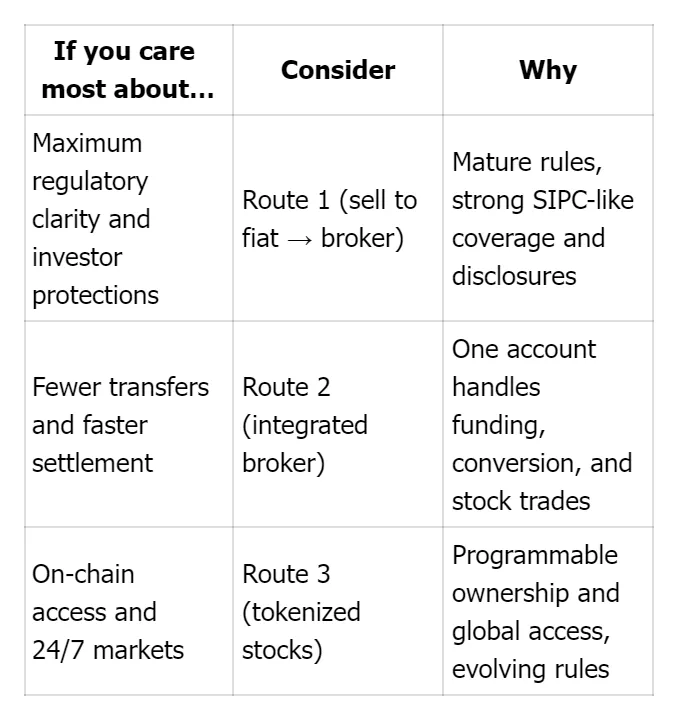
Decision helper:
Document Transactions and Prepare for Tax Reporting
Selling crypto, swapping assets, and transferring into stocks can create taxable events. Maintain thorough records for every step, including timestamps, transaction hashes, fees, cost basis, and receipts. Many investors use portfolio and tax tools (e.g., CoinTracker, CoinLedger) to aggregate exchange data and generate reports; ensure your chosen tool integrates with your platforms.
What to document for tax time:
- Dates, amounts, and prices for each buy/sell/transfer
- Transaction IDs/hashes and platform confirmations
- Cost basis and proceeds for each disposal (including fees)
- Exchange rate used when converting to fiat
- Final brokerage trade confirmations
Conduct a Test Trade Before Scaling Up
Start small. Run a full end-to-end test—crypto deposit, conversion, transfer (if applicable), and stock purchase—to confirm settlement speed, fees, and reporting. Review confirmations, wallet/exchange logs, and broker statements to ensure the process is transparent, repeatable, and compliant. Scale only after a successful, well-documented test and refine steps as needed.
Practical Tips for Managing Risks and Maximizing Efficiency
- Maintain a small stablecoin buffer (e.g., USDT) for liquidity and timing flexibility. Use reliable price dashboards and alerts to time conversions.
- Rebalance periodically to avoid overexposure to crypto; set target allocations and rebalance on a schedule.
- Keep a transaction journal or use automated reporting to simplify audits and taxes.
- Only use regulated platforms or those with strong proof-of-reserves; never park large balances on lightly supervised exchanges.
- Keep long-term holdings in hardware wallets; operational balances only on exchanges.
- Monitor evolving rules on tokenized assets and crypto taxation; laws can change quickly.
Risk-minimizing habits:
- Verify licenses and custody disclosures before funding
- Use 2FA and withdrawal whitelists
- Test with small amounts first
- Document everything
- Diversify counterparties (not all eggs in one platform)
Frequently Asked Questions
Can I convert Bitcoin or USDT directly into stocks?
No. Traditional brokers don’t accept direct crypto-for-stock swaps—you must sell to fiat first or use a platform offering tokenized equities.
What platforms are safest for converting crypto to stocks?
Regulated exchanges and brokers with audited custody, clear disclosures, and investor protections are safest; integrated platforms like ToVest can streamline steps if properly licensed.
How can I minimize risks when investing crypto in stocks?
Limit position size, store long-term holdings in hardware wallets, enable strong 2FA, and avoid leaving large balances on exchanges.
Are there indirect ways to get stock exposure using crypto?
Yes—after converting to fiat, you can buy stock ETFs; you can also use Bitcoin ETFs for BTC exposure, though neither provides ownership of individual company shares.
What security measures should I follow to store crypto safely?
Use hardware wallets or regulated custodians, keep recovery phrases offline, and enable 2FA and address whitelisting on all accounts.