1 ธันวาคม 2568
Why 2025 Is the Best Time for Fractional Tokenized U.S. Stocks
The convergence of regulatory clarity, technological maturity, and surging institutional interest has positioned 2025 as a watershed moment for fractional tokenized U.S. stocks. These digital representations of stock shares on the blockchain enable investors to purchase small fractions of U.S. equities with unprecedented accessibility and transparency. After years of development in regulatory sandboxes and pilot programs, the infrastructure supporting stock tokenization has reached a critical inflection point. Major financial institutions are committing capital, regulators are providing clearer frameworks, and blockchain platforms have proven their ability to handle complex financial products at scale. For investors seeking exposure to U.S. markets through fractional ownership, the barriers that once made this innovation speculative have largely dissolved, creating an optimal entry window.
The Evolution of Fractional Tokenized Stocks
The journey toward mainstream fractional tokenized stocks began in earnest around 2017, when blockchain developers first explored representing traditional securities on distributed ledgers. Early experiments faced significant hurdles including regulatory ambiguity, limited custody solutions, and scepticism from traditional financial institutions. By 2019, several platforms launched pilot programs in regulatory sandboxes, allowing controlled testing of tokenized securities under supervisory oversight.
The breakthrough came between 2022 and 2024, when multiple jurisdictions established clearer legal frameworks for digital securities. Switzerland's DLT Act, Singapore's Variable Capital Companies framework, and evolving SEC guidance in the United States created pathways for compliant tokenization. According to the World Economic Forum's 2025 report, the tokenized public stocks market reached just $16 million by March 2025, a modest figure when compared to the $115 trillion global public equity market in 2023, yet one that represents explosive percentage growth and enormous untapped potential.
Tokenization fundamentally allows fractional ownership, letting investors buy tiny stock fractions worth as little as $5, dramatically lowering entry barriers that traditionally required purchasing whole shares of high-priced stocks. This capability, combined with 24/7 trading windows and multi-currency support, has transformed how global investors access U.S. equities. The technology has progressed from proof-of-concept to production-ready platforms offering institutional-grade custody, real-time settlement, and transparent on-chain verification.
Democratization of Investment Access Through Tokenization
Democratization of access refers to making investment markets equally available to all participants, regardless of wealth or location, through innovations like fractional ownership. Traditional barriers such as high minimum investments, geographic restrictions, and limited trading hours have historically excluded billions of potential investors from U.S. stock markets. Tokenization dismantles these obstacles by enabling participation with minimal capital and from virtually anywhere with internet connectivity.
As XBTO notes, fractionalization democratizes access and helps investors diversify portfolios across multiple asset classes. A retail investor in Southeast Asia can now purchase $10 worth of a blue-chip U.S. technology stock that trades at $500 per share, something impossible in traditional markets. This granular access extends beyond just lowering dollar thresholds—it enables precise portfolio construction and risk management previously available only to institutional investors.
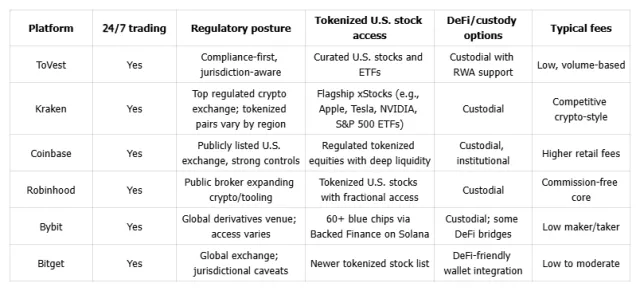
The operational advantages compound these benefits. Tokenized platforms, such as ToVest, operate continuously, allowing investors in different time zones to trade during their local business hours rather than being constrained to New York Stock Exchange hours. Multi-currency support eliminates costly foreign exchange intermediaries, and blockchain settlement removes the delays and fees associated with cross-border securities transfers. For emerging market investors facing currency controls or limited local investment options, tokenized U.S. stocks provide a transparent, accessible alternative to capital-constrained domestic markets.
Before tokenization, an investor might need $10,000 to build a diversified portfolio of 20 different U.S. stocks. With fractional tokenization, that same diversification becomes achievable with as little as $100, fundamentally reshaping who can participate in wealth-building through equity ownership.
Enhanced Transparency and Security with Blockchain
Blockchain technology serves as a decentralized digital ledger that records and verifies transactions securely and transparently, ensuring real-time auditability for tokenized stocks. Unlike traditional securities systems where ownership records reside in siloed databases controlled by brokers and clearinghouses, blockchain creates an immutable, publicly verifiable record of every transaction and ownership change.
This architecture provides on-chain transparency for tokenized stocks with immutable, auditable ownership records, dramatically reducing fraud risks and eliminating the reconciliation challenges that plague legacy systems. When an investor purchases a tokenized stock, the transaction is recorded on the blockchain within seconds, visible to all participants, and permanently preserved against tampering or revision.
The typical transaction flow demonstrates these advantages clearly. First, an investor initiates a purchase through a regulated platform interface. The platform's smart contract verifies the investor's identity and available funds, then executes the trade by minting or transferring the appropriate token quantity. The blockchain records this transaction with a timestamp and cryptographic signature, creating an unalterable proof of ownership. Settlement occurs almost instantaneously as the tokens move to the investor's wallet and payment is transferred to the seller. Throughout this process, both parties and regulators can independently verify every step without relying on a central authority's assurance.
This transparency extends beyond individual transactions to corporate actions and compliance. Dividend distributions, stock splits, and voting rights are programmed into smart contracts and executed automatically, with every action recorded on-chain. Regulators can monitor trading patterns and ownership concentrations in real time rather than waiting for periodic reports, enhancing market surveillance while reducing compliance costs for platforms and issuers.
Institutional Adoption Driving Market Growth
The credibility and scale of fractional tokenized stocks received a transformative boost as institutional investors recognized the technology's potential. According to Broadridge research, institutional investors may allocate 7–9% of portfolios to tokenized assets by 2027, driven by yield opportunities and transparency advantages. More significantly, institutional investors lead the adoption of tokenization, but custodians are the clearest early leaders, providing the secure infrastructure that makes institutional participation possible.
Major milestones in 2024 and early 2025 accelerated this trend. Several prominent hedge funds announced dedicated tokenized asset strategies while traditional asset managers began offering tokenized stock products to high-net-worth clients. Banking giants partnered with blockchain platforms to provide custody services, lending institutional credibility to what was once considered an experimental market. When BlackRock's CEO publicly urged fast-tracking stock and bond tokenization in 2025, it signaled that the world's largest asset manager viewed this technology as integral to capital markets' future rather than a peripheral innovation.
This institutional involvement creates a virtuous cycle. As more sophisticated investors enter the market, liquidity improves, spreads narrow, and the infrastructure supporting tokenized stocks becomes more robust. Institutional participation also drives standardization—common protocols for token issuance, custody arrangements, and regulatory compliance emerge as industry best practices, making the market more accessible and predictable for all participants.
The allocation forecasts suggest substantial capital flows ahead. If institutional investors globally deploy even 7% of assets under management into tokenized securities, it would represent trillions of dollars entering these markets over the next few years, fundamentally transforming tokenized stocks from a niche innovation into a mainstream asset class.
Advances in Market Efficiency and Settlement Speed
Market efficiency refers to the speed, cost, and accuracy with which assets are exchanged. Tokenized stocks deliver dramatic improvements across all three dimensions compared to traditional securities trading. As research indicates, tokenization increases market liquidity by enabling fractional investments and reducing settlement times to seconds.
Traditional stock markets operate on a T+2 settlement cycle, meaning trades executed today don't finalize until two business days later. During this period, counterparty risk exists, capital remains tied up, and the opportunity to reinvest proceeds is delayed. Multiple intermediaries—brokers, clearinghouses, custodians—each add time, cost, and potential points of failure to the process. Cross-border transactions compound these inefficiencies, sometimes requiring a week or more to settle while incurring substantial fees.
Tokenized stocks eliminate most of this friction. Settlement occurs near-instantaneously as blockchain transactions finalize within seconds or minutes. Smart contracts automatically execute the exchange of tokens for payment without requiring intermediary coordination. The cost savings are substantial—traditional settlement might involve fees of $50–100 per transaction when accounting for all intermediary charges, while blockchain settlement can cost just a few dollars in network fees.
This efficiency translates directly into improved investor experience. Traders can deploy capital immediately after selling positions rather than waiting days for settlement. The reduced counterparty risk means lower margin requirements and capital reserves. For international investors, the ability to settle cross-border trades as quickly as domestic ones removes a significant barrier to global portfolio diversification.
The liquidity improvements extend beyond settlement speed. Because fractional ownership allows more investors to participate and trade smaller positions, order books become deeper and spreads tighter. Assets that might trade infrequently in traditional markets can find continuous liquidity when tokenized and accessible to a global investor base operating 24/7.
Regulatory Developments Supporting Tokenized Stocks
Regulatory clarity describes the degree to which rules enable lawful and predictable innovation for new digital asset markets. After years of uncertainty, 2024 and 2025 have brought substantial progress in establishing frameworks that support tokenized securities while protecting investors.
The most significant U.S. development came when the SEC signaled support for tokenized securities after BlackRock's CEO urged fast-tracking stock and bond tokenization in 2025. While comprehensive legislation remains pending, the SEC has begun approving specific tokenized offerings under existing securities laws, providing a pathway for compliant issuance. The agency's approach treats tokenized stocks as securities subject to registration requirements, offering clarity that enables platforms to build compliant products.
Internationally, several jurisdictions have moved even more aggressively. The European Union's Markets in Crypto-Assets Regulation provides a comprehensive framework for digital assets including tokenized securities. Singapore's Monetary Authority has licensed multiple platforms to offer tokenized stocks to accredited investors. Switzerland's regulatory sandbox has allowed experimentation that informed more permanent rules accommodating blockchain-based securities.
Key regulatory developments supporting tokenized stocks include:
Establishment of digital asset custody standards ensuring institutional-grade security
Clarification that tokenized stocks receive the same investor protections as traditional securities
Creation of licensing frameworks specifically for tokenized asset platforms
International cooperation agreements facilitating cross-border tokenized securities trading
Guidelines for smart contract auditing and operational resilience requirements
These developments have dramatically reduced regulatory risk for platforms and investors. While challenges remain—particularly around cross-border regulatory harmonization and the treatment of decentralized protocols—the trajectory is clearly toward accommodating tokenized securities within established investor protection frameworks rather than prohibiting or severely restricting them.
Technological Maturity Enabling Scalable Tokenization
Technological maturity refers to the state when supporting technologies are robust, scalable, and tested enough for reliable mass adoption. The infrastructure supporting tokenized assets has reached this threshold, with blockchain platforms now capable of supporting complex financial products, which enhances the scalability of tokenized stocks.
Several technological advances have been critical. Multi-chain interoperability solutions allow tokenized stocks to move between different blockchain networks, preventing vendor lock-in and enabling investors to choose platforms based on features rather than network constraints. Advanced smart contract frameworks support sophisticated financial instruments including options, futures, and structured products built on tokenized stock foundations.
Real-time data infrastructure has matured significantly. Oracle networks like Chainlink provide proof of reserve verification, allowing investors to confirm that tokenized stocks are fully backed by actual securities held in custody. This transparency addresses a fundamental trust concern that plagued early tokenization attempts. Price feeds, corporate action data, and regulatory filings are now integrated directly into blockchain systems, enabling automated execution of complex strategies.
Custody solutions have evolved from experimental to institutional-grade. Regulated custodians now offer insurance, multi-signature security, and disaster recovery specifically designed for tokenized assets. These custodians undergo regular audits and maintain the same standards required for traditional securities custody, providing the assurance institutional investors require.
Key technology milestones enabling current tokenization scale include:
Layer-2 scaling solutions reducing transaction costs to pennies while maintaining security
Hardware wallet integration allowing secure self-custody for retail investors
Smart contract insurance protocols protecting against code vulnerabilities
Interoperable identity systems enabling compliant cross-platform trading
Automated compliance tools monitoring transactions for suspicious activity in real time
This technological foundation supports platforms that can handle millions of users and billions in transaction volume while maintaining the security, compliance, and reliability expected in modern financial markets.
Overcoming Challenges and Managing Risks
Despite significant progress, fractional tokenized stocks face meaningful challenges that investors must understand and navigate. According to Broadridge research, 73% of financial institutions cite regulatory uncertainty as the top challenge to scaling tokenized offerings, highlighting that despite recent progress, regulatory frameworks remain incomplete and subject to change.
Regulatory ambiguity persists in several dimensions. The treatment of tokenized stocks varies significantly across jurisdictions, creating complexity for global platforms. Tax treatment remains unclear in many countries—whether tokenized stock trades trigger capital gains, how dividends are taxed, and what reporting obligations exist are often unresolved questions. This uncertainty can create unexpected liabilities for investors and limits institutional adoption until clarified.
Platform reliability presents another risk category. While blockchain technology itself has proven robust, the platforms and interfaces through which investors access tokenized stocks vary in quality. Technical outages, smart contract bugs, or cybersecurity breaches could result in loss of funds or access. Investors should verify that platforms maintain insurance coverage, undergo regular security audits, and have demonstrated operational track records.
Liquidity limitations remain a concern, particularly for less popular tokenized stocks. As Token Metrics notes, secondary markets for tokenized real estate remain fragmented with limited liquidity and wide bid-ask spreads—a challenge that extends to tokenized stocks as well. While major U.S. stocks may trade actively, smaller companies or newly tokenized assets might have thin order books, making it difficult to execute large trades without significant price impact.
Practical risk management strategies include:
Choosing platforms with transparent regulatory compliance and licensed operations
Verifying custody arrangements and confirming assets are held with reputable, insured custodians
Starting with small positions to test platform reliability and liquidity before committing significant capital
Understanding the specific regulatory treatment in your jurisdiction before investing
Maintaining diversification across both tokenized and traditional assets to manage platform-specific risks
Reviewing smart contract audits and security assessments for platforms you use
ToVest addresses many of these concerns through institutional-grade custody partnerships, transparent on-chain verification, and regulatory compliance across multiple jurisdictions. However, investors should independently verify all claims and understand that tokenized stocks, while offering substantial benefits, remain an evolving market with risks distinct from traditional securities trading.
The Future Outlook for Fractional Tokenized U.S. Stocks
The convergence of factors examined throughout this article suggests 2025 is indeed shaping up to be a landmark year for fractional tokenized U.S. stocks, driven by increased demand from both retail and institutional investors, technological advancements, and evolving regulatory frameworks. The trajectory points toward rapid growth and mainstream integration over the next several years.
Near-term milestones likely to materialize by 2026–2027 include the tokenization of major market indices, enabling investors to hold tokenized versions of S&P 500 or Nasdaq 100 exposure. Integration with decentralized finance protocols will expand, allowing tokenized stocks to serve as collateral for lending, participate in automated market makers, and enable sophisticated yield strategies previously impossible with traditional securities. Multi-country launches will accelerate as regulatory frameworks harmonize, bringing tokenized U.S. stocks to investors in markets currently underserved by traditional brokerages.
The sector could reach $1 trillion in tokenized assets by 2030 if current growth rates continue and institutional adoption meets projections. This would still represent less than 1% of global equity markets, suggesting enormous room for continued expansion. As the technology proves itself and regulatory frameworks solidify, the distinction between "tokenized" and "traditional" stocks may blur—blockchain settlement could simply become the standard infrastructure for all securities trading.
Expected developments include:
Expansion from current hundreds of tokenized stocks to thousands, covering most liquid U.S. equities
Integration of tokenized stocks into traditional portfolio management platforms and retirement accounts
Development of tokenized derivatives and structured products enabling sophisticated hedging strategies
Increased corporate adoption, with companies issuing directly on blockchain rather than tokenizing after-the-fact
Convergence of tokenized stock trading with traditional exchanges through hybrid infrastructure
For investors, this evolution means tokenized stocks will likely transition from an alternative investment to a core portfolio component. The advantages of fractional ownership, 24/7 trading, instant settlement, and transparent on-chain verification will become expected features rather than novel innovations. Those positioning themselves in this market during 2025 are entering at an optimal time—after foundational infrastructure and regulatory frameworks are established but before mass adoption drives valuations and reduces early-adopter advantages.
Frequently Asked Questions
Why is 2025 a pivotal year for fractional tokenized stocks?
2025 marks a turning point due to explosive market growth, rising institutional adoption, and regulatory progress, making it an ideal window to access U.S. stocks on blockchain.
How does fractional ownership lower barriers for investors?
Fractional ownership lets investors buy small portions of high-value U.S. stocks, allowing more people to participate without needing large sums of money.
Can tokenized stocks be traded 24/7?
Yes, tokenized stocks can be traded around the clock on blockchain platforms like ToVest, offering greater flexibility and near-instant settlements compared to traditional markets.
What risks should investors consider with tokenized stocks?
Investors should consider regulatory uncertainties, variability in market liquidity, and the importance of using platforms with strong security and reputable custodians.
How do tokenized stocks integrate with decentralized finance?
Tokenized stocks can be used as collateral in DeFi protocols, enabling lending, borrowing, and yield strategies that go beyond traditional stock ownership.
Why Choose ToVest for Fractional Tokenized U.S. Stocks
As the fractional tokenized U.S. stock market grows rapidly in 2025, ToVest has positioned itself as a leading platform for investors seeking secure, accessible, and transparent access to these innovative financial products. ToVest combines cutting-edge blockchain technology, regulatory compliance, and user-centric design to create an optimal experience for both retail and institutional investors.
Reasons to Choose ToVest:
Institutional-Grade Security and Custody
ToVest partners with regulated custodians and employs advanced security measures, including multi-signature wallets, insurance coverage, and continuous audits. Investors can confidently trade knowing their assets are securely held.
Regulatory Compliance Across Jurisdictions
ToVest operates under transparent legal frameworks and follows best practices for tokenized asset issuance, ensuring that users remain compliant with relevant regulations while enjoying innovative investment opportunities.
Fractional Ownership and Accessibility
The platform allows investors to purchase tokenized U.S. stocks starting from just a few dollars, dramatically lowering entry barriers and enabling diversified portfolios without large upfront capital.
24/7 Trading and Multi-Currency Support
ToVest enables global participation with round-the-clock trading and seamless multi-currency support, removing the constraints of traditional market hours and currency conversion costs.
Real-Time Transparency and On-Chain Verification
All transactions are recorded on the blockchain, providing immutable proof of ownership and full visibility into corporate actions such as dividends and stock splits.
Scalable and User-Friendly Platform
Designed for both newcomers and sophisticated investors, ToVest offers an intuitive interface, advanced analytics, and automated compliance tools to simplify the investment process without sacrificing control or transparency.
By choosing ToVest, investors can confidently enter the tokenized U.S. stock market, benefiting from the democratization of access, enhanced security, and the efficiency offered by blockchain technology—all while positioning themselves at the forefront of this transformative financial trend.
Conclusion
2025 represents a unique opportunity to enter the emerging market of fractional tokenized U.S. stocks. With regulatory clarity, technological readiness, and growing institutional adoption, the time to participate is now. Platforms like ToVest make this opportunity accessible, secure, and efficient for investors of all levels. By embracing tokenized stocks today, investors can diversify their portfolios, enjoy instant settlement, and leverage blockchain transparency—positioning themselves at the forefront of a transformative shift in global equity markets.